
38% Off

CDMA DS-CDMA Simulator

Original price was: ₹3,999.00.₹2,499.00Current price is: ₹2,499.00.
In StockThe CDMA DS-CDMA Simulator with Python is a software-based communication simulation tool designed to demonstrate and analyze Direct Sequence Code Division Multiple Access (DS-CDMA) technology. Developed using Python, the simulator provides a practical environment for studying spreading codes, chip sequences, multiple-user communication, signal spreading and despreading, interference, correlation, and transmitted-data recovery. It is suitable for digital communication laboratories, wireless communication education, telecommunications training, student projects, and communication-system research.
Description
CDMA DS-CDMA Simulator
The CDMA DS-CDMA Simulator with Python is a software-based wireless communication simulation tool designed for studying, demonstrating, and analyzing Direct Sequence Code Division Multiple Access (DS-CDMA) technology. Developed using Python, the simulator provides a practical environment for understanding spread-spectrum communication, user-specific spreading codes, chip sequences, signal spreading and despreading, multiple-user access, interference, correlation, and digital data recovery.
DS-CDMA is an important multiple-access technique in wireless communication systems. It enables multiple users to share a common communication medium by assigning different spreading codes to individual users. Instead of separating users primarily by different time slots or frequency bands, DS-CDMA uses code sequences to distinguish transmitted signals. The CDMA DS-CDMA Simulator provides a software-based environment where these concepts can be studied and analyzed through practical simulation.
DS-CDMA Communication Simulation
Direct Sequence Code Division Multiple Access (DS-CDMA) combines the principles of direct-sequence spread spectrum and code division multiple access. In a DS-CDMA system, the original information signal is combined with a higher-rate spreading sequence. This process converts the data into a spread signal represented by a sequence of chips.
The receiver uses the appropriate spreading code to perform the despreading operation and recover the intended user’s information. The simulator helps users understand this complete process by providing a structured environment for examining data generation, spreading-code application, signal transmission, multiple-user signal combination, despreading, and data recovery.
This makes the simulator useful for understanding the fundamental relationship between data bits, spreading codes, chips, transmitted signals, received signals, and recovered information.
Python-Based DS-CDMA Simulator
The DS-CDMA Simulator is developed using Python, providing a flexible programming environment for implementing communication algorithms and signal-processing operations. Python is widely used for scientific computing, numerical analysis, data processing, algorithm development, and communication-system simulation.
The Python-based implementation allows students and developers to understand how DS-CDMA concepts can be translated into software algorithms. Users can study the programming logic behind operations such as data generation, spreading-code generation, chip-level processing, signal combination, correlation, despreading, and data detection.
The combination of Python programming and wireless communication simulation makes the simulator valuable for students who want to develop both telecommunications knowledge and practical programming skills.
Spreading Codes and Chip Sequences
A key concept in DS-CDMA is the use of spreading codes. Each user can be assigned a specific code sequence that is used to spread the user’s information before transmission. The receiver can then use the corresponding code to identify and recover the desired signal.
The simulator provides an effective way to study the relationship between the information data and its spreading sequence. Users can examine how individual data bits are represented by multiple chips and how the spreading operation increases the number of signal elements used to represent the original information.
Studying chip sequences helps learners understand why code selection, correlation, and code properties are important in DS-CDMA communication systems.
Multiple-User CDMA Communication
One of the most important applications of the CDMA DS-CDMA Simulator is demonstrating multiple-user communication. Several users can transmit simultaneously over the same simulated communication channel while using different spreading codes.
The simulator can be used to represent multiple transmitted signals and study how they are combined before reaching the receiver. At the receiving side, the desired user’s spreading code can be used to perform correlation and despreading to recover the corresponding data.
This provides a practical demonstration of the fundamental CDMA concept of code-based user separation.
Signal Spreading and Despreading
The simulator can demonstrate the two fundamental processing stages of DS-CDMA: spreading and despreading.
During spreading, the input data is combined with a high-rate spreading code to produce the transmitted spread signal. At the receiver, the received signal is processed using the corresponding code to reverse the spreading process and recover the original information.
By observing these stages through simulation, users can gain a better understanding of how DS-CDMA transforms digital information during transmission and how the receiver extracts the desired signal.
Correlation and Data Recovery
Correlation plays an important role in DS-CDMA receiver operation. The receiver can correlate the incoming signal with the appropriate spreading sequence to identify the desired user’s signal.
The Python DS-CDMA Simulator can be used to study this correlation process and understand how the correct spreading code contributes to signal detection and data recovery. Users can investigate how different code sequences affect the ability to distinguish between users and recover the transmitted information.
This provides a practical foundation for studying important concepts such as correlation, code matching, signal detection, spreading gain, and multi-user communication.
Interference and Channel Analysis
Multiple-user communication can introduce interference because several signals share the same communication medium. The DS-CDMA simulator provides an environment for studying the effects of multiple transmitted signals and other simulated communication conditions.
Users can investigate how interference influences the received signal and the recovery of the desired data. Where supported by the implementation, different simulation parameters can be used to explore changes in signal quality, code relationships, and receiver performance.
These experiments help learners understand practical considerations associated with CDMA interference, multi-user communication, signal detection, and communication-system performance.

Applications of CDMA DS-CDMA Simulator
The CDMA DS-CDMA Simulator with Python can be used for a wide range of educational, training, and research applications, including:
- Digital communication laboratories
- Wireless communication laboratories
- CDMA and DS-CDMA experiments
- Spread-spectrum communication studies
- Multiple-access communication demonstrations
- Telecommunications training
- Python-based communication projects
- Digital signal processing education
- Student mini-projects and final-year projects
- Academic workshops and demonstrations
- Communication-system research
- Wireless network concept studies
The simulator is suitable for electronics and communication engineering students, telecommunications students, educators, researchers, and communication-system developers.
Educational Benefits
The DS-CDMA Simulator provides a practical way to connect theoretical communication concepts with software implementation. Students can study CDMA architecture and DS-CDMA processing while gaining hands-on experience with Python-based simulation.
The simulator can help learners understand concepts that may otherwise be difficult to visualize, including spreading codes, chip sequences, spreading and despreading, multiple-user signal transmission, correlation, interference, and data recovery.
By examining signals at different stages of the simulation, students can develop a stronger understanding of how a DS-CDMA communication system operates from transmitter to receiver.
Python Programming and Wireless Communication
A key advantage of the simulator is the integration of Python programming with DS-CDMA communication concepts. Students can explore how communication algorithms are represented in software and how numerical processing can be applied to digital signals.
This makes the simulator suitable for multidisciplinary learning where communication engineering and programming are taught together. It can also provide a foundation for students working on academic projects involving wireless communication, Python programming, digital signal processing, communication algorithms, and simulation software.
Why Choose the CDMA DS-CDMA Simulator with Python?
The CDMA DS-CDMA Simulator with Python provides a practical software platform for exploring the fundamental principles of direct-sequence code division multiple access. It allows users to study spreading codes, chip sequences, multiple-user communication, signal spreading, despreading, correlation, interference, and data recovery in a controlled simulation environment.
Its Python-based development makes the simulator accessible for both communication engineering and programming education. Users can gain practical knowledge of DS-CDMA while also understanding how wireless communication algorithms can be implemented and analyzed through software.
Overall, the CDMA DS-CDMA Simulator with Python is a useful solution for digital communication laboratories, wireless communication education, telecommunications training, academic projects, technical demonstrations, and communication-system research. It helps bridge the gap between theoretical CDMA concepts and practical software-based simulation while providing a structured platform for understanding DS-CDMA communication and multiple-access techniques.
Related products
-
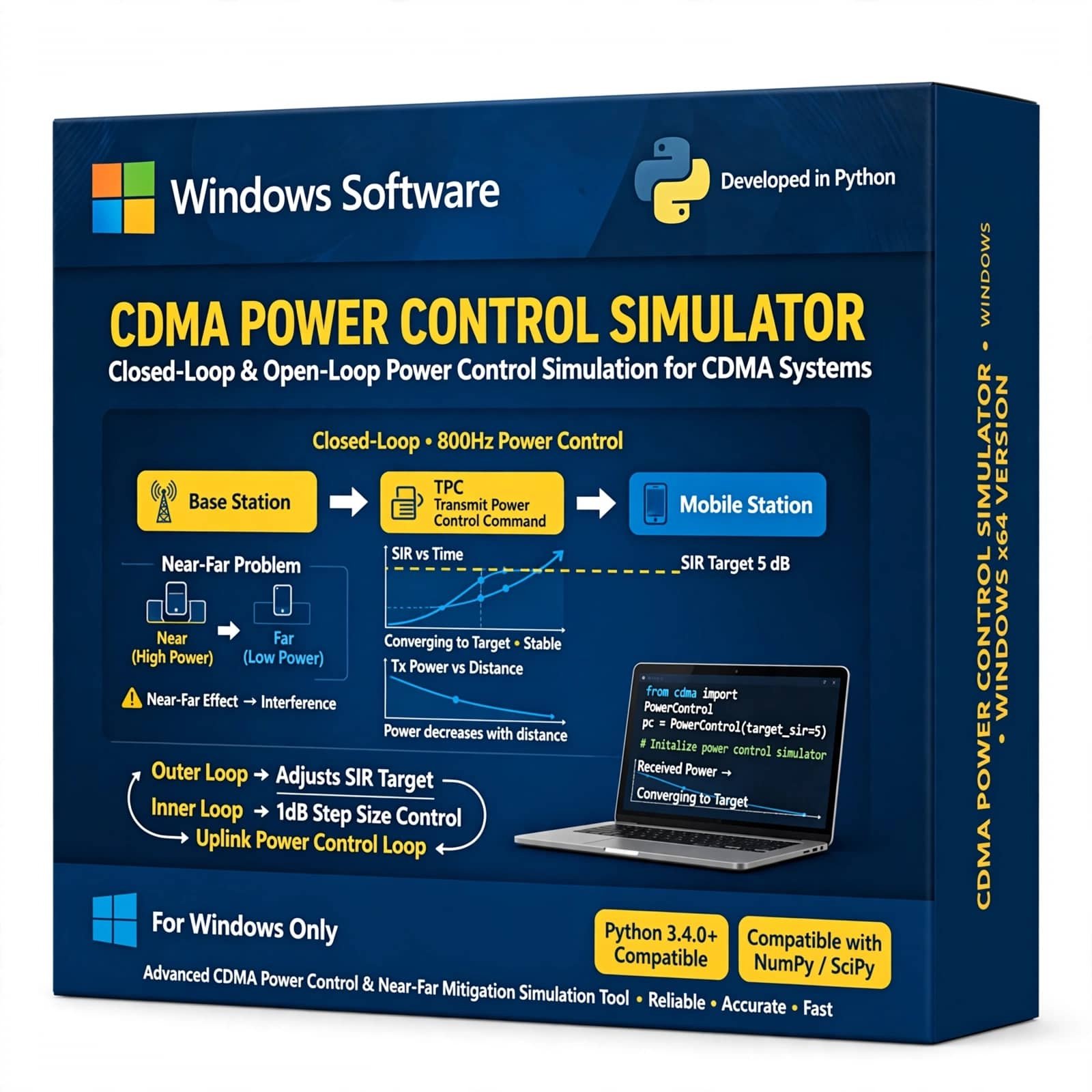
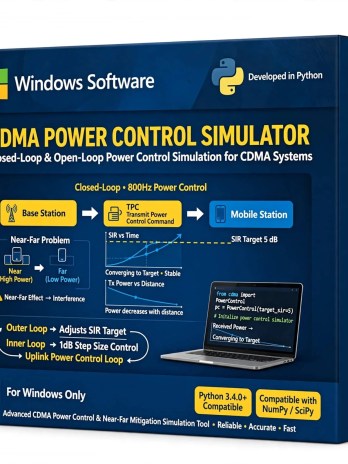
CDMA Power Control Simulator is an advanced communication engineering simulation tool designed to help students, researchers, and professionals understand and analyze power control techniques in Code Division Multiple Access (CDMA) wireless communication systems. It enables practical study of uplink and downlink power control, signal interference, power levels, and system performance.
₹3,999.00 -
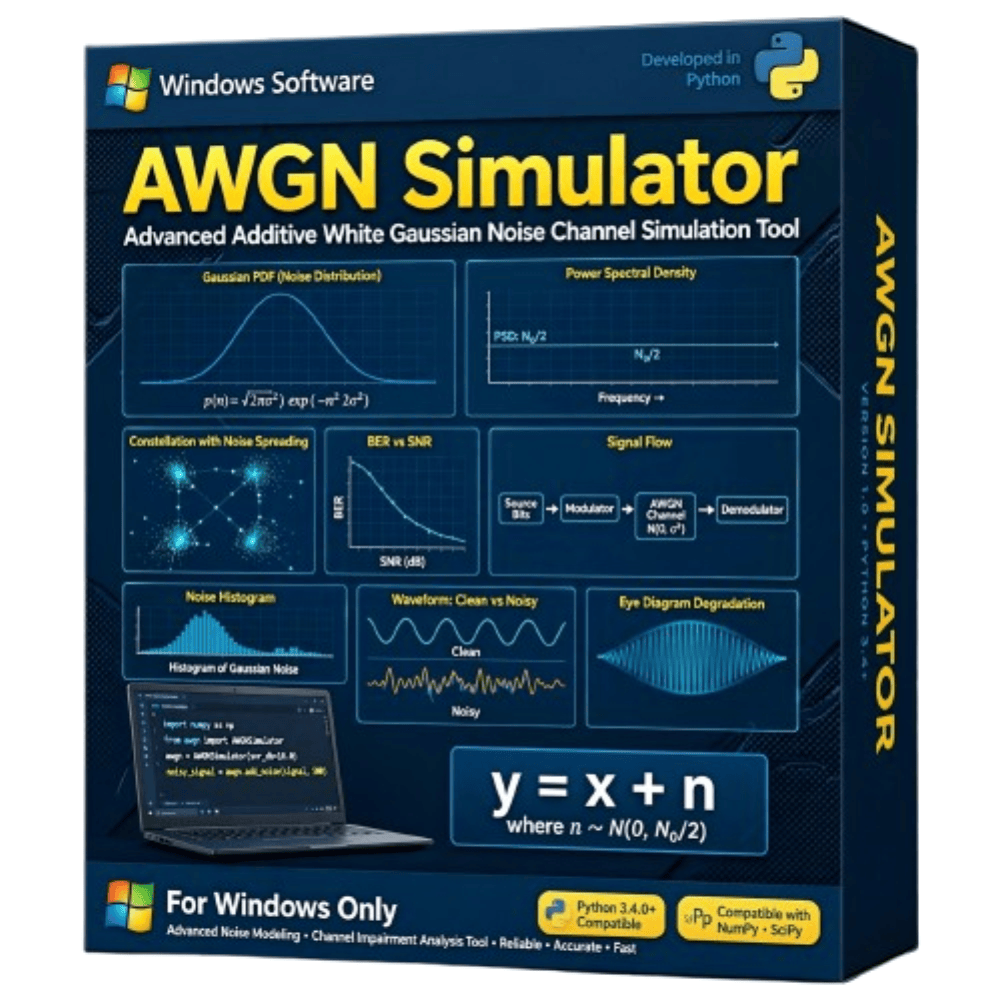
An AWGN Simulator i.e. Additive White Gaussian Noise Simulator developed using Python is a software-based tool designed to demonstrate and analyze the effect of Gaussian noise on digital communication signals. The simulator generates a clean input signal, adds controlled amounts of AWGN, and displays both the original and noisy signals for comparison. Users can vary parameters such as noise power, signal-to-noise ratio (SNR), and signal characteristics to observe how communication quality changes under different noise conditions. Python libraries such as NumPy, SciPy, and Matplotlib can be used for signal generation, noise modeling, numerical processing, and graphical visualization but this is purely from tkinter only. The simulator is useful for understanding fundamental concepts of wireless and digital communication systems.
₹1,999.00 -
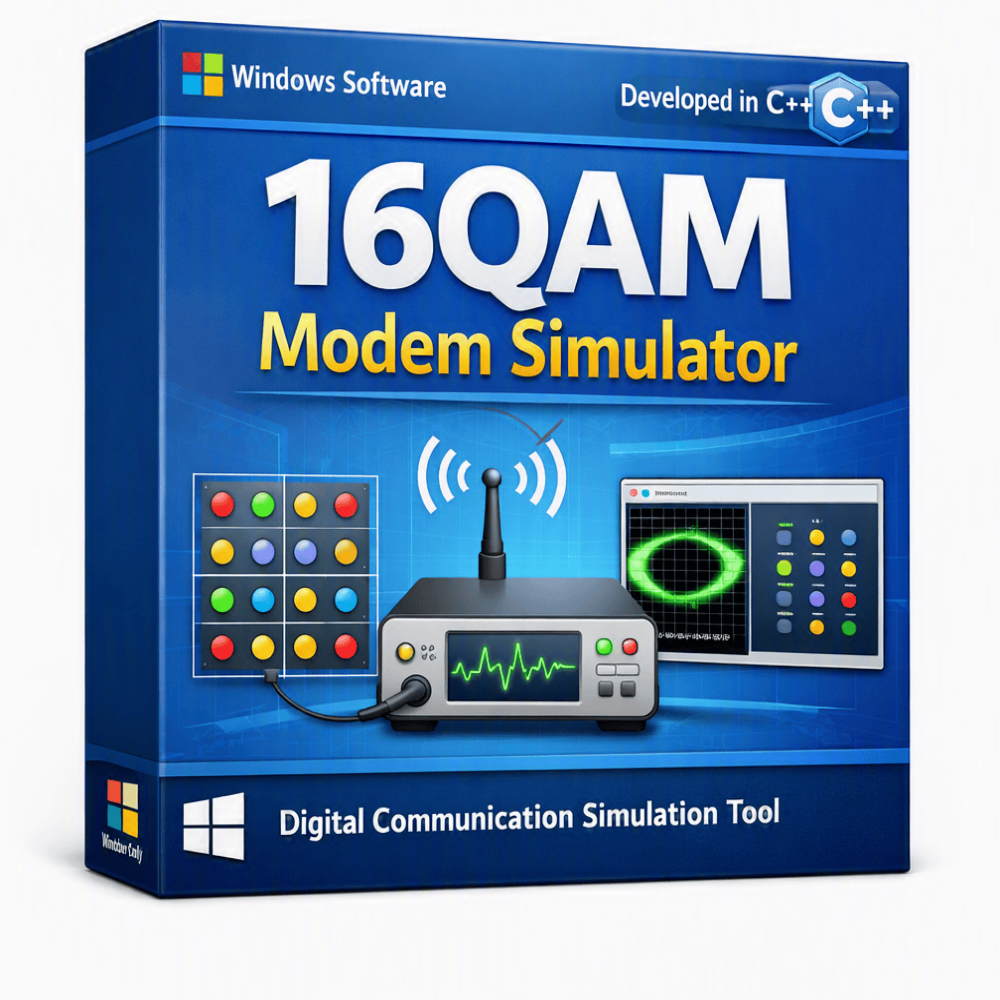
The 16QAM Modem Simulator is a C++-based software application designed to simulate and analyze a 16-QAM digital communication system. It demonstrates the complete modulation and demodulation process, including symbol mapping, signal generation, transmission, and data recovery. The simulator helps users understand key concepts of digital communication and evaluate system performance under different channel conditions.
₹1,999.00 -

GSM TDMA Simulator with Python is a software-based telecom simulation tool for studying GSM Time Division Multiple Access (TDMA), time-slot allocation, GSM frame structures, channel sharing, and wireless communication concepts. Developed using Python, it is suitable for students, researchers, telecom engineers, universities, and laboratories for GSM education, practical experiments, network simulation, and academic projects.
₹3,999.00 -
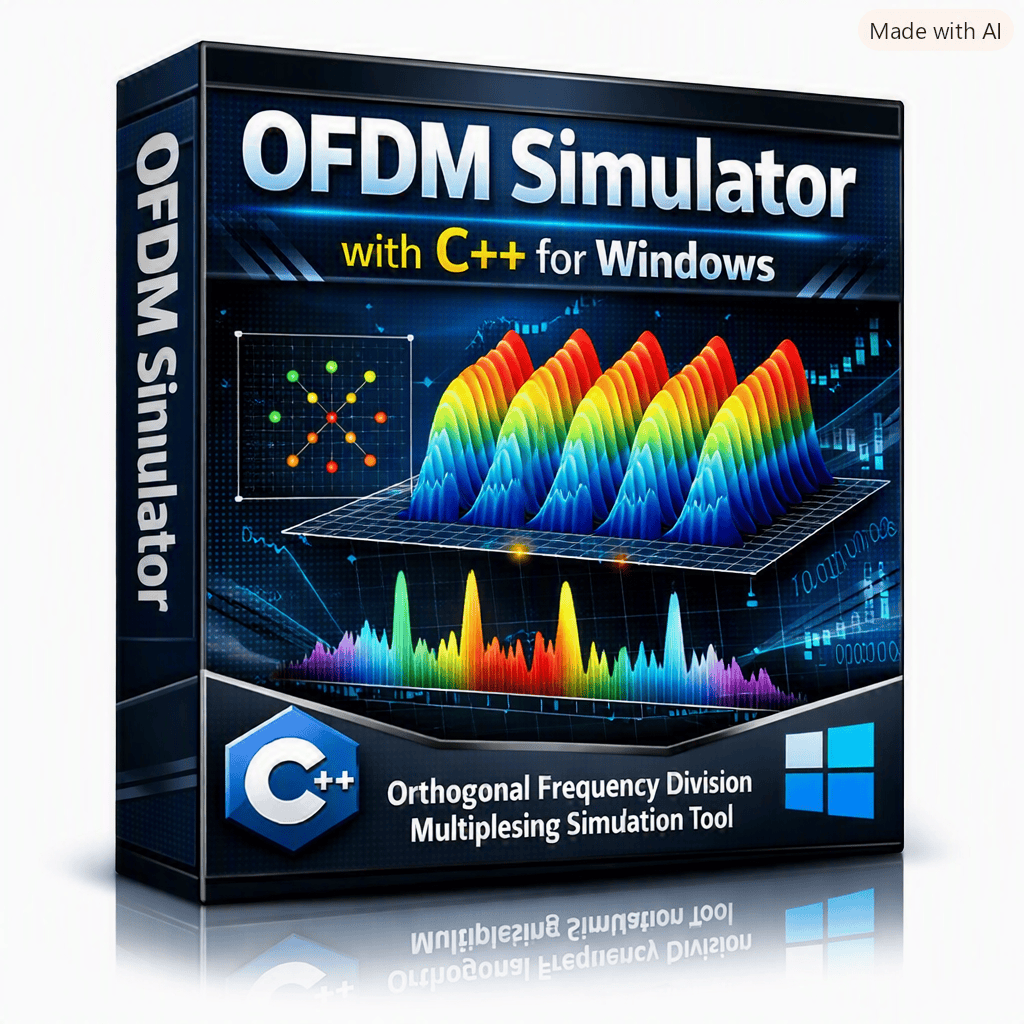
OFDM Simulator – C++ Educational Software is an interactive learning and simulation tool for understanding Orthogonal Frequency Division Multiplexing (OFDM) and digital communication concepts. Developed using C++, it allows users to configure FFT/IFFT size, active subcarriers, cyclic prefix length, modulation, SNR, and number of OFDM symbols while visualizing the resulting time-domain waveform, spectrum, and constellation. The simulator also provides measurable results such as PAPR, BER, Eb/N0, simulated bits, and cyclic-prefix overhead.
₹1,999.00 -
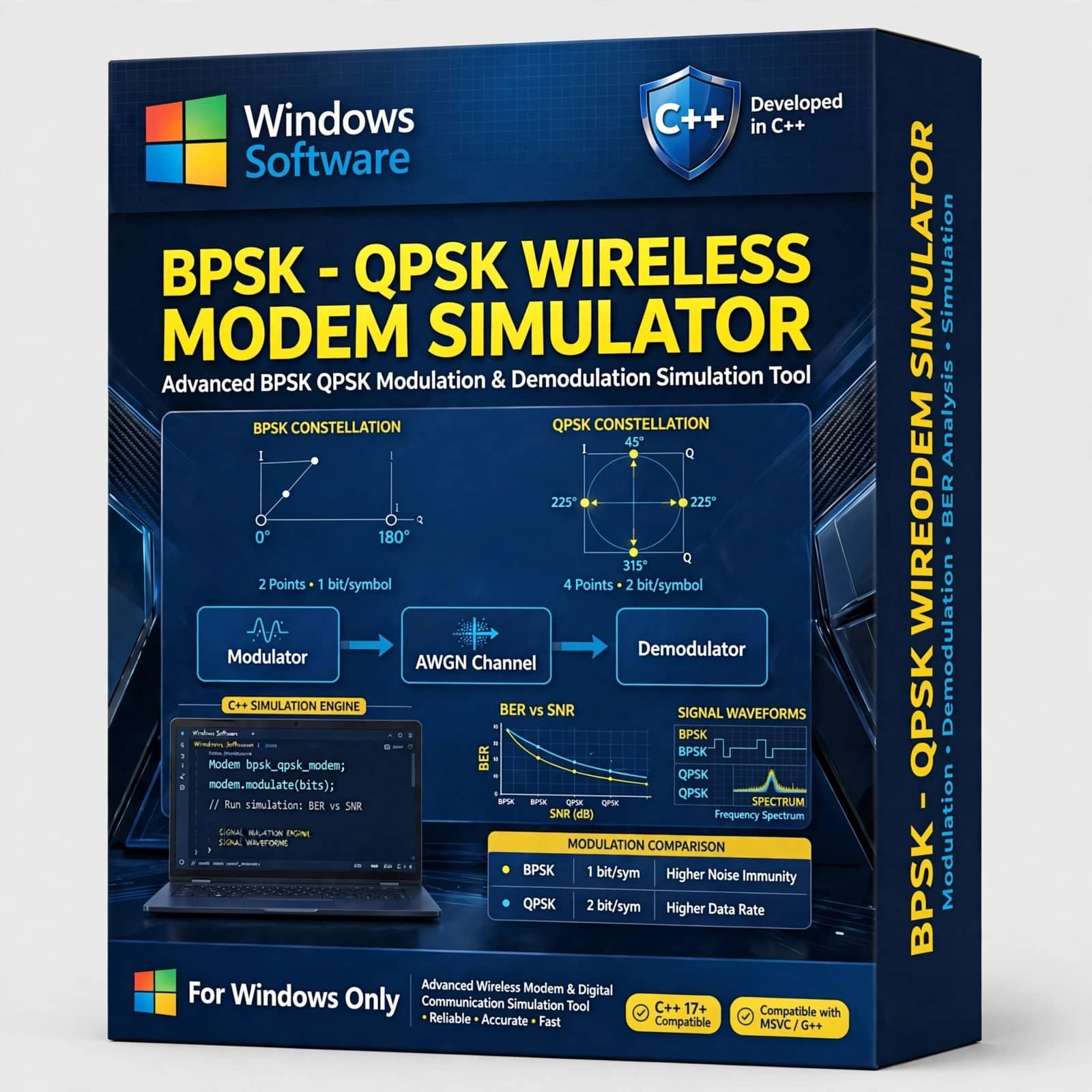
The BPSK – QPSK WIRELESS MODEM SIMULATOR with C++ is a software-based digital communication simulation tool designed for studying, demonstrating, and analyzing BPSK and QPSK modulation and demodulation techniques. Developed using C++, this wireless modem simulator provides a practical environment for understanding how digital information is converted into modulated signals, transmitted through a communication channel, received, and recovered at the receiver.
Designed for electronics and communication engineering laboratories, universities, colleges, research institutions, and technical training environments, the BPSK–QPSK simulator helps students and professionals connect digital communication theory with practical software implementation. It is suitable for learning fundamental concepts related to digital modulation, wireless communication, signal processing, modem technology, and communication system design.
₹1,999.00


Reviews
There are no reviews yet.