
New
87% Off

Radio Wave Simulator
Original price was: ₹750.00.₹100.00Current price is: ₹100.00.
In StockRadio Wave Simulator – Explore and generate a wide range of radio, RF, analog, and digital communication waveforms using this C++-based Radio Wave Simulator. The software is designed for students, researchers, electronics engineers, and communication enthusiasts to visualize and experiment with sine waves, RF signals, AM, FM, PM, ASK, FSK, GSM, and other communication waveforms in a practical simulation environment.
Description
Radio Wave Simulator
The Radio Wave Simulator is a C++-based software project designed to help users understand, generate, visualize, and experiment with different types of radio frequency (RF), analog modulation, and digital communication signals.
Radio waves and modulation techniques are fundamental concepts in electronics, telecommunications, wireless communication, signal processing, and RF engineering. Understanding these concepts theoretically is important, but being able to generate and observe different waveforms provides a much more practical approach to learning.
This C++ Radio Wave Simulator provides an educational and experimental platform for creating different types of signals and studying how their characteristics change based on frequency, amplitude, phase, modulation parameters, and other signal properties.
From a basic sine wave to more advanced communication waveforms such as AM, FM, PM, ASK, FSK, and GSM-related signals, the simulator can be used as a practical tool for exploring the fundamentals of radio and communication systems.
Generate Sine Waves and RF Signals
A sine wave is one of the most fundamental signals used in communication and electronics. It forms the foundation for understanding carrier signals, oscillations, modulation, and RF transmission.
With the Radio Wave Simulator, users can generate and analyze sine waves by experimenting with parameters such as frequency, amplitude, and phase. These basic waveforms can then be used to understand how carrier signals behave and how information can be introduced through modulation.
The simulator can also be used to create RF carrier waveforms, providing a practical way to explore the relationship between carrier frequency and modulated signals.
Explore Analog Modulation Techniques
The software provides an opportunity to experiment with important analog modulation techniques used in communication systems.
AM – Amplitude Modulation
Amplitude Modulation (AM) is a traditional analog modulation technique in which the amplitude of a carrier signal varies according to the information signal.
Using the simulator, users can generate AM waveforms and study the relationship between the carrier and message signals. AM waveform generation is useful for understanding modulation depth, carrier frequency, signal amplitude, and the basic principles behind amplitude-modulated communication.
FM – Frequency Modulation
Frequency Modulation (FM) changes the instantaneous frequency of a carrier according to the information signal.
The Radio Wave Simulator allows users to explore FM waveform generation and understand how variations in the message signal affect the carrier frequency. This makes it useful for studying concepts related to frequency deviation, carrier signals, and frequency-based communication.

PM – Phase Modulation
Phase Modulation (PM) changes the phase of the carrier signal according to the information signal.
By generating PM waveforms, students and researchers can compare phase modulation with AM and FM and gain a better understanding of how information can be represented through changes in a carrier waveform.
Digital Modulation Waveform Generation
In addition to analog modulation, the simulator can be used to explore fundamental digital modulation techniques.
ASK – Amplitude Shift Keying
Amplitude Shift Keying (ASK) represents digital information by changing the amplitude of a carrier signal between defined levels.
The simulator can help users visualize how binary data affects the carrier waveform and understand the basic concept behind amplitude-based digital modulation.

FSK – Frequency Shift Keying
Frequency Shift Keying (FSK) represents digital data by switching between different carrier frequencies.
FSK waveform generation provides a practical way to understand how digital information can be transmitted using frequency changes. Users can observe the relationship between binary data and the corresponding frequency-shifted waveform.
GSM and Wireless Communication Concepts
The Radio Wave Simulator also includes support for exploring GSM-related communication waveforms and concepts, making the project particularly relevant to students studying wireless communication and mobile communication systems.

GSM, or Global System for Mobile Communications, is an important part of the history of cellular telecommunications. Studying GSM-related signals alongside basic RF and modulation waveforms helps learners understand how communication concepts progress from simple carrier signals to more complex wireless communication systems.
Depending on the implementation and available modules, users can experiment with GSM-related waveform generation and visualization as part of a broader wireless communication simulation environment.
C++ Based Radio Wave Simulation
The project is developed using C++, making it suitable for students and developers interested in combining programming with electronics, RF engineering, and communication systems.
C++ provides a powerful environment for implementing mathematical signal-generation algorithms and processing waveform data efficiently. The source code can also provide an excellent learning opportunity for understanding how mathematical communication models can be translated into software.
Users with C++ knowledge can study the implementation and potentially extend the simulator with additional waveform types, modulation techniques, signal parameters, visualization methods, or communication-system experiments.
Useful for Electronics and Communication Engineering Projects
The Radio Wave Simulator in C++ can be useful for a variety of academic and engineering applications, including:
- Electronics Engineering Projects
- Communication Engineering Projects
- Telecommunication Projects
- RF Engineering Projects
- Wireless Communication Projects
- Digital Communication Projects
- Signal Processing Projects
- C++ Engineering Projects
- Final-Year Engineering Projects
- Mini Projects
- Communication Laboratory Demonstrations
- Academic Presentations
- Research and Experimentation
- Waveform Generation Studies
The simulator provides a practical way to demonstrate concepts that are often difficult to understand from equations alone.
Understand Communication Signals Visually
One of the major advantages of a waveform simulator is the ability to observe signals directly.
Instead of simply studying the mathematical definition of AM, FM, PM, ASK, or FSK, users can generate the corresponding waveform and examine how the signal changes.
For example, users can compare:
Sine Wave → RF Carrier → AM → FM → PM → ASK → FSK → GSM-related Signals
This progression can help demonstrate how different communication techniques modify a carrier signal to represent or transmit information.
Key Features
- C++ based Radio Wave Simulator
- Sine wave generation
- RF carrier waveform generation
- Amplitude Modulation (AM)
- Frequency Modulation (FM)
- Phase Modulation (PM)
- Amplitude Shift Keying (ASK)
- Frequency Shift Keying (FSK)
- GSM-related waveform generation
- Configurable signal parameters
- Carrier and message signal experimentation
- Digital and analog waveform simulation
- Signal visualization and analysis
- Educational communication-system simulation
- C++ source code for learning and customization
Ideal for Students and Researchers
The Radio Wave Simulator is designed to make radio wave and communication signal concepts easier to understand through practical experimentation.
Students can use the project to demonstrate modulation techniques during laboratory sessions, project presentations, and academic evaluations. Teachers and instructors can use waveform generation to explain the difference between analog and digital modulation.
Researchers and developers can also use the project as a starting point for experimenting with additional communication algorithms and signal-processing techniques.
Expandable C++ Communication Project
Because the simulator is developed in C++, it can serve as a foundation for further development. Advanced users may extend the project with additional modulation techniques, filters, noise models, spectrum analysis, FFT-based visualization, demodulation, signal-to-noise ratio analysis, BER measurement, or other RF and digital communication experiments.
This makes the project more than a basic waveform generator—it can serve as a foundation for developing a broader C++ communication system simulation platform.
Why Choose the Radio Wave Simulator?
If you are looking for a C++ radio wave simulator, RF signal generator project, communication waveform simulator, or modulation simulation project, this software provides a practical way to explore fundamental concepts in radio and wireless communication.
From generating a simple sine wave to experimenting with RF carriers, AM, FM, PM, ASK, FSK, and GSM-related waveforms, the simulator brings multiple communication concepts together in one project.
It is particularly suitable for learners who want to connect C++ programming with electronics, signal processing, RF engineering, and wireless communication.
Product Highlights
- C++ Radio Wave Simulator
- Sine and RF waveform generation
- AM, FM and PM simulation
- ASK and FSK digital modulation
- GSM-related waveform simulation
- Analog and digital communication experiments
- Practical RF and communication signal visualization
- Suitable for electronics and telecommunication students
- Useful for academic and final-year projects
- C++ source code for customization and further development
Get the Radio Wave Simulator in C++ and explore the generation and simulation of radio, RF, analog modulation, digital modulation, and wireless communication waveforms through practical software-based experimentation.
Related products
-
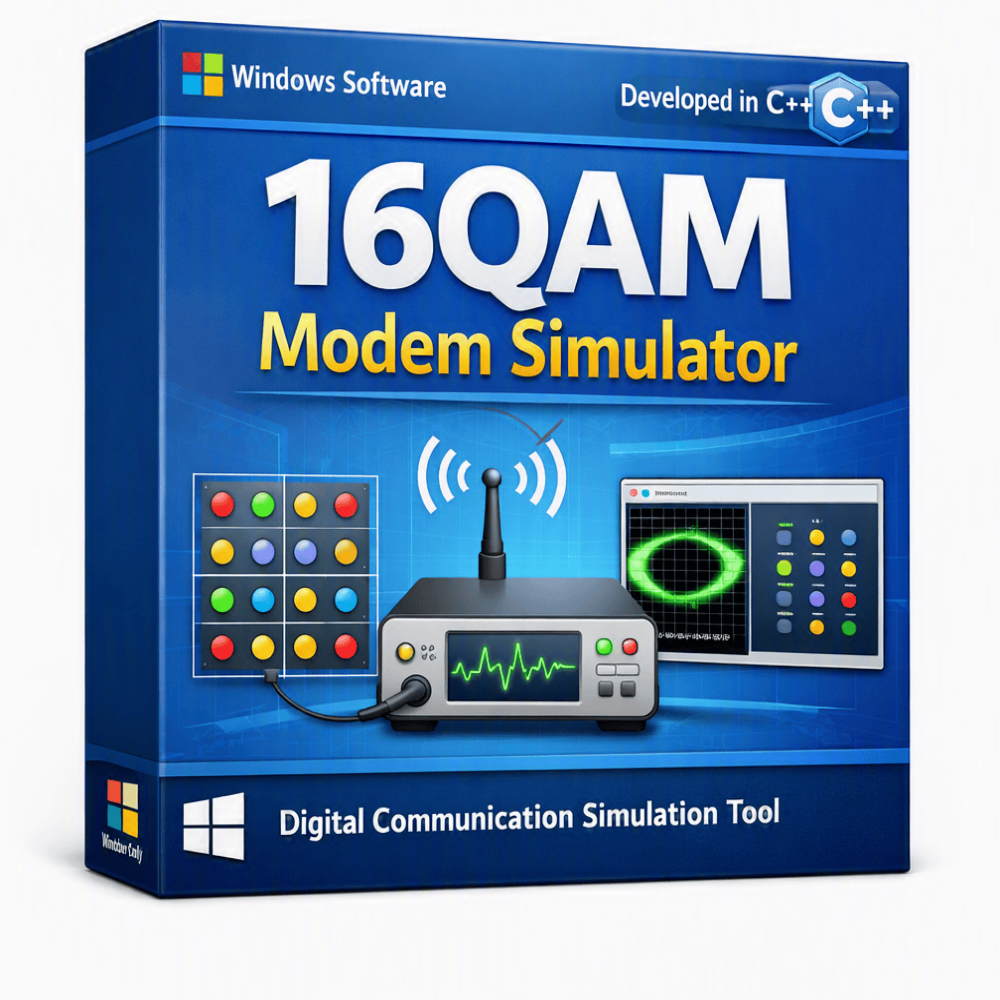
The 16QAM Modem Simulator is a C++-based software application designed to simulate and analyze a 16-QAM digital communication system. It demonstrates the complete modulation and demodulation process, including symbol mapping, signal generation, transmission, and data recovery. The simulator helps users understand key concepts of digital communication and evaluate system performance under different channel conditions.
Original price was: ₹750.00.₹250.00Current price is: ₹250.00. -
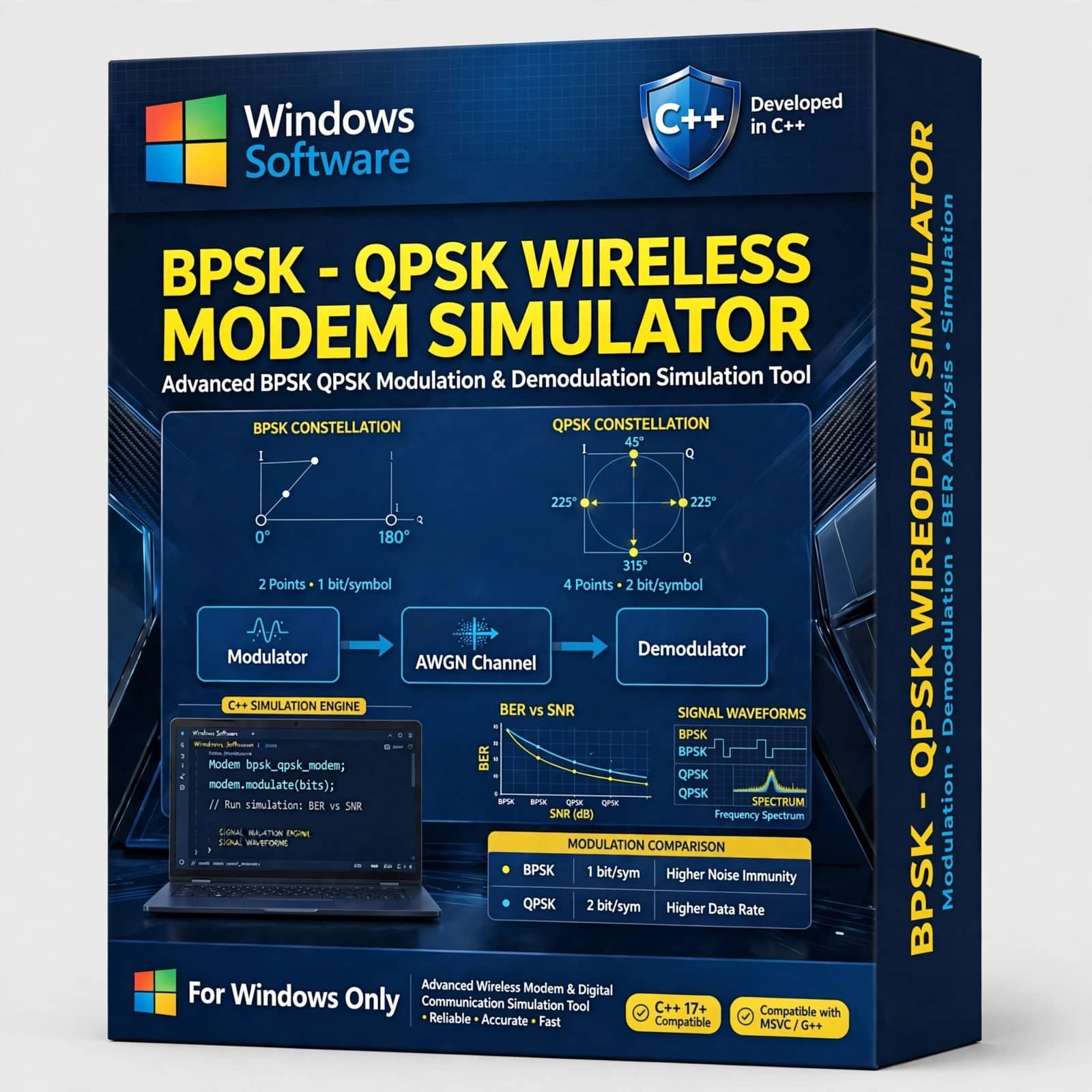
The BPSK – QPSK WIRELESS MODEM SIMULATOR with C++ is a software-based digital communication simulation tool designed for studying, demonstrating, and analyzing BPSK and QPSK modulation and demodulation techniques. Developed using C++, this wireless modem simulator provides a practical environment for understanding how digital information is converted into modulated signals, transmitted through a communication channel, received, and recovered at the receiver.
Designed for electronics and communication engineering laboratories, universities, colleges, research institutions, and technical training environments, the BPSK–QPSK simulator helps students and professionals connect digital communication theory with practical software implementation. It is suitable for learning fundamental concepts related to digital modulation, wireless communication, signal processing, modem technology, and communication system design.
Original price was: ₹750.00.₹250.00Current price is: ₹250.00. -
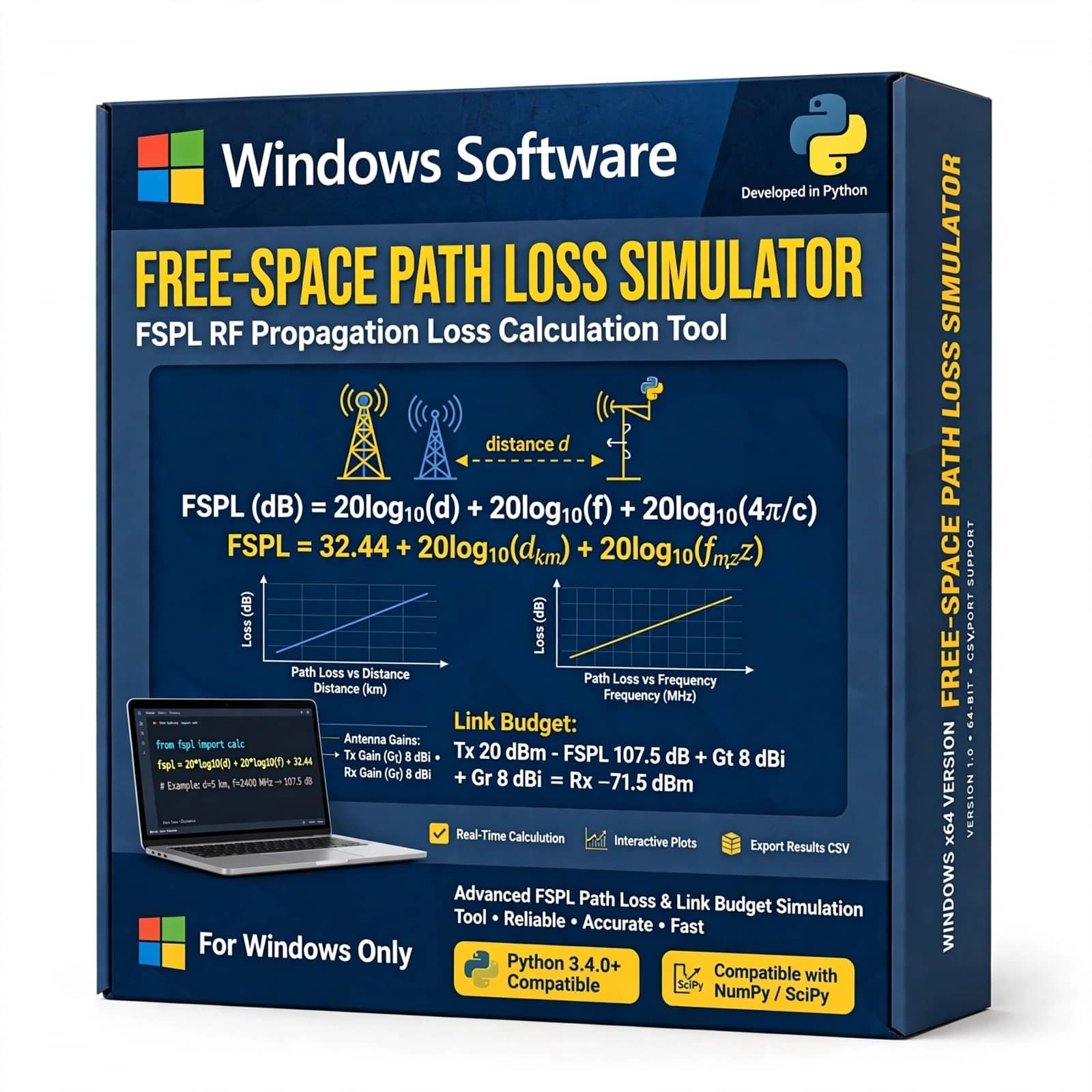
Free-Space Path Loss Simulator is an educational RF and wireless communication simulation tool designed to help students, engineers, researchers, and telecom professionals understand how radio signals lose power as they propagate through free space. It enables users to analyze the impact of frequency, distance, antenna characteristics, and transmission parameters on received signal strength and path loss.
Original price was: ₹750.00.₹250.00Current price is: ₹250.00. -
GSM TDMA Simulator with Python is a software-based telecom simulation tool for studying GSM Time Division Multiple Access (TDMA), time-slot allocation, GSM frame structures, channel sharing, and wireless communication concepts. Developed using Python, it is suitable for students, researchers, telecom engineers, universities, and laboratories for GSM education, practical experiments, network simulation, and academic projects.
Original price was: ₹750.00.₹250.00Current price is: ₹250.00. -
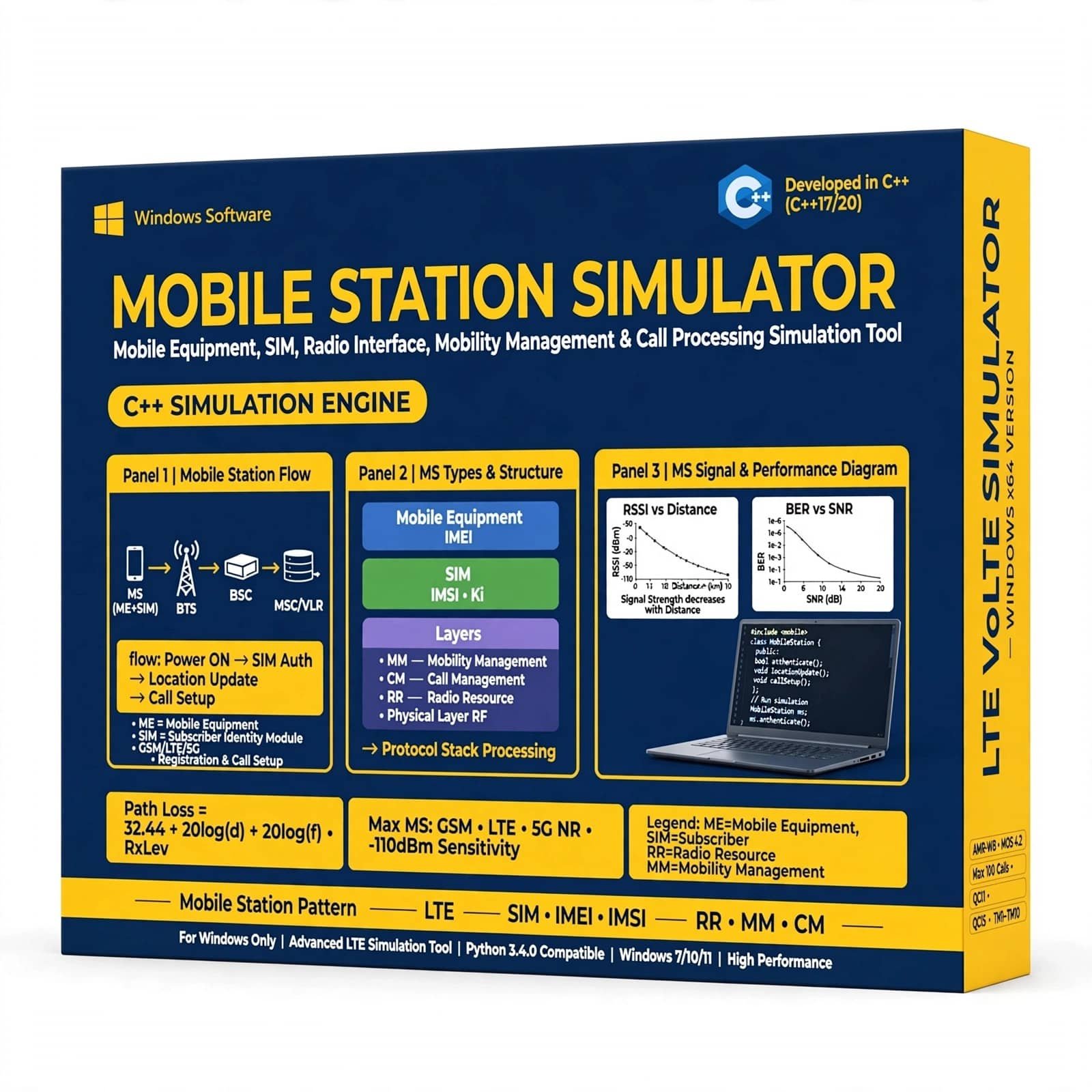
GSM Mobile Station Simulator – C++ Educational Software is an interactive educational simulator designed to demonstrate key GSM mobile station concepts, including MS hardware and identity, SIM card status, battery level, authentication, network registration, cell connectivity, signal strength, mobility, and Call/SMS states. Developed in C++, this simulator provides a simple visual environment for learning and demonstrating GSM network and mobile-station behavior.
Original price was: ₹750.00.₹100.00Current price is: ₹100.00. -
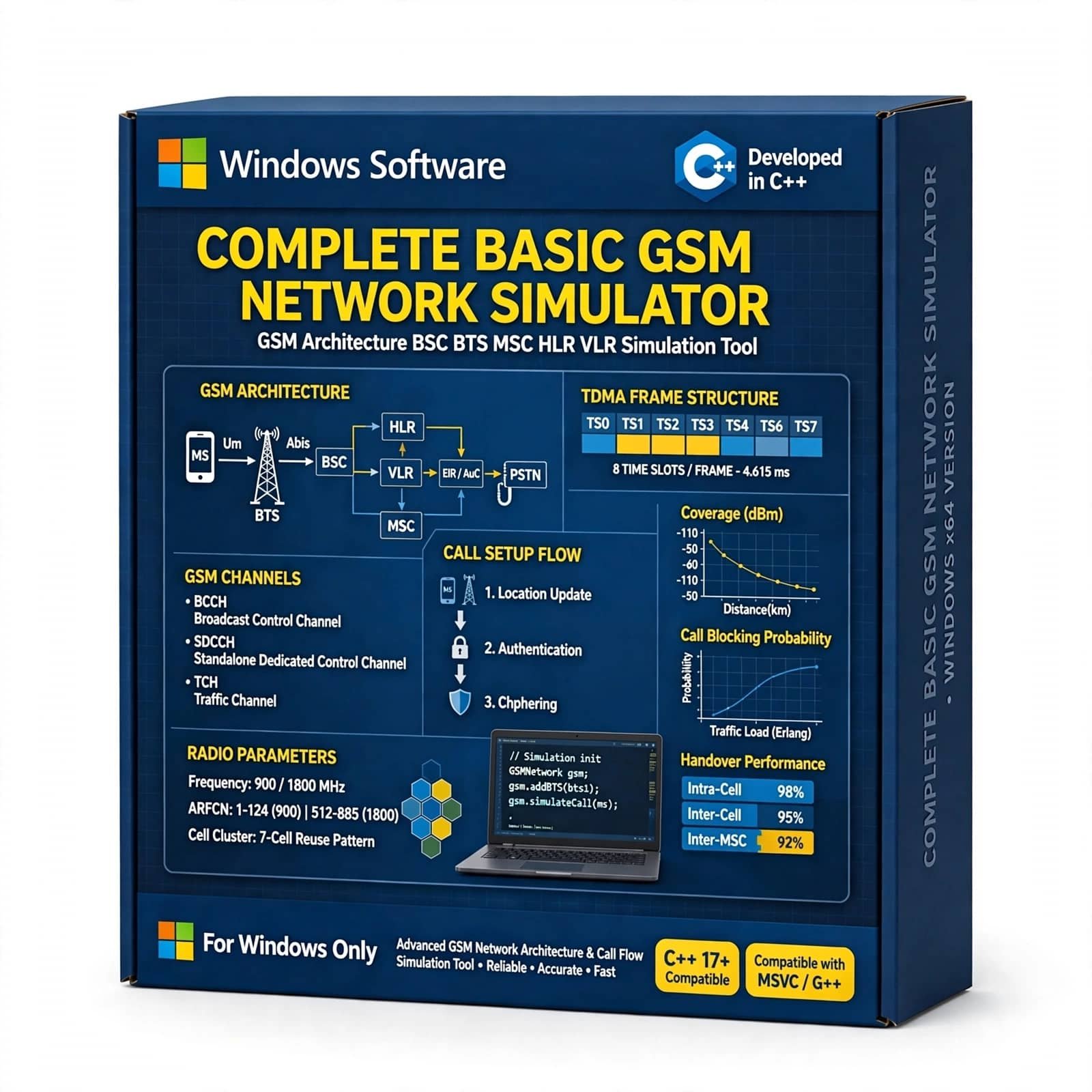
Complete Basic GSM Network with C++ is an educational and simulation-based project that demonstrates the fundamental architecture and operation of a GSM network using C++. It helps students and researchers understand GSM components, mobile communication, call and message handling, network signaling, and basic cellular network operations through a practical C++ implementation.
Original price was: ₹750.00.₹250.00Current price is: ₹250.00.



Reviews
There are no reviews yet.