
New
67% Off

QAM Communication System Simulator

Original price was: ₹750.00.₹250.00Current price is: ₹250.00.
In StockQAM Communication System Simulator – Explore and simulate Quadrature Amplitude Modulation (QAM) with this Python-based Communication System Simulator. Designed for students, researchers, and communication engineering enthusiasts, this project provides an interactive way to understand QAM modulation, signal transmission, noise effects, constellation diagrams, demodulation, and communication system performance using Python.
Description
QAM Communication System Simulator
Learn, analyze, and simulate one of the most important digital modulation techniques with the QAM Communication System Simulator, a Python-based project developed for studying and demonstrating the principles of Quadrature Amplitude Modulation (QAM).
Quadrature Amplitude Modulation, commonly known as QAM, is widely used in modern digital communication systems because it can transmit multiple bits per symbol by varying both the amplitude and phase of a carrier signal. Understanding how QAM works is essential for students and professionals studying digital communication, wireless communication, signal processing, and communication engineering.
This QAM Communication System Simulator in Python provides a practical environment for exploring the complete QAM communication process. Instead of relying only on theoretical equations and diagrams, users can use the simulator to observe how digital data is converted into QAM symbols, transmitted through a communication channel, affected by noise, and recovered through demodulation.
Understand QAM Modulation with Python
The simulator is particularly useful for students working on digital communication projects, Python projects, signal processing projects, and engineering final-year projects. Python provides a flexible environment for implementing mathematical models, generating communication signals, visualizing results, and analyzing system performance.
With the QAM simulator, users can study important concepts such as:
- Digital data generation
- QAM symbol mapping
- In-phase (I) and Quadrature (Q) components
- QAM modulation
- Carrier signal generation
- Communication channel simulation
- Additive noise effects
- QAM demodulation
- Symbol detection
- Constellation diagrams
- Transmitted and received signals
- Signal visualization
- Communication system performance analysis
Explore QAM Constellation Diagrams
One of the most useful features when learning QAM is the constellation diagram. A constellation diagram provides a visual representation of the possible QAM symbols in the I-Q plane.
Using this Python-based simulator, users can observe how QAM symbols are distributed and how channel noise can affect their positions. As noise increases, received symbols can move away from their ideal constellation points, making symbol detection more difficult.

This visualization makes the simulator useful for understanding the relationship between signal quality, noise, modulation, and demodulation in a digital communication system.
Python-Based Communication System Simulation
The project is implemented using Python, making it suitable for users who want to combine programming with communication engineering concepts. Python’s scientific and visualization capabilities make it possible to build simulations that are easy to modify, experiment with, and extend.
Students can use the project as a foundation for learning how communication algorithms are translated into practical Python programs. Researchers and developers can also modify parameters and experiment with different QAM configurations to study system behavior under different conditions.
Suitable for Academic and Engineering Projects
The QAM Communication System Simulator can be useful for a variety of academic applications, including:
- Digital Communication Laboratory Projects
- Communication Engineering Projects
- Python Mini Projects
- Final-Year Engineering Projects
- Electronics and Telecommunication Projects
- Signal Processing Projects
- Wireless Communication Projects
- Digital Modulation Demonstrations
- Academic Research and Experimentation
- Student Learning and Practical Demonstrations
The simulator can help bridge the gap between theoretical concepts and practical implementation. Students can study QAM equations and principles and then observe their practical behavior through Python-based simulation and visualization.

Learn Digital Modulation Through Simulation
QAM is an important digital modulation technique used in several high-speed communication applications. By experimenting with a QAM simulator, learners can gain a better understanding of how information is represented using changes in amplitude and phase.
The project can also serve as a starting point for advanced experimentation. Depending on the implementation, users may extend the simulator by adding different modulation orders, configurable noise levels, performance measurements, error analysis, or additional visualization features.
Key Benefits
Python-Based: Built using Python for flexible implementation and experimentation.
Practical Learning: Understand QAM concepts through simulation instead of theory alone.
Signal Visualization: Observe transmitted, modulated, received, and demodulated signals.
Constellation Analysis: Visualize QAM constellation points and the impact of noise.
Educational: Suitable for students, teachers, researchers, and communication engineering enthusiasts.
Customizable: Python source code can be studied and modified for additional experiments and features.
Why Choose the QAM Communication System Simulator?
If you are looking for a Python QAM project, digital communication simulator, or practical project for understanding digital modulation, this simulator offers a useful combination of programming, signal processing, and communication engineering.
Rather than treating QAM as a purely theoretical topic, the project provides an opportunity to experiment with the communication process and understand how different stages work together. It is especially valuable for students who need a practical implementation for coursework, laboratory demonstrations, academic presentations, or engineering projects.
The QAM Communication System Simulator is a practical Python project for exploring Quadrature Amplitude Modulation, signal transmission, constellation analysis, noise effects, and demodulation. Whether you are learning digital communication, developing a Python engineering project, or looking for a foundation for further research, this simulator can help you understand QAM communication through hands-on experimentation.
Product Highlights
- Python-based QAM communication system simulator
- Practical digital communication implementation
- QAM modulation and demodulation
- I-Q signal representation
- Constellation diagram visualization
- Communication channel and noise simulation
- Signal analysis and visualization
- Suitable for academic and educational projects
- Useful for communication engineering students
- Python source code for learning and customization
Get the QAM Communication System Simulator and explore digital communication concepts through practical Python-based simulation.
Related products
-
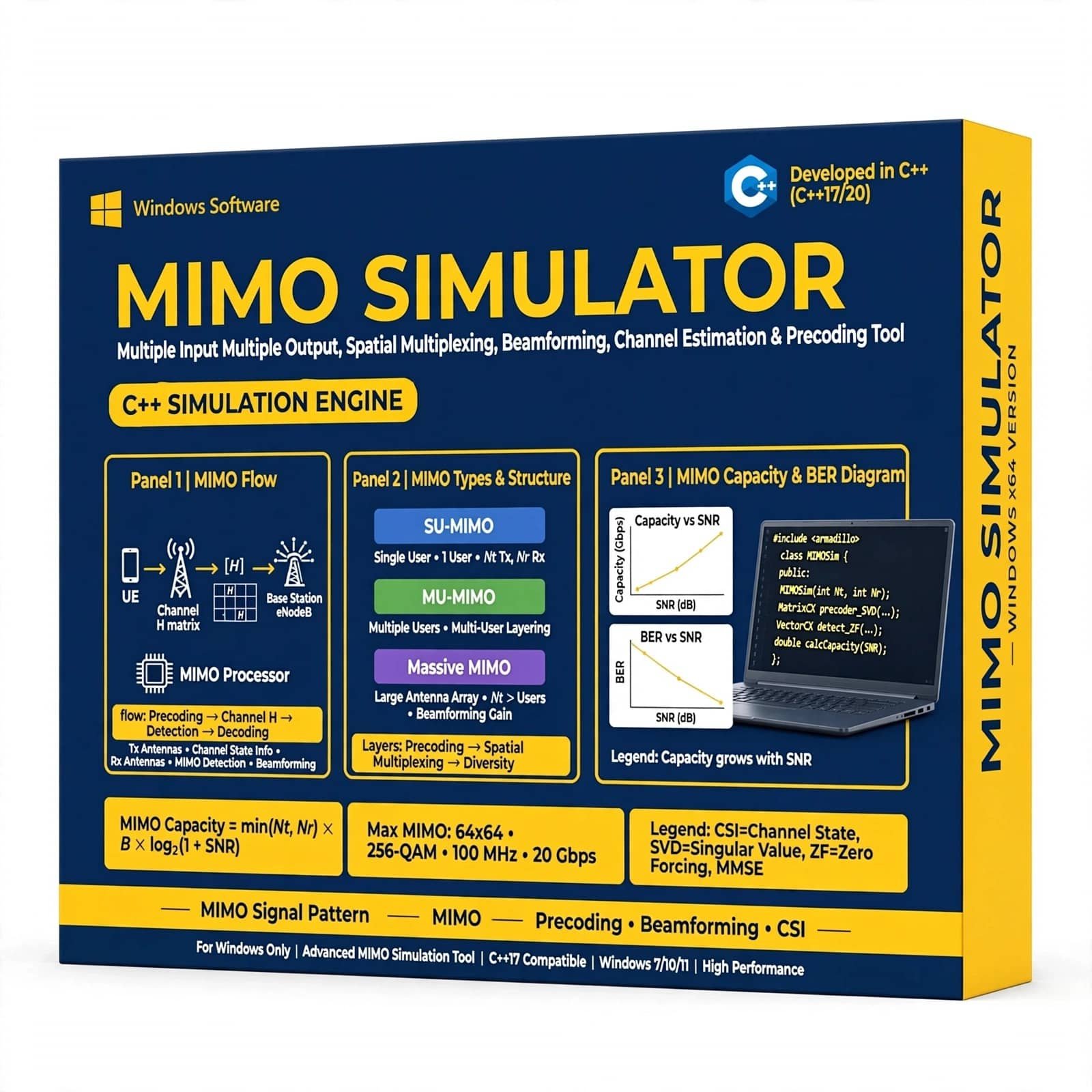
MIMO Simulator with C++ is a powerful wireless communication simulation solution designed for students, researchers, engineers, and communication professionals. Simulate Multiple-Input Multiple-Output (MIMO) systems, analyze channel performance, evaluate BER and SNR, and study different modulation, detection, and fading techniques using efficient C++ implementation.
Original price was: ₹750.00.₹250.00Current price is: ₹250.00. -
GSM TDMA Simulator with Python is a software-based telecom simulation tool for studying GSM Time Division Multiple Access (TDMA), time-slot allocation, GSM frame structures, channel sharing, and wireless communication concepts. Developed using Python, it is suitable for students, researchers, telecom engineers, universities, and laboratories for GSM education, practical experiments, network simulation, and academic projects.
Original price was: ₹750.00.₹250.00Current price is: ₹250.00. -
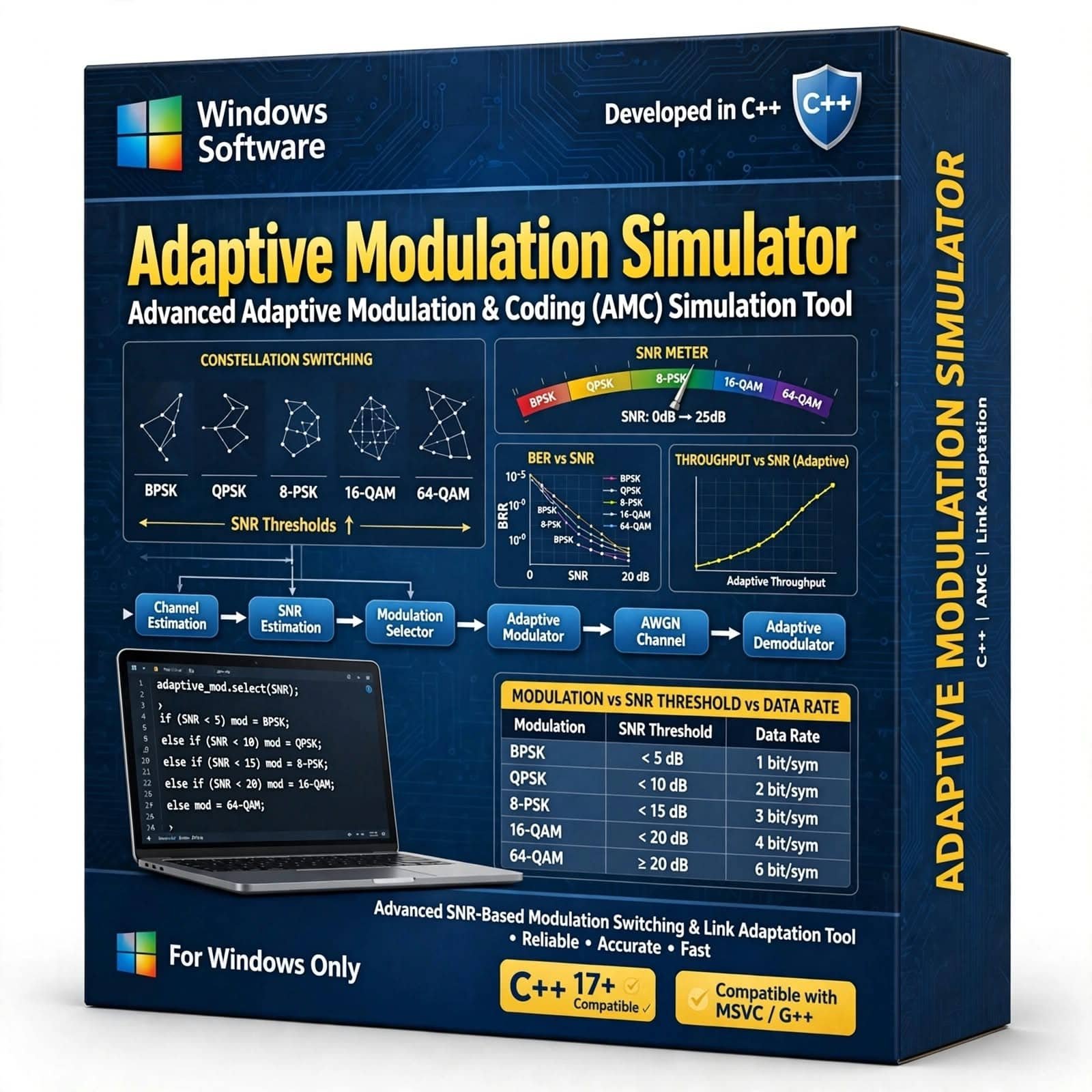
The Adaptive Modulation Simulator is a C++-based software solution designed for students, researchers, engineers, developers, and telecommunications professionals working with digital communication and adaptive modulation techniques. The simulator provides a practical environment for studying how modulation schemes can be selected or adapted according to communication-system conditions.
Developed using C++, the simulator is suitable for academic projects, digital communication research, laboratory demonstrations, signal-processing studies, algorithm development, and educational applications.
Available for sale as a software product. Contact us for pricing, licensing, technical specifications, customization, and purchase information.
Original price was: ₹750.00.₹250.00Current price is: ₹250.00. -
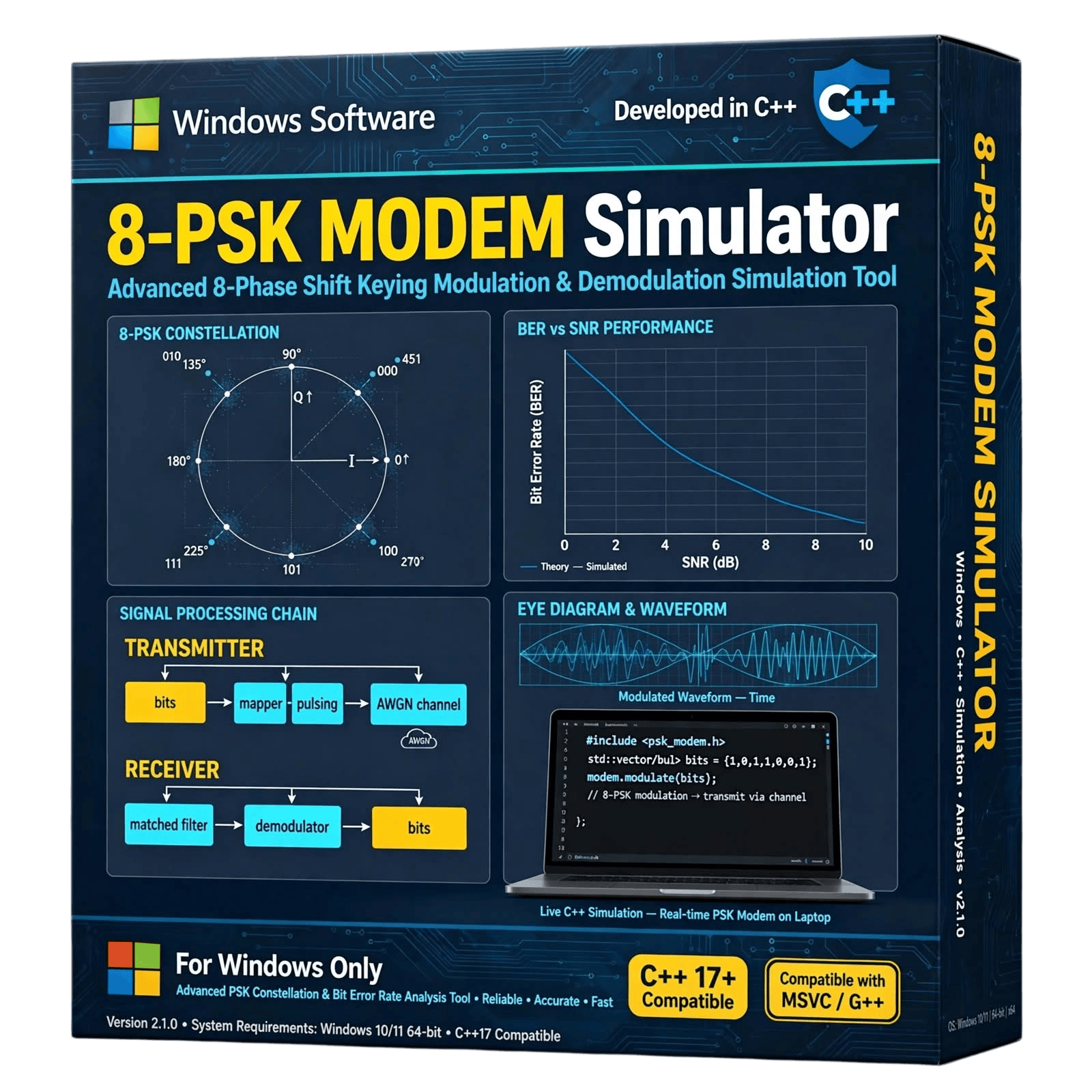
The 8-PSK Modem Simulator is a C++-based software solution designed for students, researchers, communication engineers, developers, and academic institutions working with digital communication and modulation techniques. The simulator provides a practical environment for studying 8-Phase Shift Keying (8-PSK) modulation and demodulation concepts.
Developed using C++, the simulator can be used for digital communication research, academic projects, laboratory demonstrations, signal-processing studies, experimentation, and educational purposes.
Available for sale as a software product. Contact us for pricing, licensing, technical specifications, customization, and purchase information.
Original price was: ₹750.00.₹250.00Current price is: ₹250.00. -
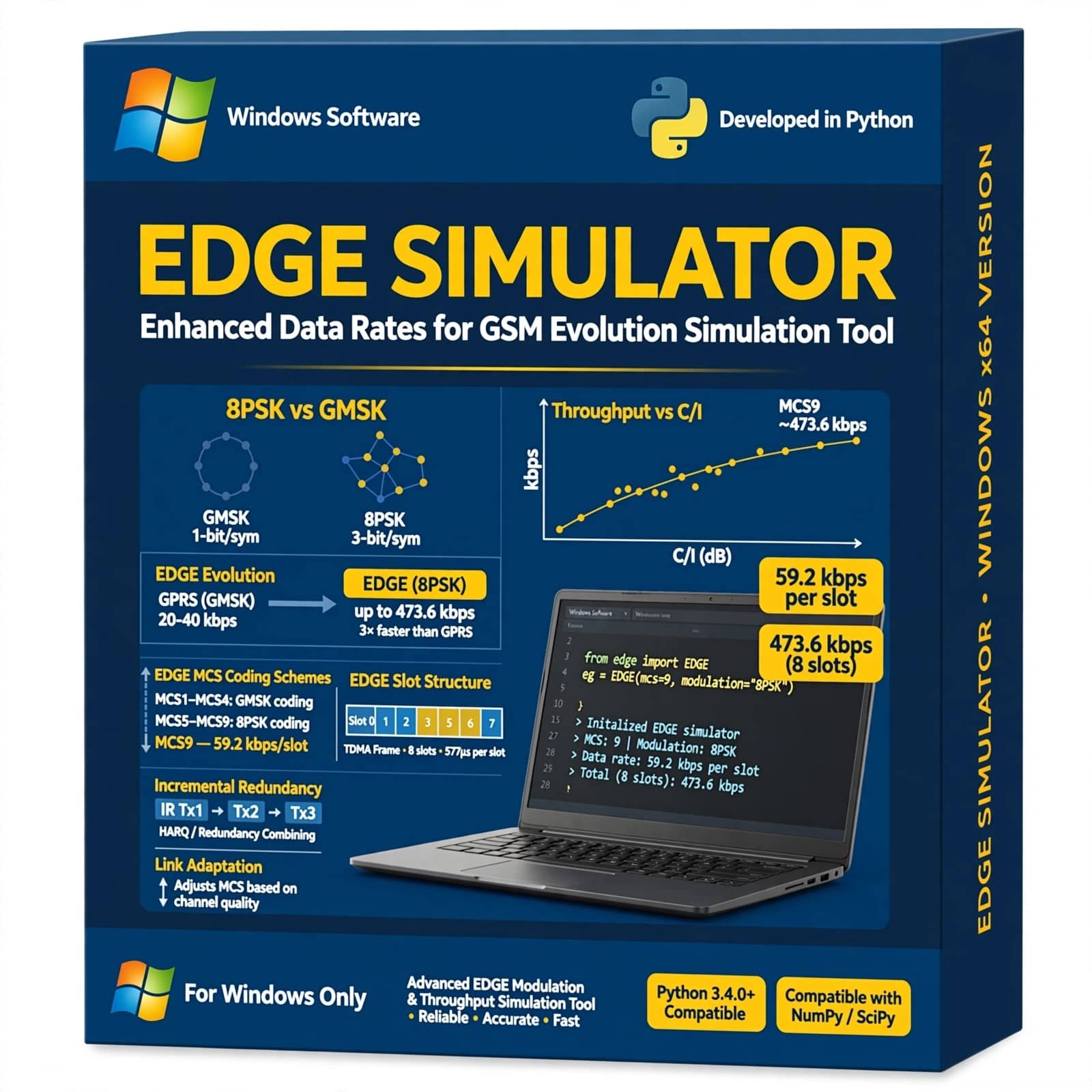
EDGE Simulator Using Python is a practical mobile communication simulation tool designed to demonstrate and analyze Enhanced Data rates for GSM Evolution (EDGE) technology. It helps students, researchers, and communication engineers study GSM/EDGE data transmission, modulation, channel conditions, bit error rate, data rates, and wireless communication performance using Python-based simulation.
Original price was: ₹750.00.₹250.00Current price is: ₹250.00. -
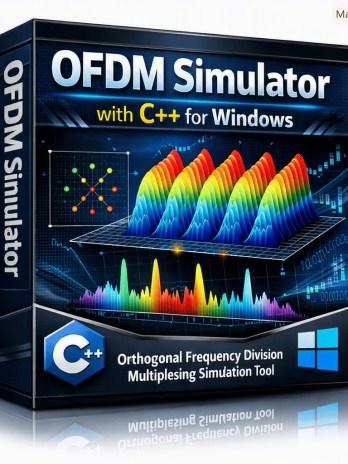
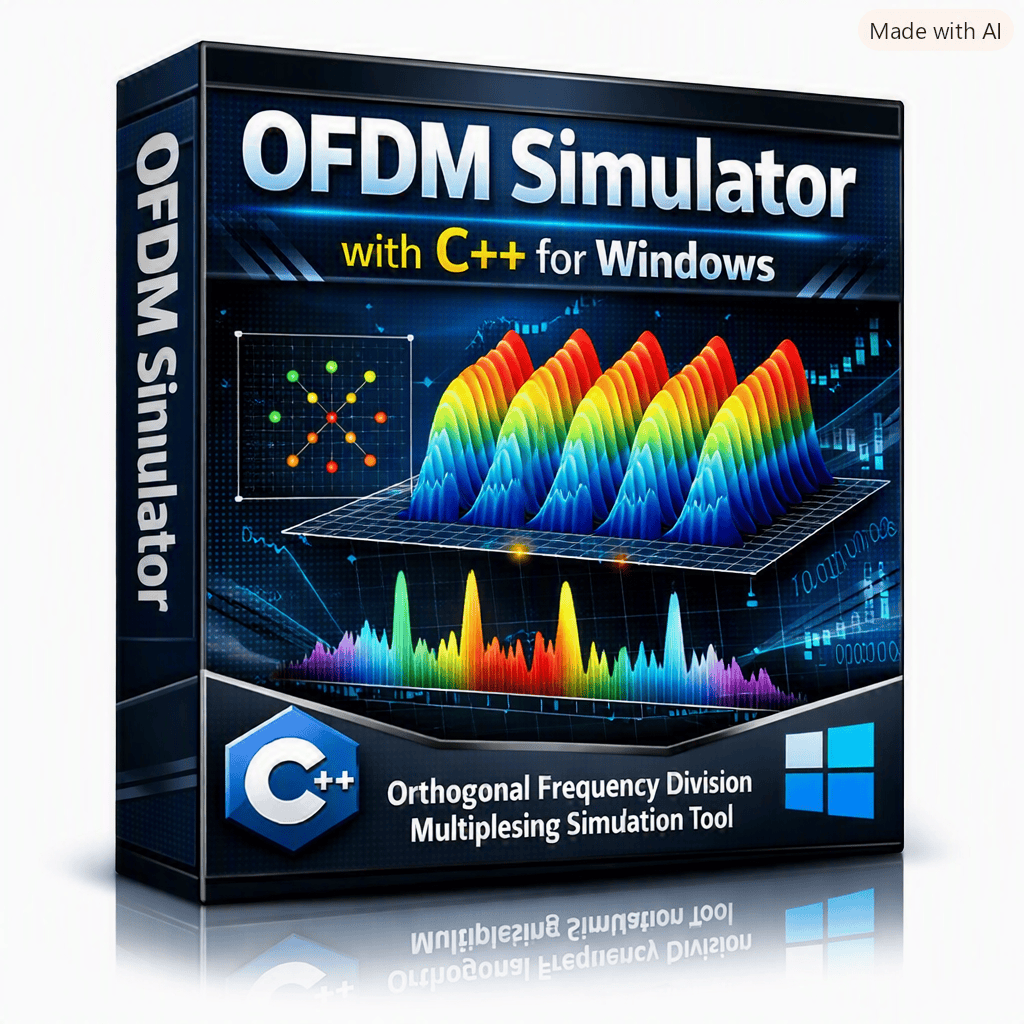
OFDM Simulator – C++ Educational Software is an interactive learning and simulation tool for understanding Orthogonal Frequency Division Multiplexing (OFDM) and digital communication concepts. Developed using C++, it allows users to configure FFT/IFFT size, active subcarriers, cyclic prefix length, modulation, SNR, and number of OFDM symbols while visualizing the resulting time-domain waveform, spectrum, and constellation. The simulator also provides measurable results such as PAPR, BER, Eb/N0, simulated bits, and cyclic-prefix overhead.
Original price was: ₹750.00.₹250.00Current price is: ₹250.00.


Reviews
There are no reviews yet.