

Free Space Path Loss Simulator

₹1,999.00
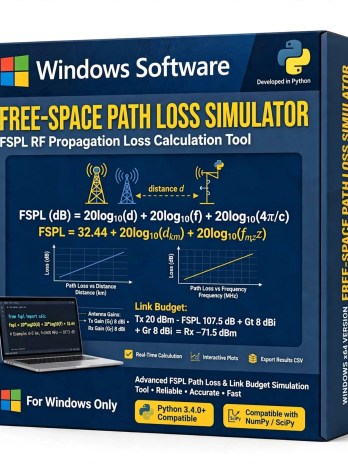
In StockFree Space Path Loss Simulator Using Python is a practical wireless communication simulation project designed to calculate and visualize signal power loss as a radio wave travels through free space. Developed using Python, this simulator helps students, researchers, and communication engineers understand Free Space Path Loss (FSPL), transmission distance, frequency, received signal power, and wireless link performance.
The project provides an easy-to-understand simulation environment for analyzing how distance and operating frequency affect signal propagation. It is suitable for B.Tech, M.Tech, engineering students, academic projects, wireless communication studies, RF analysis, and Python-based simulation projects.
Description
Free Space Path Loss Simulator Using Python
The Free Space Path Loss Simulator Using Python is an educational and practical simulation project developed to demonstrate how electromagnetic signals lose power while propagating through free space. Free Space Path Loss (FSPL) is one of the fundamental concepts in wireless communication, radio frequency engineering, antenna systems, satellite communication, and network planning.
This Python-based simulator allows users to study the relationship between transmission distance, signal frequency, wavelength, transmit power, antenna characteristics, and received signal power. By changing the simulation parameters, users can observe how propagation conditions influence wireless signal strength and link performance.
The simulator is particularly useful for students and researchers who want to understand wireless propagation concepts through an interactive and computational approach rather than relying only on theoretical calculations.
What Is Free Space Path Loss?
Free Space Path Loss refers to the reduction in signal power that occurs as a radio signal travels through an unobstructed Free Space environment. Even when there are no physical obstacles, a transmitted electromagnetic wave spreads over an increasingly larger area as the distance from the transmitter increases.
The simulator uses the commonly applied FSPL equation:
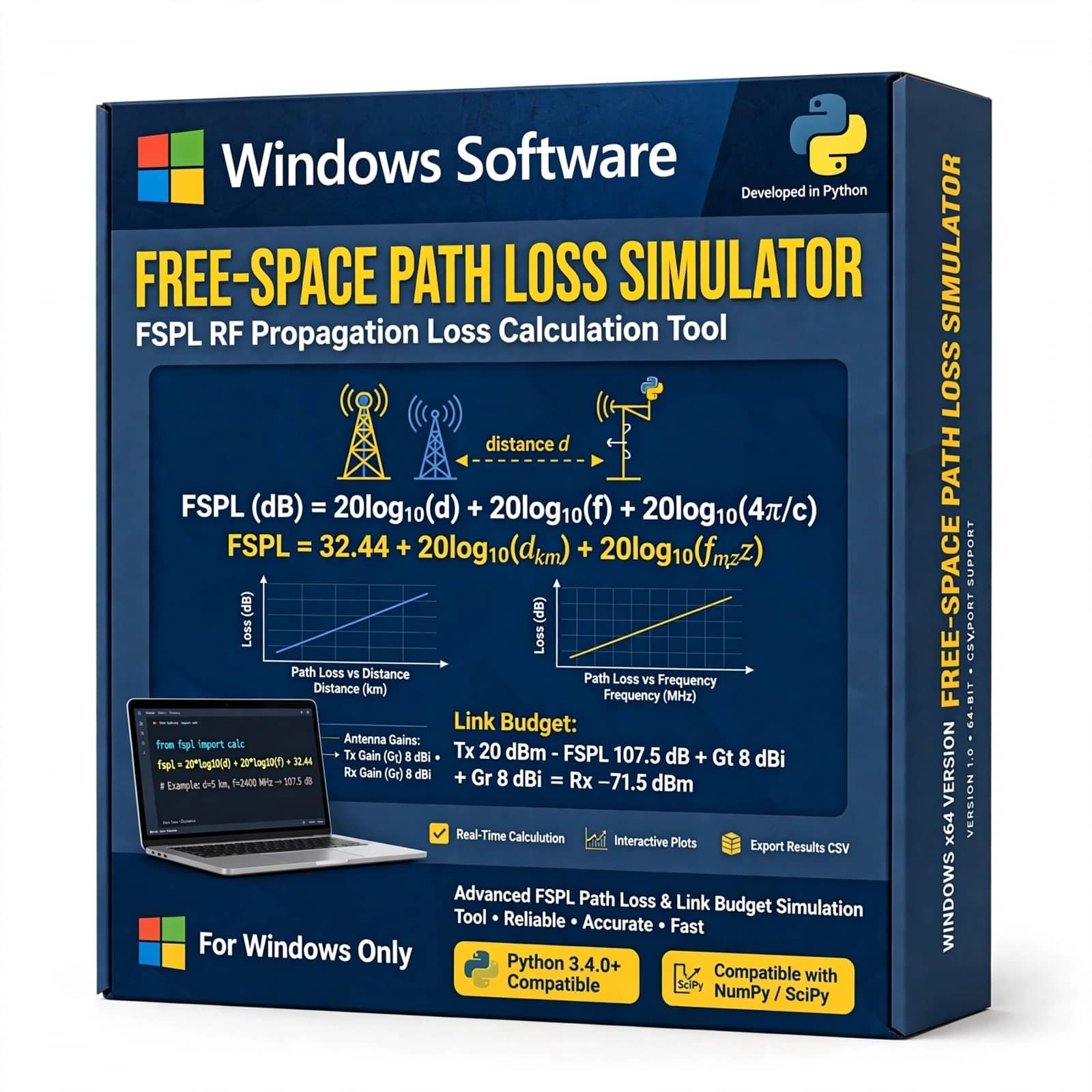
FSPL(dB) = 20 log₁₀(d) + 20 log₁₀(f) + 20 log₁₀(4π/c)
where:
- d represents the distance between the transmitter and receiver.
- f represents the operating frequency.
- c represents the speed of light.
The resulting path loss is expressed in decibels (dB). The simulator makes it easier to understand how increasing distance or frequency can increase Free Space path loss.
Python-Based Wireless Communication Simulation
Built using Python, the Free Space Path Loss Simulator provides a simple and flexible platform for wireless communication analysis. Python is widely used for engineering simulations because of its readable syntax, extensive scientific libraries, and ability to generate graphs and visualizations.
The project can be used to calculate FSPL for different combinations of frequency and distance and present the results in an easy-to-understand format. Graphical representation helps users identify trends and understand how signal attenuation changes as the propagation distance increases.
Key Features
- Calculate Free Space Path Loss in dB.
- Analyze the effect of transmission distance on path loss.
- Analyze the effect of operating frequency on signal attenuation.
- Calculate and analyze received signal power based on link parameters.
- Python-based implementation suitable for academic learning.
- Graphical visualization of simulation results.
- Easy-to-understand input and output structure.
- Useful for wireless communication and RF engineering studies.
- Suitable for student mini projects and major projects.
- Can be extended with additional propagation models and parameters.
- Helps demonstrate practical applications of wireless communication theory.
Applications
The Free Space Path Loss Simulator can be used in a variety of educational and engineering applications. It is suitable for studying wireless communication systems, RF propagation, antenna systems, satellite links, radio communication, microwave communication, IoT networks, and wireless network planning.
Students can use the simulator to understand how changing the carrier frequency affects propagation loss. They can also investigate how increasing the transmitter-receiver separation impacts received signal strength.
The project can be particularly useful for B.Tech and M.Tech Electronics and Communication Engineering (ECE) students, Electrical and Electronics Engineering students, telecommunications students, computer engineering students, and researchers working on wireless communication simulations.


Educational Benefits
This project connects theoretical wireless communication concepts with practical Python programming. Instead of manually calculating individual FSPL values, users can automate the calculations and visualize the results.
By working with the simulator, students can gain practical knowledge of:
- Radio wave propagation
- Free Space path loss
- Wireless link budgets
- Signal attenuation
- RF frequency analysis
- Received signal strength
- Distance-dependent propagation
- Python programming for engineering
- Data visualization
- Wireless communication system analysis
The simulator can also serve as a foundation for more advanced projects involving Okumura-Hata models, COST-231 models, log-distance path loss models, multipath propagation, fading channels, and wireless network simulation.
Why Choose This Project?
The Free Space Path Loss Simulator Using Python is a useful choice for anyone looking for a practical Python wireless communication project. It combines programming, mathematical modeling, and wireless engineering concepts into a single project.
Its straightforward structure makes it suitable for academic demonstrations, laboratory experiments, project presentations, and self-learning. Users can modify the Python source code and experiment with different parameters to develop a deeper understanding of radio propagation.
The project is also useful as a starting point for students who want to build more advanced RF and wireless communication simulation projects using Python.
Who Can Use This Project?
This project is suitable for:
- B.Tech students
- M.Tech students
- Diploma engineering students
- ECE students
- Telecommunication engineering students
- Wireless communication researchers
- Python programming learners
- RF and microwave engineering students
- Academic project developers
- Engineering project enthusiasts
Conclusion
The Free Space Path Loss Simulator Using Python provides a practical way to explore one of the most important concepts in wireless communication. By combining FSPL calculations with Python-based simulation and visualization, the project helps users understand how frequency and distance influence wireless signal propagation.
Whether you are working on an ECE academic project, Python simulation project, wireless communication experiment, RF engineering study, or final-year engineering project, this simulator provides a strong foundation for learning and experimentation.
Related products
-
dBm Calculator Using C++ is a practical software tool for calculating and converting radio frequency and electrical power values in dBm. It helps students, researchers, and communication engineers understand power measurements, signal strength, dBm-to-watt conversions, and RF calculations through a simple C++ implementation.
Original price was: ₹750.00.₹100.00Current price is: ₹100.00. -
GSM Mobile Station Simulator – C++ Educational Software is an interactive educational simulator designed to demonstrate key GSM mobile station concepts, including MS hardware and identity, SIM card status, battery level, authentication, network registration, cell connectivity, signal strength, mobility, and Call/SMS states. Developed in C++, this simulator provides a simple visual environment for learning and demonstrating GSM network and mobile-station behavior.
Original price was: ₹3,999.00.₹749.00Current price is: ₹749.00. -

QAM Communication System Simulator – Explore and simulate Quadrature Amplitude Modulation (QAM) with this Python-based Communication System Simulator. Designed for students, researchers, and communication engineering enthusiasts, this project provides an interactive way to understand QAM modulation, signal transmission, noise effects, constellation diagrams, demodulation, and communication system performance using Python.
₹1,999.00 -
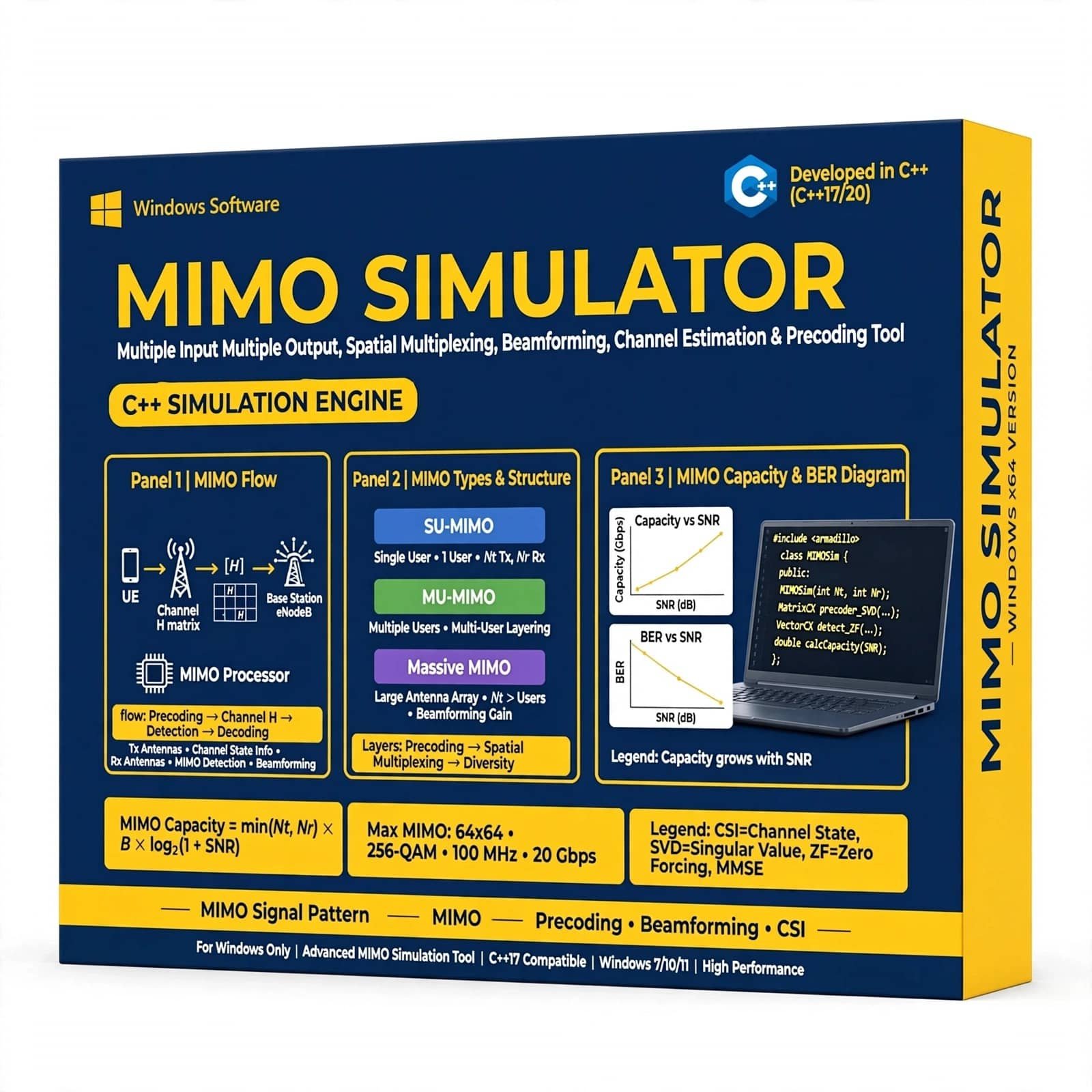
MIMO Simulator with C++ is a powerful wireless communication simulation solution designed for students, researchers, engineers, and communication professionals. Simulate Multiple-Input Multiple-Output (MIMO) systems, analyze channel performance, evaluate BER and SNR, and study different modulation, detection, and fading techniques using efficient C++ implementation.
₹3,999.00 -
Free-Space Path Loss Simulator is an educational RF and wireless communication simulation tool designed to help students, engineers, researchers, and telecom professionals understand how radio signals lose power as they propagate through free space. It enables users to analyze the impact of frequency, distance, antenna characteristics, and transmission parameters on received signal strength and path loss.
Original price was: ₹1,999.00.₹749.00Current price is: ₹749.00. -

Cell Coverage Simulator is a wireless communication simulation tool designed to model and analyze cellular network coverage using Python. It helps students, researchers, and telecom professionals visualize cell coverage, signal propagation, coverage areas, and network planning concepts through practical simulation and analysis.
₹6,999.00


Reviews
There are no reviews yet.