
New
67% Off

Doppler Shift Simulator


Original price was: ₹750.00.₹250.00Current price is: ₹250.00.
In StockDoppler Shift Simulator Using Python is a practical wireless communication simulation tool for studying the Doppler effect and frequency shift caused by relative motion between a transmitter and receiver. It helps students, researchers, and communication engineers analyze Doppler frequency, carrier frequency, velocity, and mobile channel effects through Python-based simulation.
Description
Doppler Shift Simulator
The Doppler Shift Simulator Using Python is an educational and simulation-based project designed to demonstrate the principles of the Doppler effect and Doppler frequency shift in wireless communication systems. The project provides a practical environment for students, researchers, educators, and communication engineers to understand how the movement of a transmitter or receiver affects the frequency of a received wireless signal.
In mobile and wireless communication systems, the relative movement between a transmitter and receiver can cause a change in the observed frequency of a signal. This phenomenon is known as the Doppler effect. The resulting frequency variation is called Doppler shift or Doppler frequency shift.
Doppler shift is an important consideration in mobile communication because user movement causes the wireless channel to change over time. The effect can become more significant as the speed of movement or carrier frequency increases. The Doppler Shift Simulator Using Python provides a convenient way to model these conditions and observe their impact through simulation.
Understand the Doppler Effect in Wireless Communication
The Doppler effect occurs when there is relative motion between a signal source and an observer. In a wireless communication system, this can happen when a mobile device moves toward or away from a base station, or when the transmitter itself is moving.
When the receiver moves toward the transmitter, the received frequency can increase. When it moves away, the observed frequency can decrease. The amount of frequency shift depends on parameters such as relative velocity, carrier frequency, and wavelength.
The Python-based simulator makes this concept easier to understand by allowing users to experiment with different input conditions and observe the corresponding frequency changes.
Python-Based Doppler Shift Simulation
Python is widely used in engineering, scientific computing, digital signal processing, and communication-system simulation. The Doppler Shift Simulator Using Python combines these programming capabilities with fundamental wireless communication concepts.
The project can help students understand how communication formulas and mathematical models can be implemented in Python. Users can modify simulation parameters, perform calculations, analyze results, and visualize the relationship between motion and frequency variation.
This makes the simulator useful for students studying Python programming, wireless communication, mobile communication, digital communication, signal processing, and telecommunications engineering.
Key Features and Simulation Capabilities
Depending on the implementation, the simulator can be used to explore various Doppler-related parameters and scenarios, including:
- Doppler frequency shift calculation
- Doppler effect simulation
- Relative transmitter and receiver velocity
- Carrier frequency analysis
- Received frequency calculation
- Approaching and receding motion
- Wireless signal propagation
- Mobile communication channel effects
- Frequency variation due to movement
- Velocity versus Doppler frequency analysis
- Carrier frequency versus Doppler shift analysis
- Python-based communication simulation
- Graphical analysis of simulation results
These capabilities provide a practical way to investigate how different operating conditions affect Doppler frequency.
Study Doppler Frequency
Doppler frequency is an important parameter in wireless communication systems because it indicates the frequency variation produced by relative motion.
For a simplified communication scenario, Doppler frequency is related to the velocity of the moving transmitter or receiver and the wavelength of the transmitted signal. Since wavelength is related to carrier frequency, changing either the velocity or carrier frequency can change the resulting Doppler shift.
The Doppler Shift Simulator Using Python allows learners to experiment with these parameters and understand their relationship through practical simulation.
Analyze the Effect of Velocity
The speed of a mobile user has a direct influence on the Doppler shift. At low speeds, the frequency variation may be relatively small. As the velocity increases, the Doppler frequency can also increase.
The simulator allows users to investigate different velocity conditions and study their influence on the received signal frequency. This is particularly useful when learning about wireless systems used by vehicles, aircraft, high-speed trains, and other moving platforms.
Understanding this relationship provides a foundation for studying high-mobility wireless communication and time-varying wireless channels.
Analyze the Effect of Carrier Frequency
Carrier frequency is another important factor affecting Doppler shift. For the same relative velocity, a higher carrier frequency generally produces a larger Doppler frequency shift.
The simulator can be used to compare different carrier-frequency scenarios and observe how the resulting Doppler shift changes. This helps students understand why Doppler effects need to be considered when designing and analyzing wireless communication systems operating at different frequencies.

Applications of Doppler Shift Simulation
Doppler shift is relevant to a wide range of communication and sensing technologies. The simulator can be used to introduce and study concepts associated with:
- Mobile communication
- Cellular communication
- Wireless communication
- Digital communication
- Satellite communication
- Vehicular communication
- Radar systems
- Radio communication
- Wireless channel modeling
- High-speed wireless networks
- Signal propagation
The project therefore provides a useful foundation for studying how mobility affects wireless signal transmission and reception.
Educational and Laboratory Applications
The Doppler Shift Simulator Using Python is suitable for engineering colleges, universities, wireless communication laboratories, research institutions, and technical training programs.
It can be used for:
- Wireless communication laboratory experiments
- Mobile communication demonstrations
- Python programming projects
- Digital communication projects
- Signal processing experiments
- Telecommunications projects
- Final-year engineering projects
- Mini projects
- Classroom demonstrations
- Academic research
The simulator allows students to complement theoretical learning with practical experimentation, helping them develop a better understanding of Doppler frequency and wireless channel behavior.
Benefits of the Doppler Shift Simulator
A simulation-based approach allows users to experiment with different scenarios without requiring specialized RF or wireless communication equipment.
The Doppler Shift Simulator Using Python can help users:
- Understand the fundamentals of the Doppler effect.
- Calculate and analyze Doppler frequency shift.
- Study the relationship between velocity and frequency shift.
- Investigate the effect of carrier frequency.
- Understand frequency variation in mobile communication.
- Experiment with different transmitter and receiver conditions.
- Visualize the impact of relative motion.
- Connect Python programming with wireless communication theory.
- Support engineering laboratory experiments.
- Develop academic and final-year projects.
- Build a foundation for advanced wireless channel studies.
Useful for Python and Communication Engineering Projects
The project is particularly suitable for students working on Python-based communication projects, wireless communication projects, mobile communication projects, digital signal processing projects, and telecommunications engineering projects.
The basic Doppler simulation can also be extended with additional functionality such as Rayleigh fading, Rician fading, multipath propagation, Doppler spectrum analysis, OFDM simulation, MIMO communication, channel modeling, and signal visualization.
Such extensions can help students progress from a basic Doppler calculation toward more advanced wireless communication simulations.
Ideal for Wireless Communication Laboratories
The Doppler Shift Simulator Using Python can be incorporated into a wireless communication or mobile communication laboratory to demonstrate the practical effects of mobility on signal frequency.
Instead of relying exclusively on theoretical equations, students can modify parameters and observe how the simulation responds. This interactive approach makes Doppler shift easier to visualize and provides practical experience with communication-system modeling using Python.
Conclusion
The Doppler Shift Simulator Using Python provides a practical and educational platform for studying the Doppler effect and frequency variations in wireless communication systems. It helps users understand how relative velocity and carrier frequency influence Doppler shift and provides a foundation for exploring the effects of mobility on wireless channels.
Whether used for a wireless communication laboratory, mobile communication course, Python programming project, digital signal processing experiment, telecommunications project, or final-year engineering project, the Doppler Shift Simulator Using Python offers an effective way to connect theoretical communication concepts with practical simulation and analysis.
Related products
-
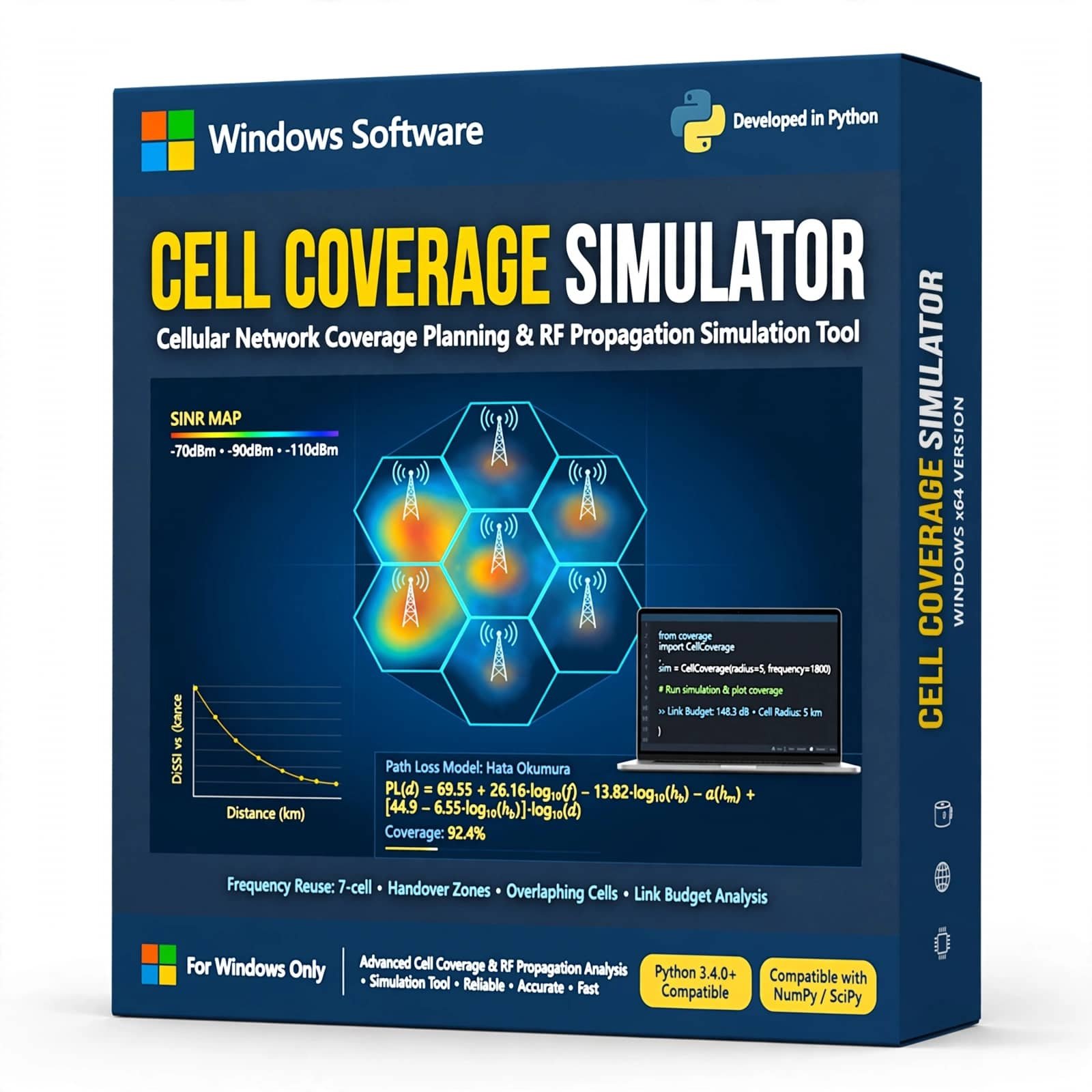
Cell Coverage Simulator is a wireless communication simulation tool designed to model and analyze cellular network coverage using Python. It helps students, researchers, and telecom professionals visualize cell coverage, signal propagation, coverage areas, and network planning concepts through practical simulation and analysis.
Original price was: ₹750.00.₹250.00Current price is: ₹250.00. -
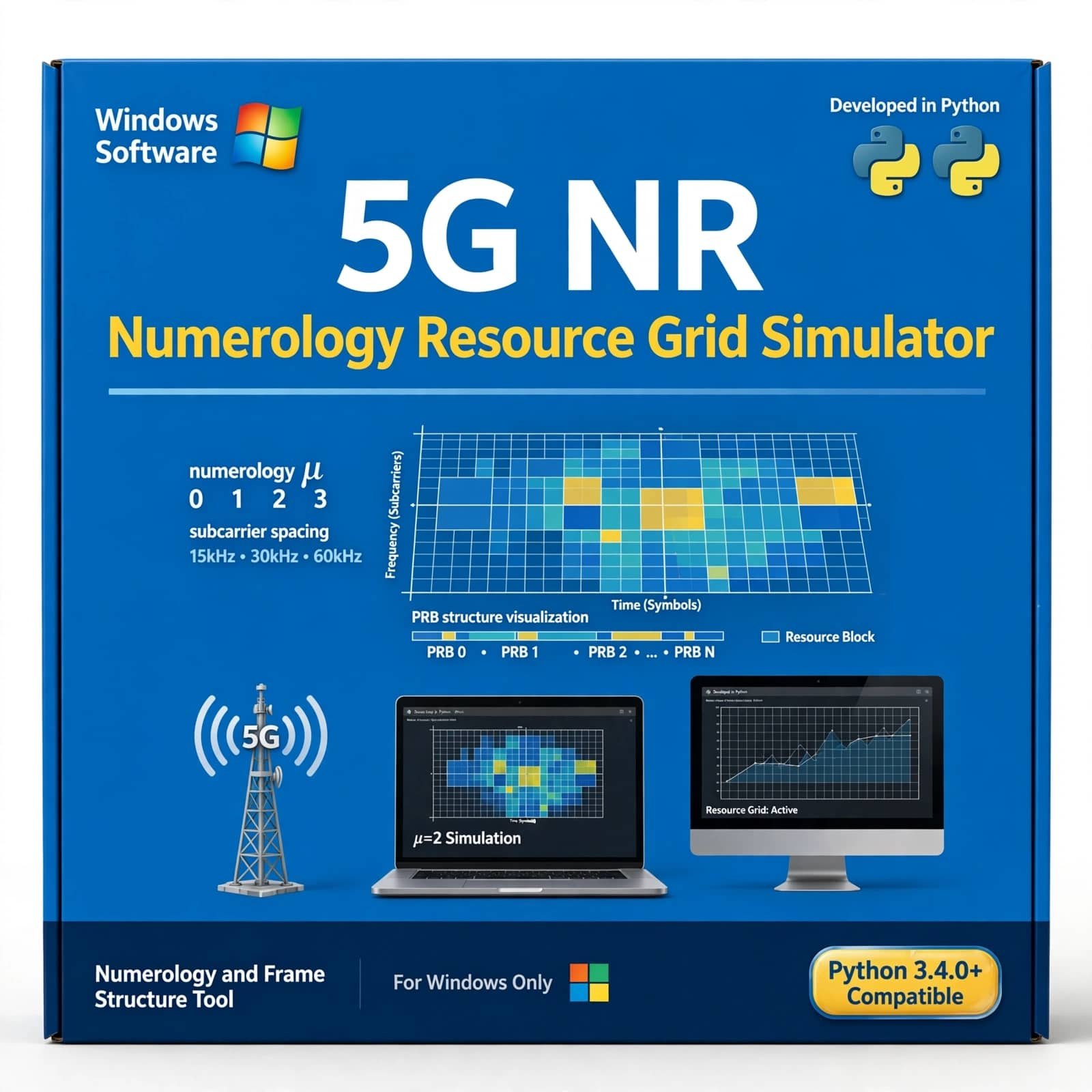
5G NR Numerology Resource Grid Simulator is an advanced simulation solution for modeling and analyzing 5G New Radio numerology and time-frequency resource grid structures. It enables users to study subcarrier spacing, OFDM symbols, slot structure, cyclic prefix, Physical Resource Blocks (PRBs), Resource Elements (REs), bandwidth configurations, and resource mapping. The simulator is ideal for 5G NR physical-layer research, numerology analysis, resource allocation studies, academic projects, waveform development, and 5G/6G wireless communication research.
Original price was: ₹750.00.₹250.00Current price is: ₹250.00. -
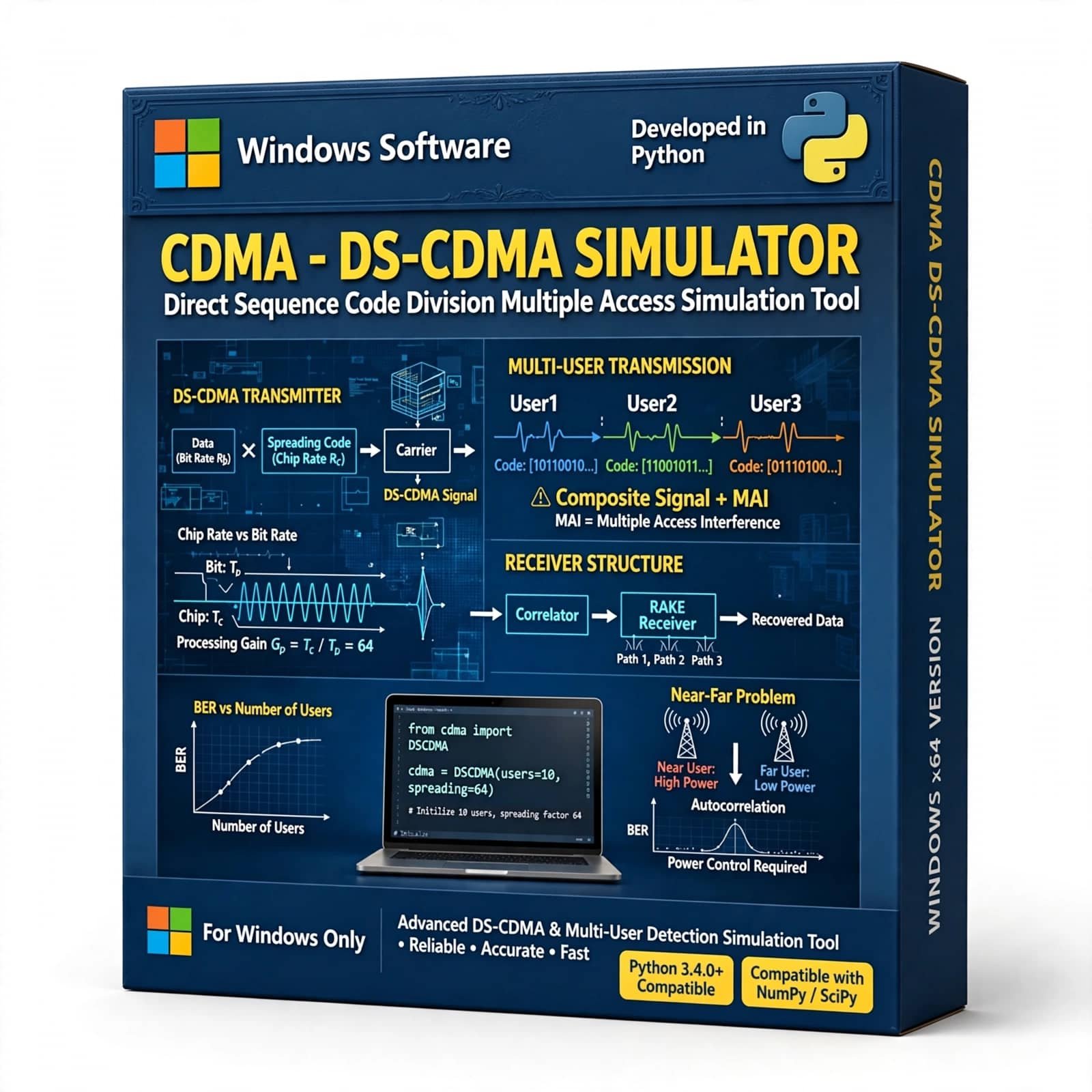
The CDMA DS-CDMA Simulator with Python is a software-based communication simulation tool designed to demonstrate and analyze Direct Sequence Code Division Multiple Access (DS-CDMA) technology. Developed using Python, the simulator provides a practical environment for studying spreading codes, chip sequences, multiple-user communication, signal spreading and despreading, interference, correlation, and transmitted-data recovery. It is suitable for digital communication laboratories, wireless communication education, telecommunications training, student projects, and communication-system research.
Original price was: ₹750.00.₹250.00Current price is: ₹250.00. -
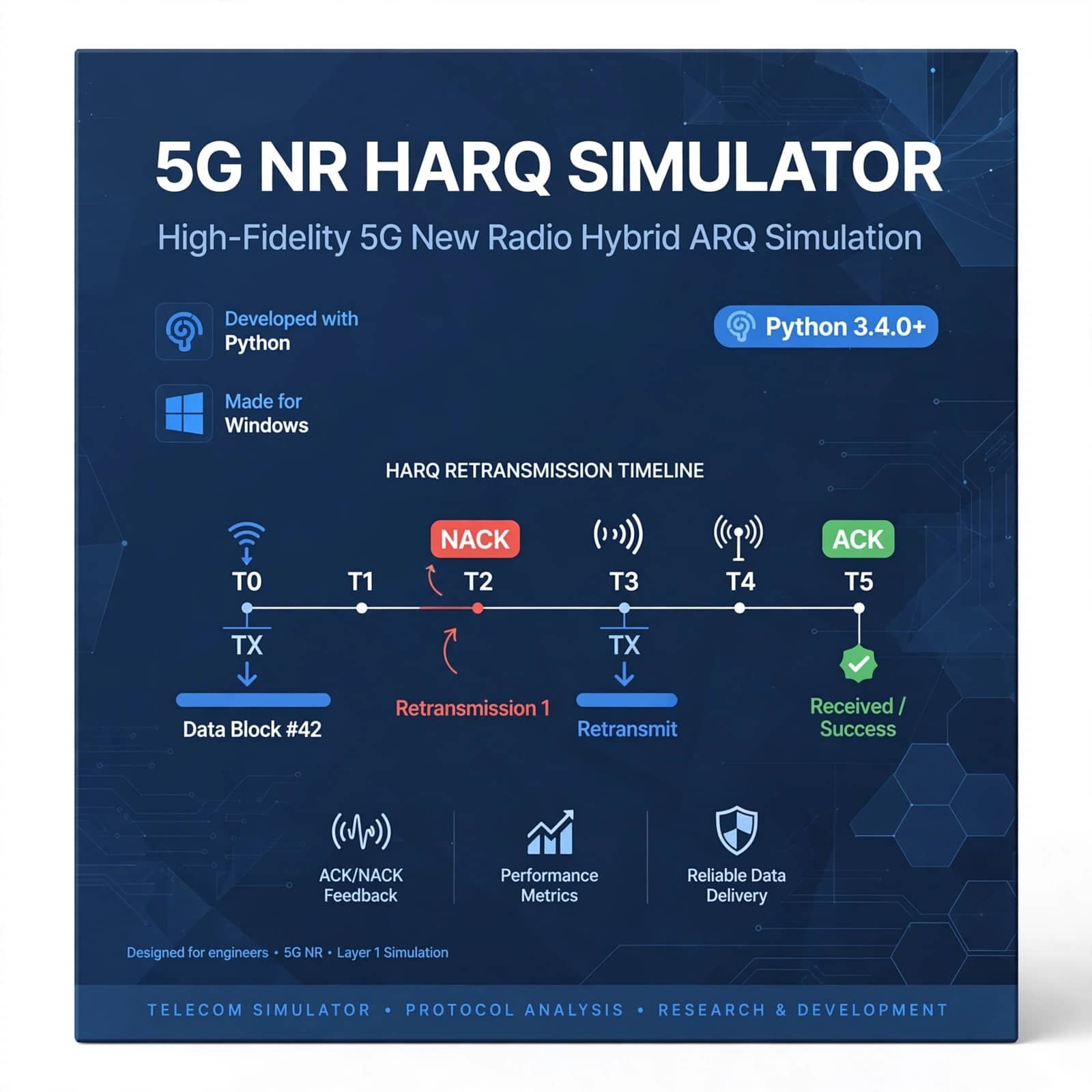
5G NR HARQ Simulator is an advanced simulation solution for modeling and analyzing Hybrid Automatic Repeat Request (HARQ) mechanisms in 5G New Radio networks. It enables users to study HARQ processes, ACK/NACK feedback, retransmissions, link adaptation, channel errors, and communication reliability under configurable network conditions. The simulator supports analysis of throughput, BLER, latency, retransmission rate, packet errors, spectral efficiency, and other key performance metrics, making it suitable for 5G NR research, algorithm development, academic projects, and wireless communication system optimization.
Original price was: ₹750.00.₹250.00Current price is: ₹250.00. -
The 16QAM Modem Simulator is a C++-based software application designed to simulate and analyze a 16-QAM digital communication system. It demonstrates the complete modulation and demodulation process, including symbol mapping, signal generation, transmission, and data recovery. The simulator helps users understand key concepts of digital communication and evaluate system performance under different channel conditions.
Original price was: ₹750.00.₹250.00Current price is: ₹250.00. -
5G NR MAC Resource Scheduler Simulator is an advanced simulation solution for modeling and analyzing Medium Access Control (MAC) layer resource scheduling in 5G New Radio networks. It enables users to evaluate dynamic resource allocation, multi-UE scheduling, uplink and downlink resource management, QoS-aware scheduling, traffic conditions, and scheduling algorithms. The simulator supports analysis of throughput, latency, fairness, spectral efficiency, resource utilization, packet loss, and QoS performance, making it ideal for 5G NR research, scheduler algorithm development, academic projects, and wireless network optimization.
Original price was: ₹750.00.₹250.00Current price is: ₹250.00.

Reviews
There are no reviews yet.