
New
67% Off

Cell Coverage Simulator
Original price was: ₹750.00.₹250.00Current price is: ₹250.00.
In StockCell Coverage Simulator is a wireless communication simulation tool designed to model and analyze cellular network coverage using Python. It helps students, researchers, and telecom professionals visualize cell coverage, signal propagation, coverage areas, and network planning concepts through practical simulation and analysis.
Description
Cell Coverage Simulator
The Cell Coverage Simulator is a practical and flexible simulation tool designed to help students, researchers, educators, and telecommunications professionals understand and analyze cellular network coverage using Python. It provides a simulation environment for studying how cellular signals propagate across a geographical area and how factors such as transmitter location, coverage radius, signal strength, and network configuration influence overall cell coverage.
Cellular network planning is an important part of modern wireless communication. Before deploying a base station or cellular network, engineers need to understand the expected coverage area and identify regions where signal strength may be insufficient. A cell coverage simulation provides an efficient way to study these scenarios without requiring an actual network deployment.
The Cell Coverage Simulator Python offers a practical approach to learning and experimenting with fundamental cellular communication and wireless network planning concepts.
Understand Cellular Network Coverage
A cellular network divides a geographical region into multiple coverage areas, commonly represented as cells. Each cell is served by a base station or cell site that communicates with mobile users within its coverage area. The size and quality of a cell can depend on several parameters, including transmitter characteristics, propagation conditions, antenna configuration, and distance from the base station.
With the Python Cell Coverage Simulator, users can model cellular coverage and observe how changes in network parameters affect the simulated coverage area. This makes it easier to understand concepts that can otherwise be difficult to visualize through theoretical calculations alone.
The simulator can be used to explore cell radius, coverage regions, base station placement, signal distribution, overlapping coverage, and cellular network planning.
Key Features and Simulation Capabilities
The simulator can provide a convenient environment for experimenting with cellular coverage models and analyzing different network scenarios. Depending on the implementation and configured simulation parameters, users can study:
- Cellular coverage area simulation
- Base station and cell-site placement
- Cell radius and coverage distance
- Signal strength distribution
- Wireless signal propagation
- Coverage area visualization
- Multiple-cell network scenarios
- Overlapping cellular coverage
- Coverage gaps and weak-signal regions
- Cellular network planning concepts
- Effect of changing simulation parameters
- Python-based wireless communication modeling
By adjusting simulation inputs, users can compare different network configurations and gain a better understanding of how cellular infrastructure can be designed to provide effective coverage.
Python-Based Cellular Network Simulation
One of the key advantages of the Cell Coverage Simulator Python is its association with the Python programming environment. Python is widely used in engineering education, scientific computing, data analysis, and research because of its flexibility and extensive ecosystem.

A Python-based cell coverage simulation can help learners connect wireless communication theory with programming and computational analysis. Students can study cellular network concepts while also gaining practical experience in developing or modifying simulation models.
This makes the simulator suitable for academic projects involving Python programming, wireless communication, mobile communication, telecommunications, network simulation, and signal propagation.
Useful for Wireless Communication Education
The Cell Coverage Simulator Python can be used in engineering colleges, universities, telecommunications laboratories, research institutions, and technical training environments. It can support classroom demonstrations, laboratory exercises, academic projects, final-year projects, and research experiments.
Students can use the simulator to visualize cellular coverage instead of relying solely on equations or static diagrams. By modifying parameters and comparing simulation results, they can develop a more intuitive understanding of how cellular networks operate.
The simulator is especially useful for courses and laboratory work related to:
- Mobile communication
- Wireless communication
- Cellular networks
- Telecommunication engineering
- Digital communication
- Network planning
- Signal propagation
- Python programming
- Wireless network simulation
Study Cellular Network Planning
Effective network planning requires careful consideration of where base stations should be located and how their coverage areas interact. A poorly planned network can result in coverage holes, excessive overlap, or inefficient use of infrastructure.
The Cell Coverage Simulator allows users to experiment with different cell configurations and study their potential impact on coverage. Users can evaluate how changing the number or location of cells may alter the overall network coverage.
This simulation-based approach can be valuable for demonstrating the basic principles behind cellular network planning and optimization in an academic or research environment.
Visualize Coverage Areas
Visualization is an important benefit of cellular coverage simulation. Representing coverage areas graphically can make it easier to identify the relationship between base station locations and the regions they serve.
The simulator can help users visualize individual cells as well as multiple-cell arrangements, making concepts such as adjacent coverage, overlapping areas, and coverage gaps easier to understand.
For students, this visual approach can improve learning and make laboratory demonstrations more interactive. For researchers and developers, it can provide a useful starting point for testing different simulation scenarios and network configurations.
Benefits of Cell Coverage Simulation
Using a simulation tool allows users to perform experiments without the cost and complexity associated with physical cellular infrastructure. Network scenarios can be modified and tested repeatedly, allowing users to compare different configurations efficiently.
The Cell Coverage Simulator Python can help users:
- Understand cellular network coverage principles.
- Learn the fundamentals of cell planning.
- Visualize simulated coverage regions.
- Study base station placement.
- Analyze the effect of changing cell parameters.
- Identify potential coverage gaps.
- Experiment with multiple-cell configurations.
- Connect Python programming with wireless communication.
- Support academic and final-year projects.
- Demonstrate wireless network concepts in laboratories.
- Develop practical knowledge of telecommunications simulation.
Ideal for Academic Projects and Research
The simulator is well suited for students working on wireless communication projects, cellular network projects, Python-based engineering projects, and telecommunications research. It can be used as a foundation for exploring more advanced topics such as propagation models, network optimization, interference analysis, handover planning, and coverage enhancement.
Researchers can also extend a Python-based simulation environment by incorporating additional parameters, algorithms, visualization methods, or network models according to their project requirements.
Conclusion
The Cell Coverage Simulator Python provides a practical way to explore and understand cellular network coverage, wireless signal propagation, and basic network planning concepts. By combining cellular communication principles with Python-based simulation, it enables students, educators, researchers, and telecommunications professionals to experiment with different coverage scenarios and visualize their results.
Whether used for a wireless communication laboratory, mobile communication course, Python project, academic demonstration, final-year engineering project, or telecommunications research, the Cell Coverage Simulator Python offers an effective simulation-based approach to studying cellular network coverage and planning.
Related products
-
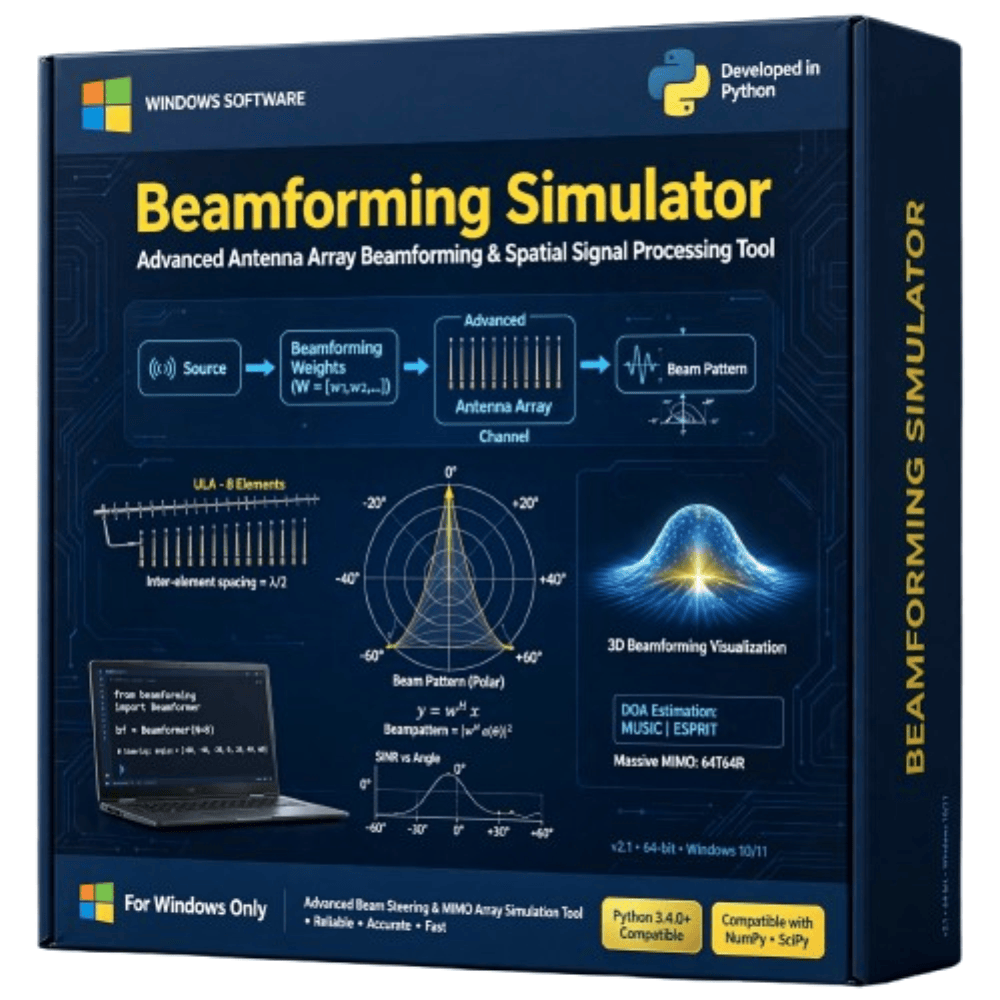
The Beamforming Simulator is a practical wireless communication simulation project designed to demonstrate how antenna arrays can control and direct radio-frequency signals toward desired users or directions. The simulator helps visualize beam patterns, signal direction, antenna-array behavior, and beam steering under different parameters. It is suitable for studying beamforming, antenna arrays, MIMO, 5G communication, wireless networks, and signal processing. This project is ideal for engineering students, researchers, and learners working on wireless communication and advanced antenna technologies.
Original price was: ₹750.00.₹250.00Current price is: ₹250.00. -
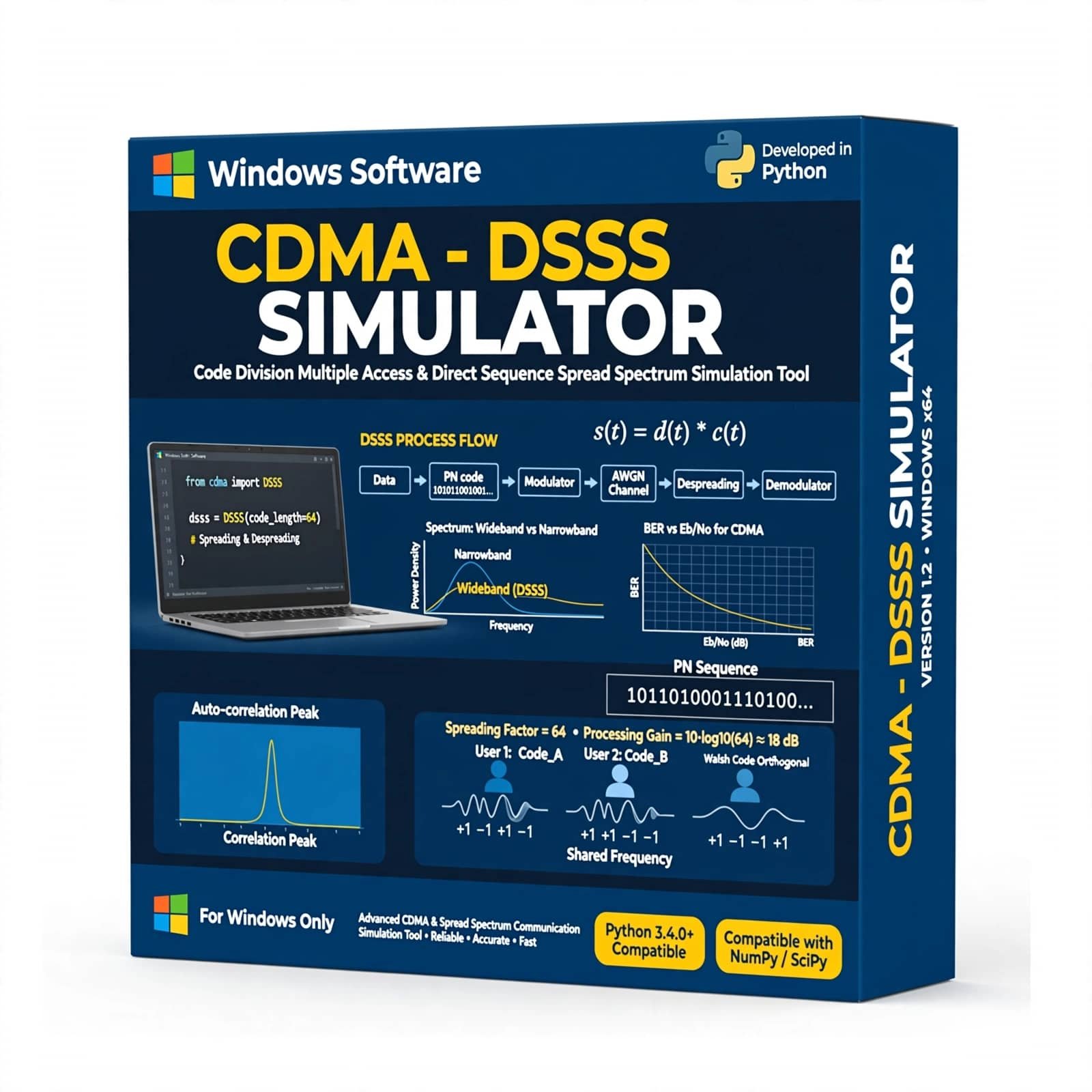
The CDMA – DSSS Simulator with Python is a software-based communication simulation tool designed to demonstrate and analyze Code Division Multiple Access (CDMA) and Direct Sequence Spread Spectrum (DSSS) techniques. Developed using Python, the simulator provides a practical environment for studying spreading codes, signal spreading and despreading, data transmission, multiple-access communication, interference, and signal recovery. It is ideal for digital communication and wireless communication laboratories, engineering education, student projects, technical training, and communication-system research.
Original price was: ₹750.00.₹250.00Current price is: ₹250.00. -
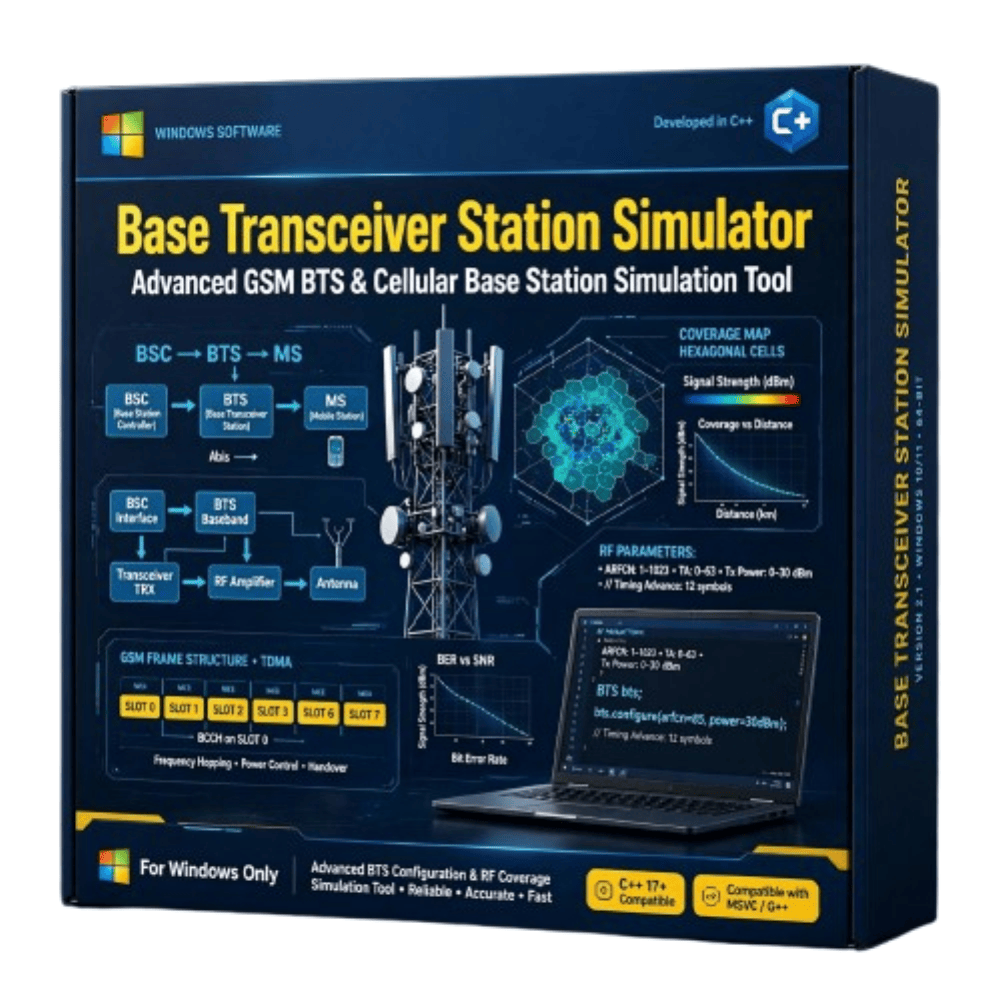
The Base Transceiver Station Simulator Using C++ is a practical cellular communication simulation project designed to demonstrate the basic operation of a BTS in a mobile communication network. Developed using C++, the simulator can model communication between mobile users and a base station, including signal handling, user connectivity, channel allocation, and basic network operations. This BTS Simulator project is suitable for engineering students, researchers, and learners working on GSM, wireless communication, cellular networks, and C++ programming projects.
Original price was: ₹750.00.₹250.00Current price is: ₹250.00. -
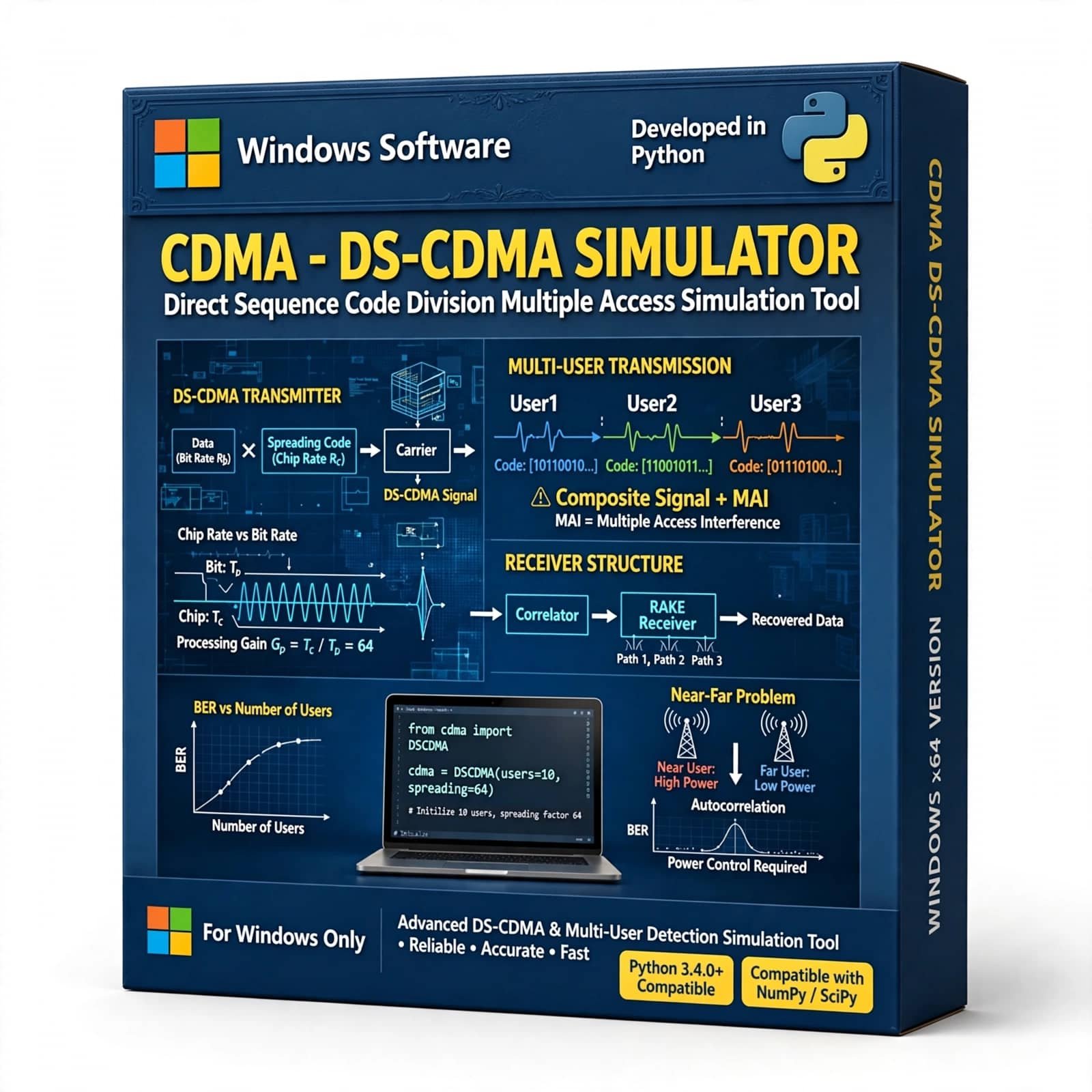
The CDMA DS-CDMA Simulator with Python is a software-based communication simulation tool designed to demonstrate and analyze Direct Sequence Code Division Multiple Access (DS-CDMA) technology. Developed using Python, the simulator provides a practical environment for studying spreading codes, chip sequences, multiple-user communication, signal spreading and despreading, interference, correlation, and transmitted-data recovery. It is suitable for digital communication laboratories, wireless communication education, telecommunications training, student projects, and communication-system research.
Original price was: ₹750.00.₹250.00Current price is: ₹250.00. -
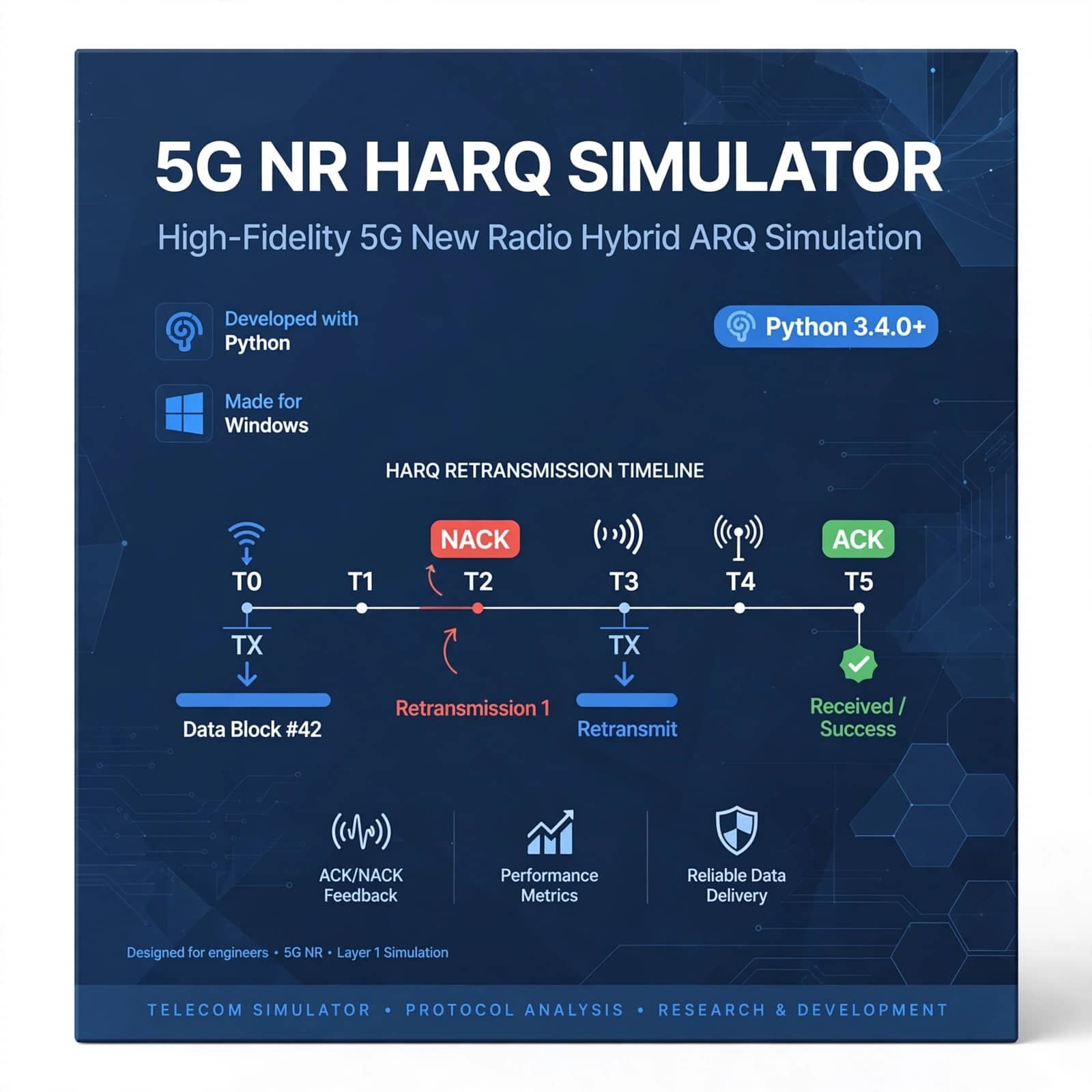
5G NR HARQ Simulator is an advanced simulation solution for modeling and analyzing Hybrid Automatic Repeat Request (HARQ) mechanisms in 5G New Radio networks. It enables users to study HARQ processes, ACK/NACK feedback, retransmissions, link adaptation, channel errors, and communication reliability under configurable network conditions. The simulator supports analysis of throughput, BLER, latency, retransmission rate, packet errors, spectral efficiency, and other key performance metrics, making it suitable for 5G NR research, algorithm development, academic projects, and wireless communication system optimization.
Original price was: ₹750.00.₹250.00Current price is: ₹250.00. -
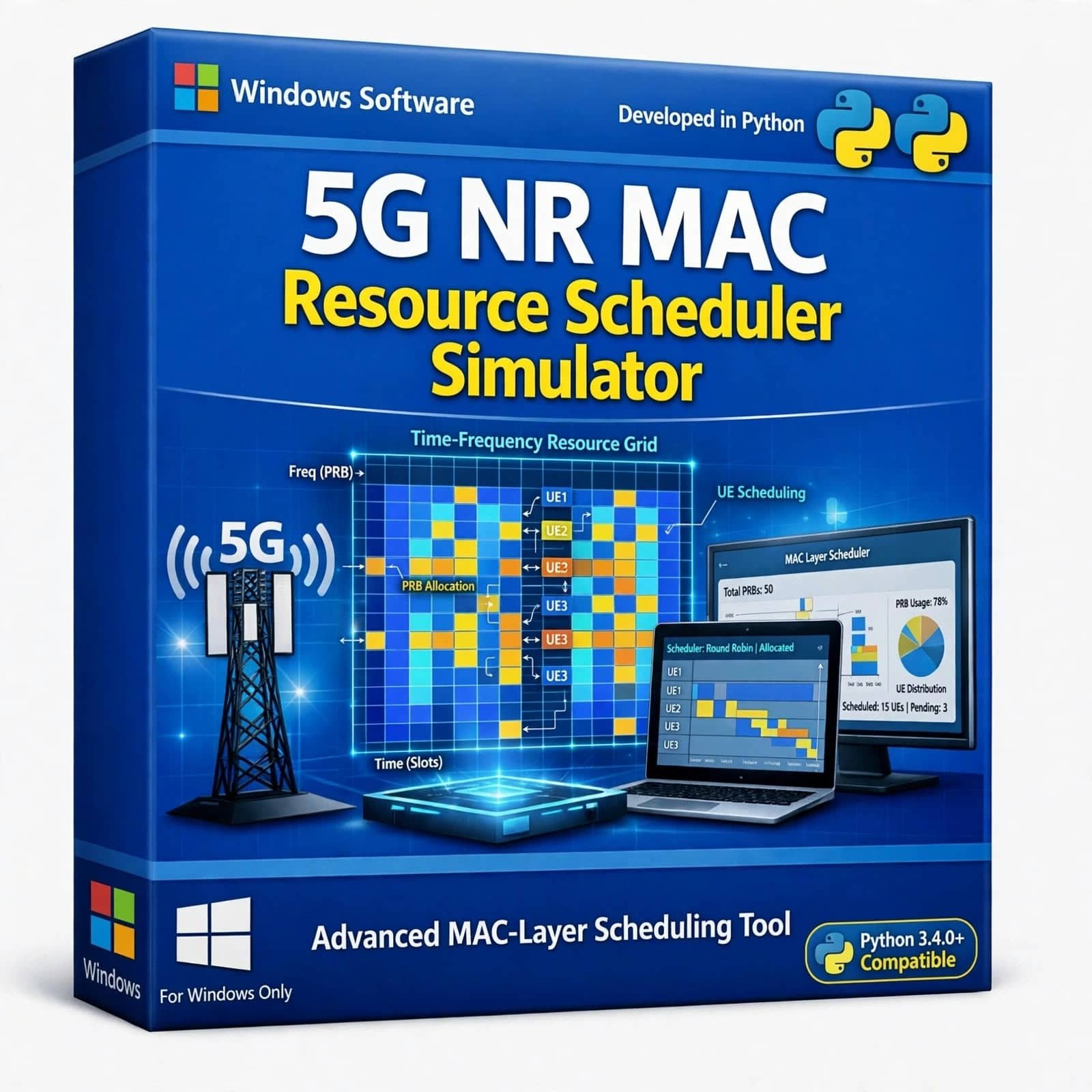
5G NR MAC Resource Scheduler Simulator is an advanced simulation solution for modeling and analyzing Medium Access Control (MAC) layer resource scheduling in 5G New Radio networks. It enables users to evaluate dynamic resource allocation, multi-UE scheduling, uplink and downlink resource management, QoS-aware scheduling, traffic conditions, and scheduling algorithms. The simulator supports analysis of throughput, latency, fairness, spectral efficiency, resource utilization, packet loss, and QoS performance, making it ideal for 5G NR research, scheduler algorithm development, academic projects, and wireless network optimization.
Original price was: ₹750.00.₹250.00Current price is: ₹250.00.

Reviews
There are no reviews yet.