
New
67% Off

Rician Fading Simulator
Original price was: ₹750.00.₹250.00Current price is: ₹250.00.
In StockRician Fading Simulator with Python is a wireless communication simulation tool designed for analyzing Rician fading channels, line-of-sight propagation, scattered signal components, and wireless channel behavior. Ideal for students, researchers, engineers, and Python developers, it can be used for Rician K-factor analysis, signal-processing research, communication algorithm testing, wireless channel modeling, and academic projects. The simulator provides a flexible Python-based environment for studying the impact of Rician fading on wireless communication systems.
Description
Rician Fading Simulator
The Rician Fading Simulator with Python is a powerful wireless communication simulation tool designed for analyzing Rician fading channels, wireless signal propagation, channel variations, and communication performance. It is suitable for students, researchers, communication engineers, Python developers, and professionals working on wireless communication, digital signal processing, RF systems, and wireless channel modeling.
Rician fading is an important channel model used when a wireless communication system has a dominant line-of-sight (LOS) component in addition to multiple reflected, scattered, or non-line-of-sight signal components. The Rician Fading Simulator provides an effective environment for studying these channel conditions and understanding how fading affects transmitted and received signals.
With Python-based implementation, users can configure simulation parameters, generate Rician fading channel conditions, analyze signal behavior, and evaluate communication performance. Python provides a flexible and accessible programming environment for scientific computing, signal processing, data analysis, and wireless communication research.
Rician Fading Channel Simulation
The simulator is designed to model the behavior of wireless signals passing through a Rician fading channel. Unlike a purely scattered fading environment, the Rician model includes a dominant signal component, making it useful for representing communication scenarios where a direct or strong propagation path exists.
Rician fading models are commonly studied in wireless communication systems, including mobile communications, satellite links, microwave communication, wireless networks, and other systems where a line-of-sight component may be present.
By using the simulator, users can experiment with different channel conditions and observe how fading influences signal quality and communication performance.

Python-Based Wireless Communication Simulation
The Rician Fading Simulator with Python is particularly useful for developers and researchers who use Python for wireless communication and signal-processing applications. Python makes it possible to combine channel simulation with numerical analysis, visualization, data processing, and custom communication algorithms.
Users can integrate the simulator into Python-based workflows for testing communication concepts, evaluating channel behavior, developing research prototypes, and analyzing wireless system performance.
Python is also widely used in academic and engineering environments, making this simulator suitable for classroom demonstrations, laboratory exercises, research projects, and wireless communication experimentation.
Analyze Rician Fading and Channel Effects
A wireless signal can experience variations in amplitude and phase as it travels through an environment containing reflections, scattering, and other propagation effects. Rician fading provides a useful mathematical model for environments where a strong signal path exists along with scattered components.
The simulator allows users to study these effects and better understand the relationship between channel characteristics and received signal behavior.
The Rician K-factor is an important parameter when analyzing Rician fading. It represents the relationship between the power of the dominant line-of-sight component and the power of the scattered components. Changing the K-factor allows users to investigate different channel conditions and observe how the fading characteristics change.

Suitable for Wireless Communication Research
The Rician Fading Simulator can be used as part of wireless communication research and development workflows. Engineers and researchers can use simulated channel conditions to test communication algorithms before deploying them in real-world environments.
It can support studies involving channel modeling, signal propagation, fading analysis, communication performance, digital communication systems, and wireless signal processing.
Simulation also provides a cost-effective way to investigate different channel conditions without requiring physical wireless hardware for every experiment.
Educational and Academic Applications
The simulator is an excellent resource for students studying wireless communication, digital communications, RF engineering, signal processing, and telecommunications.
Students can use it to understand the theoretical concepts behind Rician fading and observe how channel conditions influence wireless signals. Researchers and educators can also use simulation results for laboratory exercises, demonstrations, assignments, and communication-system experiments.
The Python environment makes it easier to modify parameters, automate experiments, process simulation data, and create customized analysis workflows.
Applications of Rician Fading Simulator
The Rician Fading Simulator with Python can be used for:
- Rician fading channel simulation
- Wireless channel modeling
- Line-of-sight communication analysis
- Wireless signal fading studies
- Digital communication research
- RF and telecommunications research
- Python-based signal processing
- Wireless system performance evaluation
- Communication algorithm testing
- Channel characterization
- Academic and engineering projects
- Mobile communication research
- Satellite communication studies
- Wireless network simulation
- Signal propagation analysis

Key Features
- Python-based Rician fading simulation
- Rician wireless channel modeling
- Analysis of line-of-sight and scattered signal components
- Rician K-factor analysis
- Wireless signal fading evaluation
- Suitable for digital communication research
- Useful for signal-processing applications
- Python development and experimentation support
- Suitable for academic and engineering projects
- Useful for wireless communication algorithm testing
- Supports repeatable simulation-based analysis
Why Choose a Rician Fading Simulator with Python?
The Rician Fading Simulator with Python provides a practical way to understand and analyze one of the important wireless channel models used in communication-system studies. By combining Rician channel modeling with Python’s flexible development environment, users can experiment with wireless propagation conditions, analyze fading behavior, and incorporate simulation results into broader communication-system workflows.
Whether you are a student learning wireless communication, a researcher developing a channel model, or an engineer testing a wireless communication algorithm, this simulator provides a flexible platform for Rician fading analysis, wireless channel simulation, and Python-based communication research.
The simulator can help bridge the gap between theoretical wireless communication concepts and practical simulation by allowing users to study the effects of Rician fading in a controlled software environment.
Related products
-
5G NR Massive MIMO Simulator is an advanced simulation solution for modeling and analyzing Massive Multiple-Input Multiple-Output (MIMO) technologies in 5G New Radio networks. It enables users to study large-scale antenna arrays, beamforming, precoding, spatial multiplexing, multi-user MIMO, channel estimation, and interference under configurable channel conditions. The simulator supports analysis of throughput, spectral efficiency, SINR, BER, BLER, MIMO capacity, beamforming gain, and multi-user performance, making it ideal for 5G NR research, algorithm development, academic projects, and 5G/6G wireless system optimization.
Original price was: ₹750.00.₹250.00Current price is: ₹250.00. -
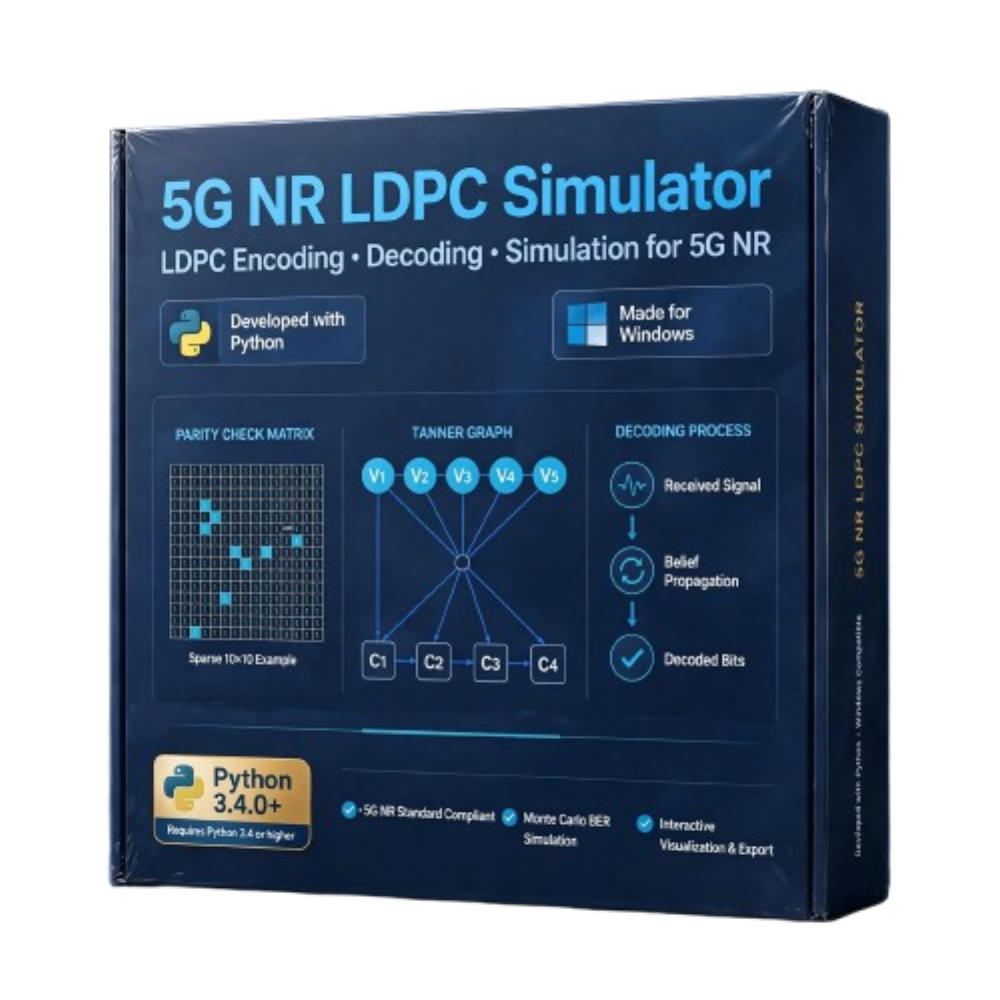
5G NR LDPC Simulator is an advanced simulation solution for modeling and analyzing Low-Density Parity-Check (LDPC) channel coding used in 5G New Radio systems. It enables users to simulate LDPC encoding and decoding, evaluate error correction performance, and analyze BER, BLER, SNR, coding rate, decoding iterations, throughput, and convergence under configurable channel conditions. The simulator is ideal for 5G NR channel coding research, algorithm development, academic projects, decoder performance analysis, and next-generation wireless communication system optimization.
Original price was: ₹750.00.₹250.00Current price is: ₹250.00. -
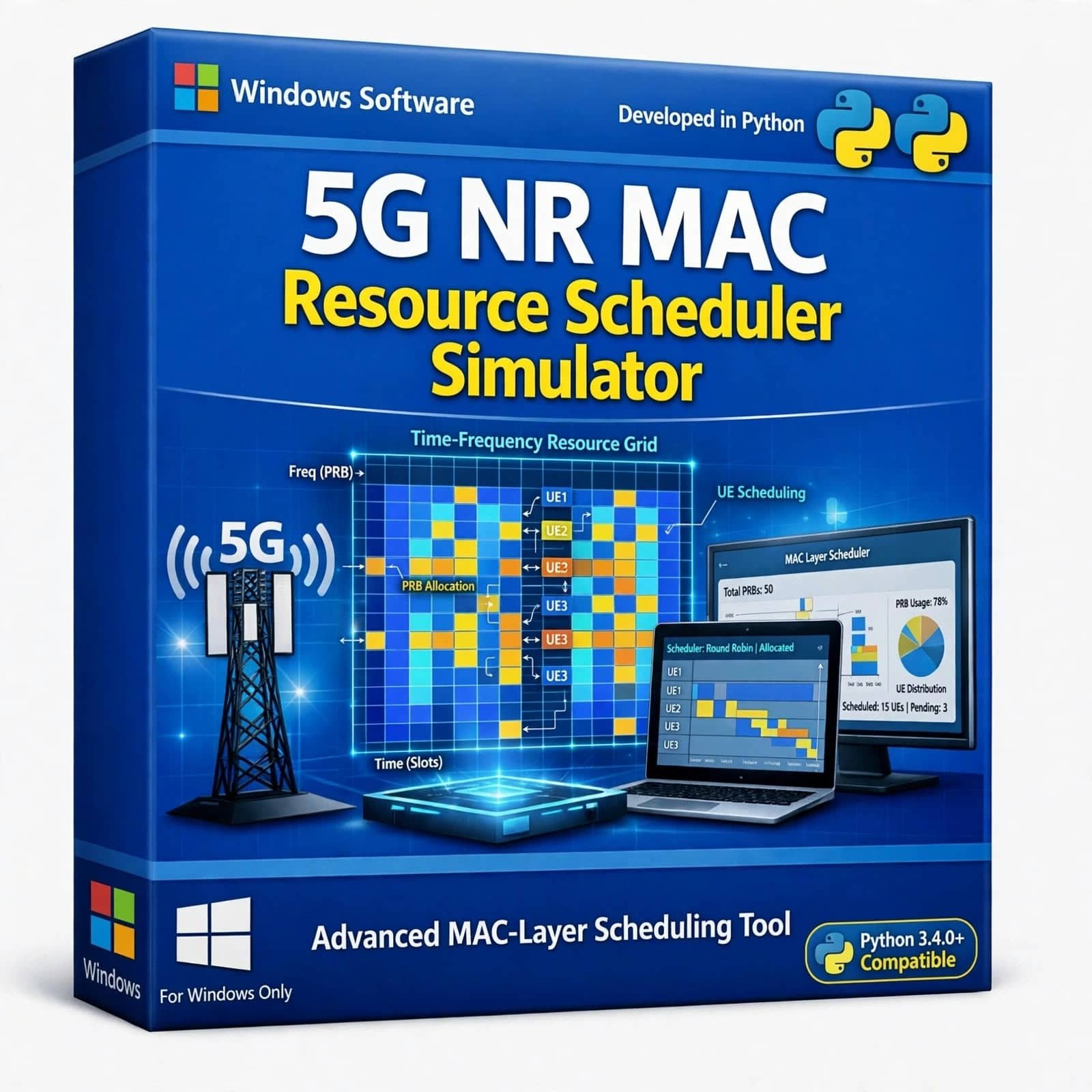
5G NR MAC Resource Scheduler Simulator is an advanced simulation solution for modeling and analyzing Medium Access Control (MAC) layer resource scheduling in 5G New Radio networks. It enables users to evaluate dynamic resource allocation, multi-UE scheduling, uplink and downlink resource management, QoS-aware scheduling, traffic conditions, and scheduling algorithms. The simulator supports analysis of throughput, latency, fairness, spectral efficiency, resource utilization, packet loss, and QoS performance, making it ideal for 5G NR research, scheduler algorithm development, academic projects, and wireless network optimization.
Original price was: ₹750.00.₹250.00Current price is: ₹250.00. -
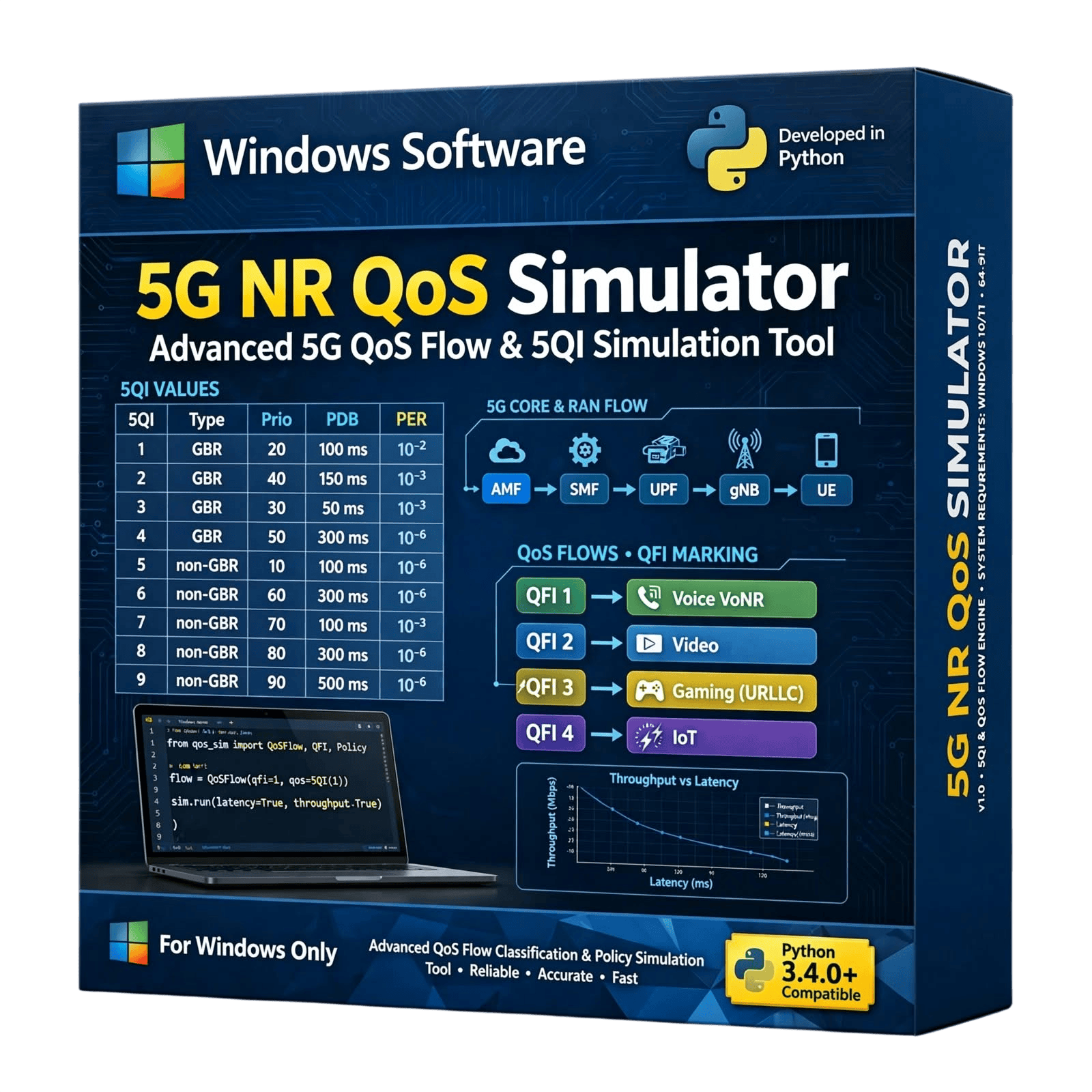
The 5G QoS Simulator is a Python-based software solution designed for researchers, engineers, students, developers, and telecommunications professionals working with 5G Quality of Service (QoS) concepts. The simulator provides a software-based environment for studying and analyzing QoS-related aspects of 5G communication networks, including service performance, traffic behavior, resource management, and network performance evaluation.
Developed using Python, the simulator is suitable for academic research, telecommunications projects, demonstrations, experimentation, algorithm development, and educational applications.
Available for sale as a software product. Contact us for pricing, licensing, features, customization, and purchase information.
Original price was: ₹750.00.₹250.00Current price is: ₹250.00. -
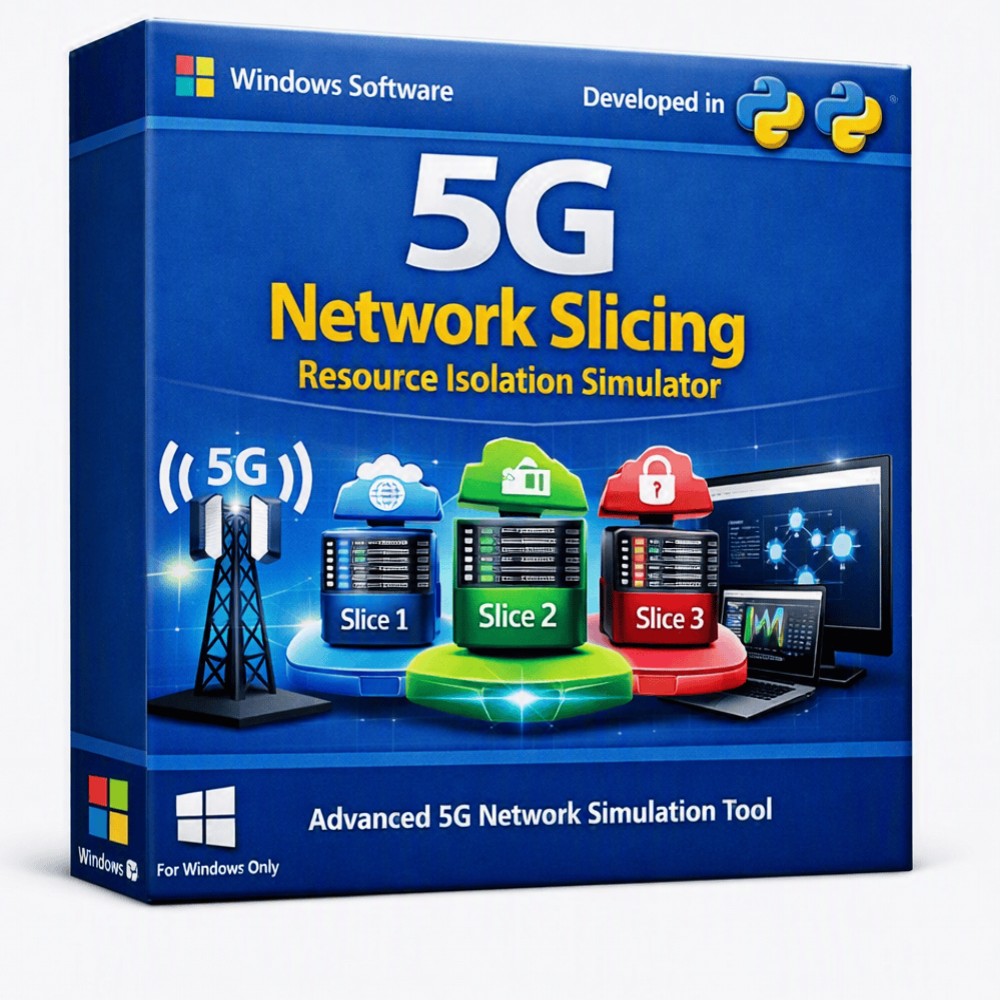
A Python-based 5G Network Slicing and Resource Isolation Simulator designed to model and analyze how multiple logical network slices can share physical 5G infrastructure while maintaining resource isolation. The simulator enables users to study CPU, memory, bandwidth, network capacity, traffic allocation, and resource management across different 5G network slices.
Ideal for 5G research, telecom engineering, academic projects, network optimization, resource allocation studies, and university laboratories.
Original price was: ₹750.00.₹250.00Current price is: ₹250.00. -
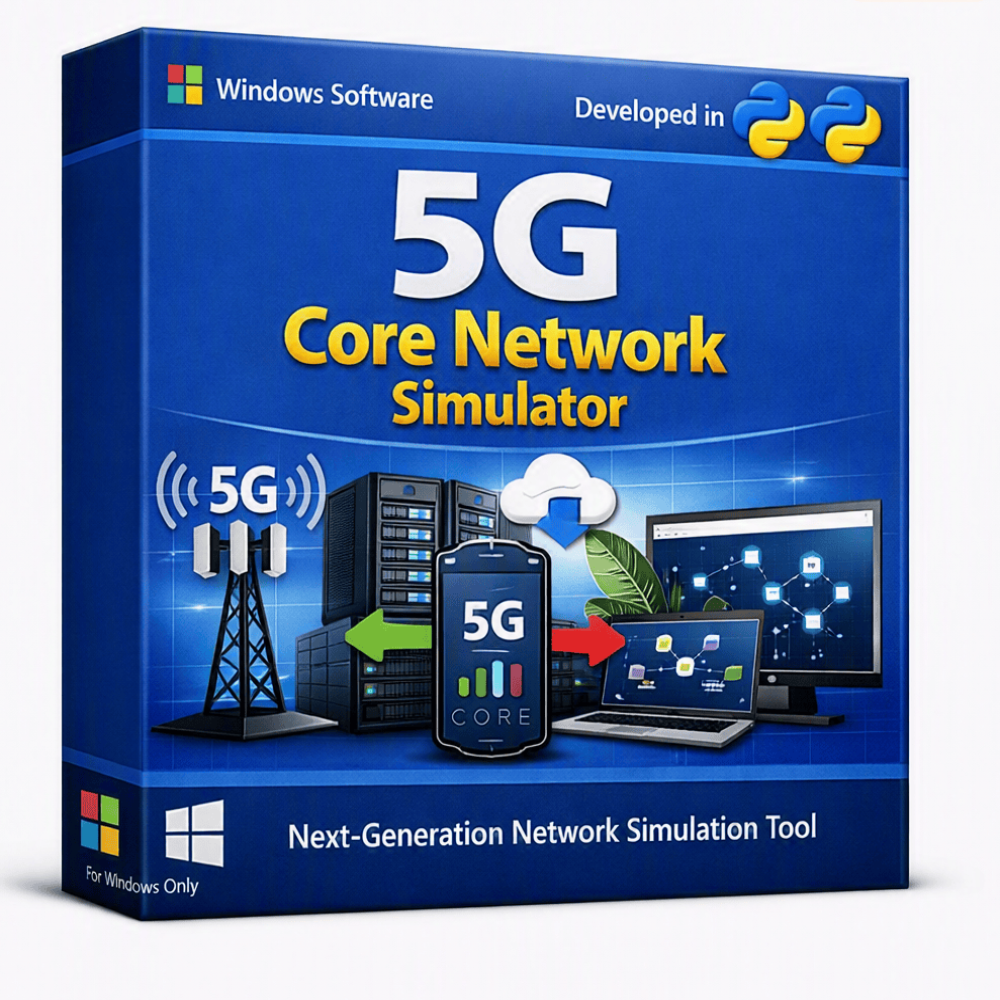
A Python-based 5G Core Network Simulator designed for studying, analyzing, and demonstrating 5G Core network architecture and procedures. Explore key 5G Network Functions such as AMF, SMF, UPF, AUSF, UDM, PCF, NRF, and NSSF, along with UE registration, authentication, session management, mobility, and signaling procedures.
Ideal for 5G research, telecom engineering, academic projects, university laboratories, protocol development, and network simulation. Provides a flexible software environment for experimenting with 5G Core concepts without requiring a complete commercial 5G network infrastructure.
Original price was: ₹750.00.₹250.00Current price is: ₹250.00.



Reviews
There are no reviews yet.