
63% Off

Free-Space Path Loss Simulator

Original price was: ₹1,999.00.₹749.00Current price is: ₹749.00.
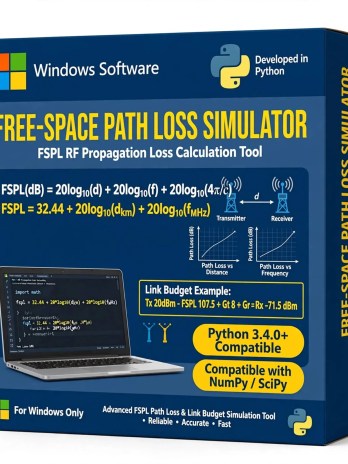
In StockFree-Space Path Loss Simulator is an educational RF and wireless communication simulation tool designed to help students, engineers, researchers, and telecom professionals understand how radio signals lose power as they propagate through free space. It enables users to analyze the impact of frequency, distance, antenna characteristics, and transmission parameters on received signal strength and path loss.
Description
Free-Space Path Loss Simulator
Understanding Free-Space Path Loss Simulator and radio wave propagation and signal attenuation is fundamental to wireless communication, RF engineering, antenna design, satellite communication, and cellular network planning. The Free-Space Path Loss Simulator provides an interactive and practical environment for studying how the strength of a wireless signal changes as the distance between a transmitter and receiver increases.
Based on the Free-Space Path Loss model, the simulator helps users visualize and calculate the amount of signal power lost when an electromagnetic wave travels through unobstructed free space. By changing important RF parameters, users can explore the relationship between frequency, transmission distance, wavelength, path loss, and received power.
The simulator is particularly useful for wireless communication education, RF laboratory exercises, telecom engineering training, antenna studies, and introductory link-budget analysis.
Understand Free-Space Path Loss
Free-space path loss represents the reduction in received signal power caused by the spreading of a radio wave as it travels through free space. It is an important theoretical model used as a starting point for understanding wireless propagation.
The FSPL relationship can be expressed as:
FSPL (dB) = 20 log₁₀(d) + 20 log₁₀(f) + 32.44
when distance is expressed in kilometers and frequency in MHz.
Alternatively, the simulator can be used to explore the same relationship using other commonly used units and formulations.
Through interactive parameter changes, users can observe a fundamental RF engineering principle: path loss increases with distance and frequency. This makes the simulator an effective visual aid for explaining why higher-frequency wireless systems can experience greater free-space path loss for the same propagation distance.
Explore the Effect of Frequency
Frequency has a significant influence on free-space path loss. The FSPL Simulator allows users to experiment with different operating frequencies and observe their effect on signal attenuation.
This is particularly useful when comparing technologies and applications operating at different frequency ranges, such as:
- Wireless LAN and Wi-Fi
- Cellular communication
- 4G and 5G networks
- Microwave links
- Satellite communication
- RF point-to-point systems
- Radio communication
- Antenna and propagation experiments
By adjusting the frequency, learners can develop an intuitive understanding of how RF propagation changes across different parts of the electromagnetic spectrum.
Analyze the Impact of Distance
Distance is another major factor in free-space propagation loss. As the transmitter and receiver become farther apart, the signal spreads over a larger area, resulting in increased path loss.
The simulator provides a convenient way to examine this relationship by changing the transmitter-to-receiver distance and observing the resulting FSPL.
This can help users understand why increasing the range of a wireless link generally requires careful consideration of transmit power, antenna gain, receiver sensitivity, frequency selection, and link budget.
Practical RF and Link-Budget Learning
The FSPL Simulator can also serve as a foundation for learning about wireless link budgets. Path loss is one of the key components considered when estimating the received power of a radio link.
A basic link-budget relationship can be represented as:
Received Power = Transmit Power + Transmit Antenna Gain + Receive Antenna Gain − Path Loss − Other Losses
Using FSPL calculations, students can understand how propagation loss fits into the larger process of determining whether a wireless link has sufficient signal strength.
This makes the simulator useful not only for learning a mathematical formula but also for developing practical RF engineering skills.

Visualize RF Propagation Concepts
One of the biggest advantages of an FSPL simulation environment is the ability to turn an abstract mathematical relationship into an interactive learning exercise.
Instead of manually calculating multiple scenarios, users can change input values and compare results. This makes it easier to investigate questions such as:
- How does doubling the distance affect path loss?
- What happens when the carrier frequency increases?
- How does a long-distance microwave link differ from a short-range wireless link?
- How does antenna gain influence the overall link?
- How much received power remains after free-space propagation loss?
- How does frequency selection affect wireless system planning?
These experiments can make complex RF propagation concepts easier to understand.
Applications of the FSPL Simulator
The Free-Space Path Loss Simulator can be used in a wide range of educational and technical scenarios, including:
- RF engineering courses
- Wireless communication laboratories
- Antenna and propagation studies
- Telecom engineering education
- 4G and 5G network fundamentals
- Microwave communication training
- Satellite communication studies
- Point-to-point wireless link planning
- Link-budget exercises
- Student projects and assignments
- RF research and experimentation
- Classroom demonstrations
Key Benefits
Easy RF Learning: Explore fundamental propagation concepts without requiring physical RF equipment.
Interactive Calculations: Change frequency and distance parameters and immediately investigate their effect on path loss.
Practical Link-Budget Understanding: Learn how free-space path loss contributes to received signal power.
Frequency Analysis: Compare path loss at different operating frequencies.
Distance Analysis: Study the relationship between propagation distance and signal attenuation.
Educational Focus: Suitable for students, educators, researchers, and wireless communication professionals.
RF Engineering Foundation: Build a strong understanding of concepts used in antenna systems, microwave links, cellular networks, and wireless communication.
Why Choose the Free-Space Path Loss Simulator?
The Free-Space Path Loss (FSPL) Simulator provides a straightforward way to connect the mathematical theory of electromagnetic propagation with practical wireless communication concepts. By experimenting with frequency and distance, users can see how fundamental propagation parameters influence signal loss.
It is an excellent learning tool for anyone studying RF communication, wireless networks, antenna engineering, microwave systems, satellite links, or telecom network planning.
Whether you are a student learning the fundamentals of radio propagation, an instructor demonstrating FSPL calculations, or an engineer reviewing basic wireless link-budget concepts, the simulator provides a convenient environment for exploring free-space path loss and RF signal attenuation
Related products
-
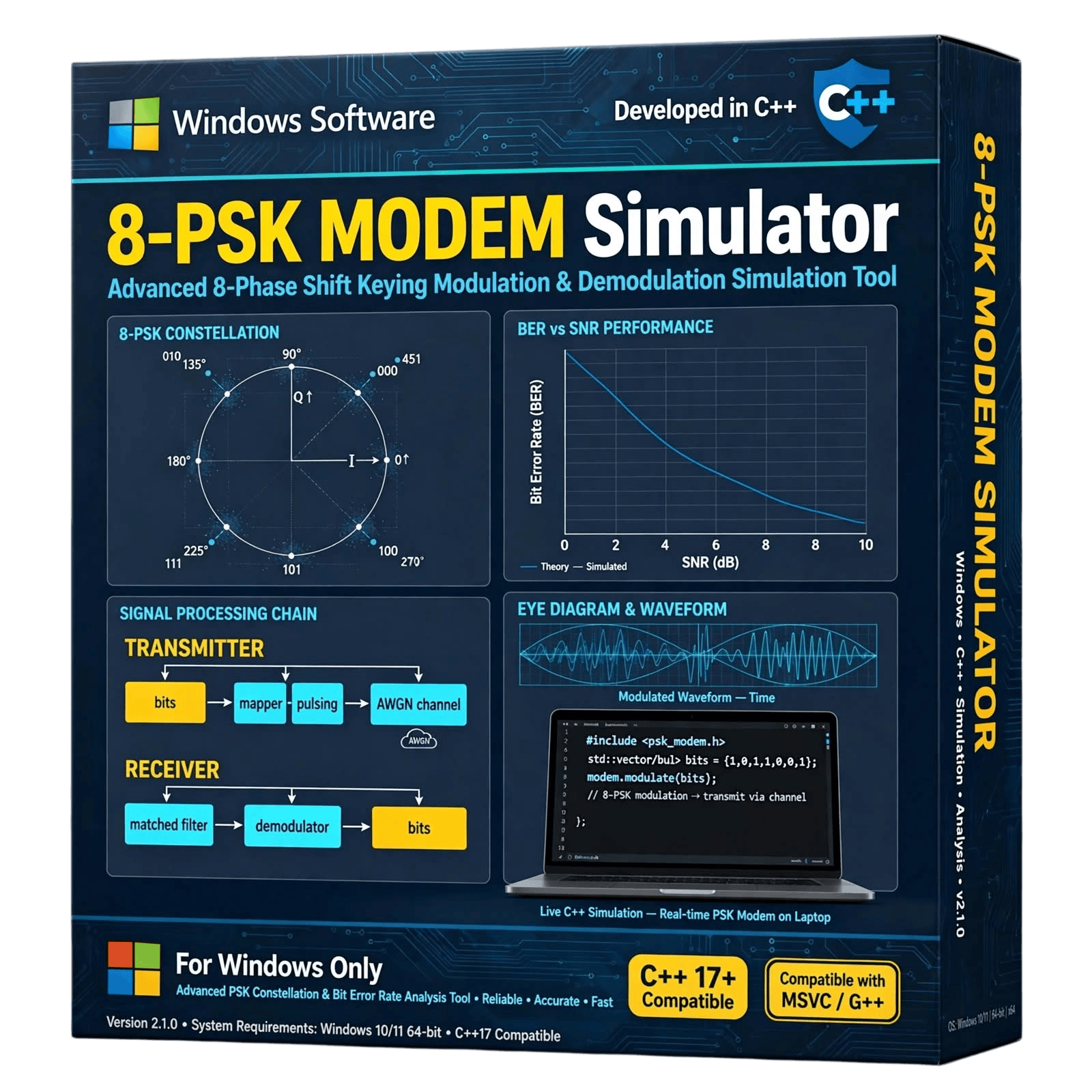
The 8-PSK Modem Simulator is a C++-based software solution designed for students, researchers, communication engineers, developers, and academic institutions working with digital communication and modulation techniques. The simulator provides a practical environment for studying 8-Phase Shift Keying (8-PSK) modulation and demodulation concepts.
Developed using C++, the simulator can be used for digital communication research, academic projects, laboratory demonstrations, signal-processing studies, experimentation, and educational purposes.
Available for sale as a software product. Contact us for pricing, licensing, technical specifications, customization, and purchase information.
₹1,999.00 -
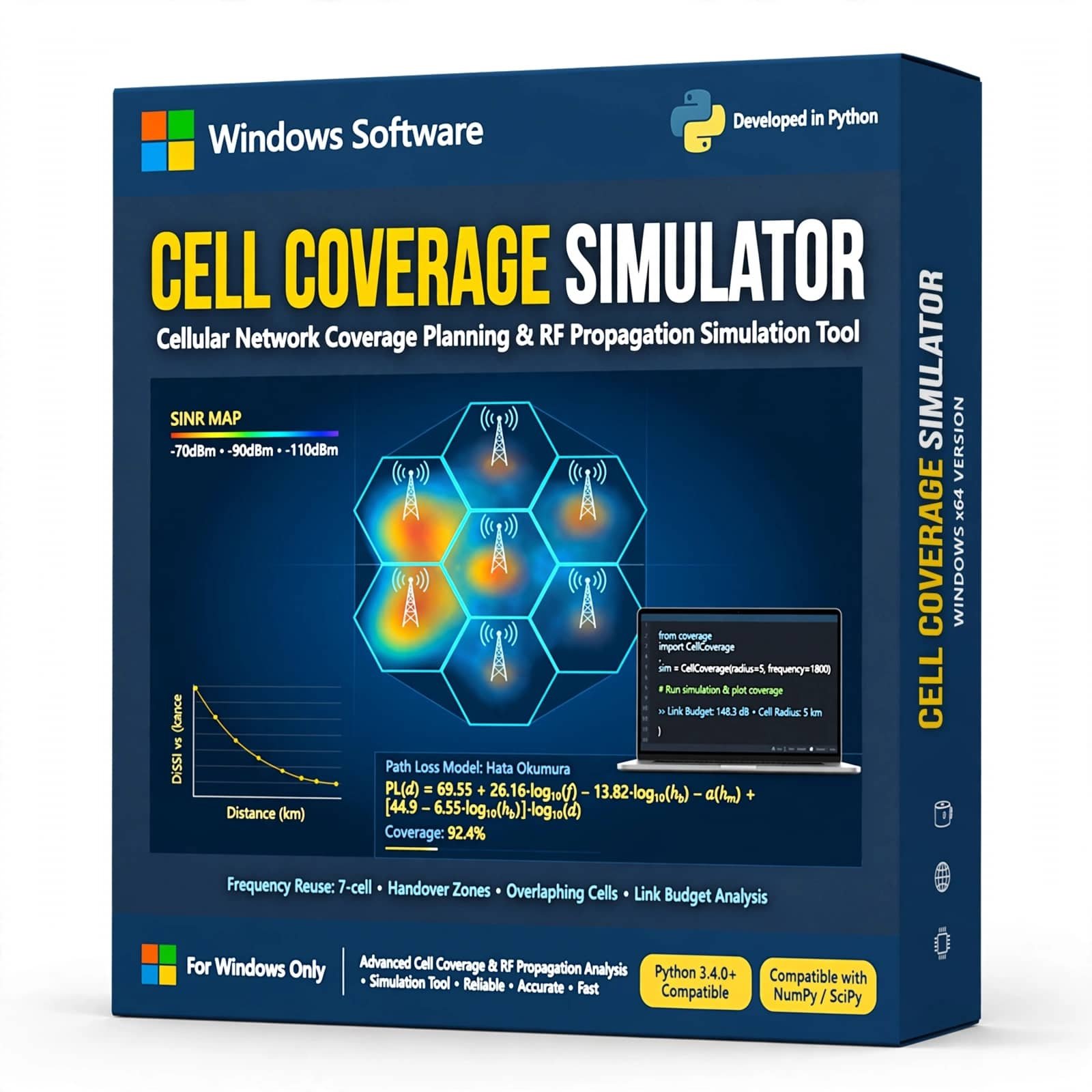
Cell Coverage Simulator is a wireless communication simulation tool designed to model and analyze cellular network coverage using Python. It helps students, researchers, and telecom professionals visualize cell coverage, signal propagation, coverage areas, and network planning concepts through practical simulation and analysis.
₹6,999.00 -
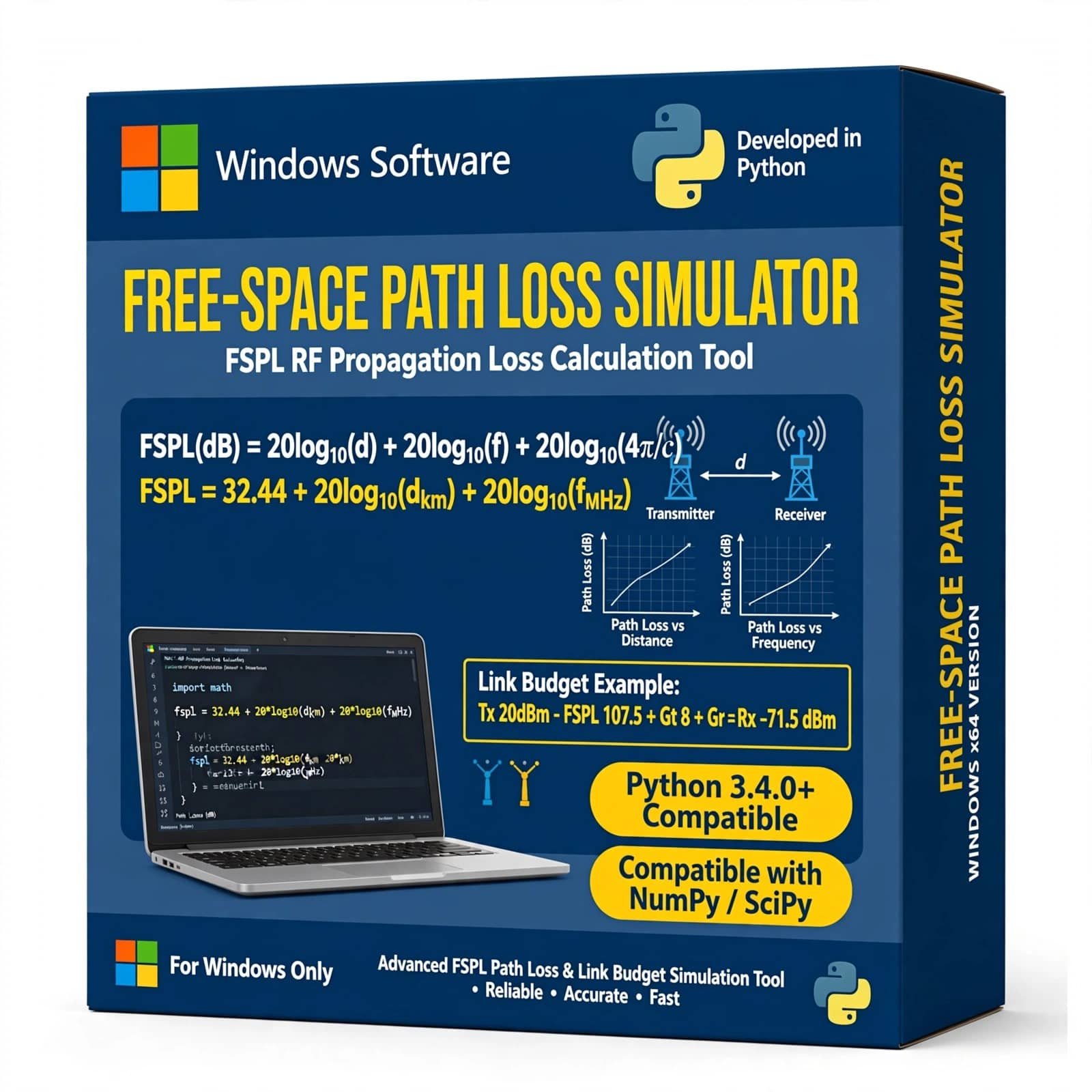
Free Space Path Loss Simulator Using Python is a practical wireless communication simulation project designed to calculate and visualize signal power loss as a radio wave travels through free space. Developed using Python, this simulator helps students, researchers, and communication engineers understand Free Space Path Loss (FSPL), transmission distance, frequency, received signal power, and wireless link performance.
The project provides an easy-to-understand simulation environment for analyzing how distance and operating frequency affect signal propagation. It is suitable for B.Tech, M.Tech, engineering students, academic projects, wireless communication studies, RF analysis, and Python-based simulation projects.
₹1,999.00 -
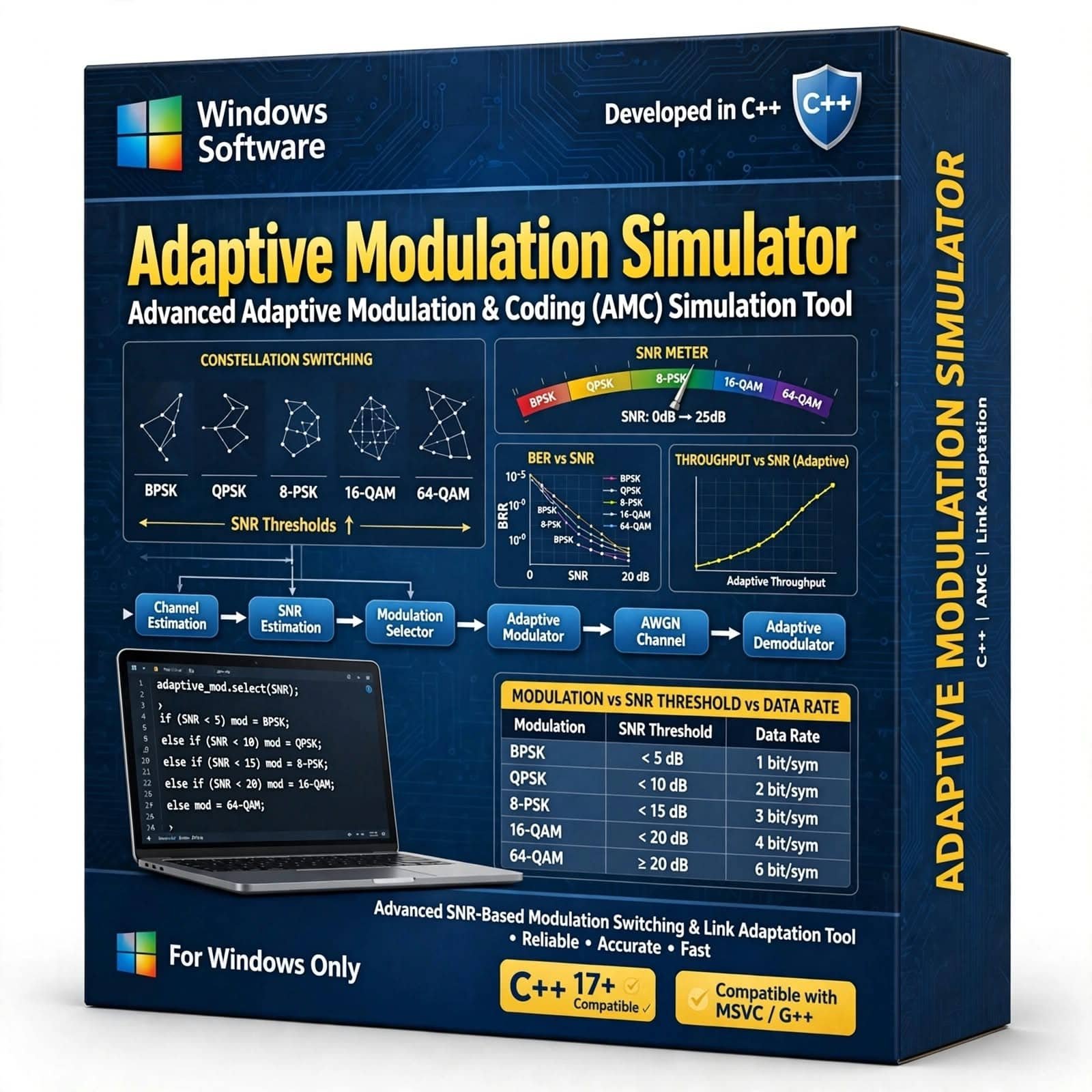
The Adaptive Modulation Simulator is a C++-based software solution designed for students, researchers, engineers, developers, and telecommunications professionals working with digital communication and adaptive modulation techniques. The simulator provides a practical environment for studying how modulation schemes can be selected or adapted according to communication-system conditions.
Developed using C++, the simulator is suitable for academic projects, digital communication research, laboratory demonstrations, signal-processing studies, algorithm development, and educational applications.
Available for sale as a software product. Contact us for pricing, licensing, technical specifications, customization, and purchase information.
₹1,999.00 -
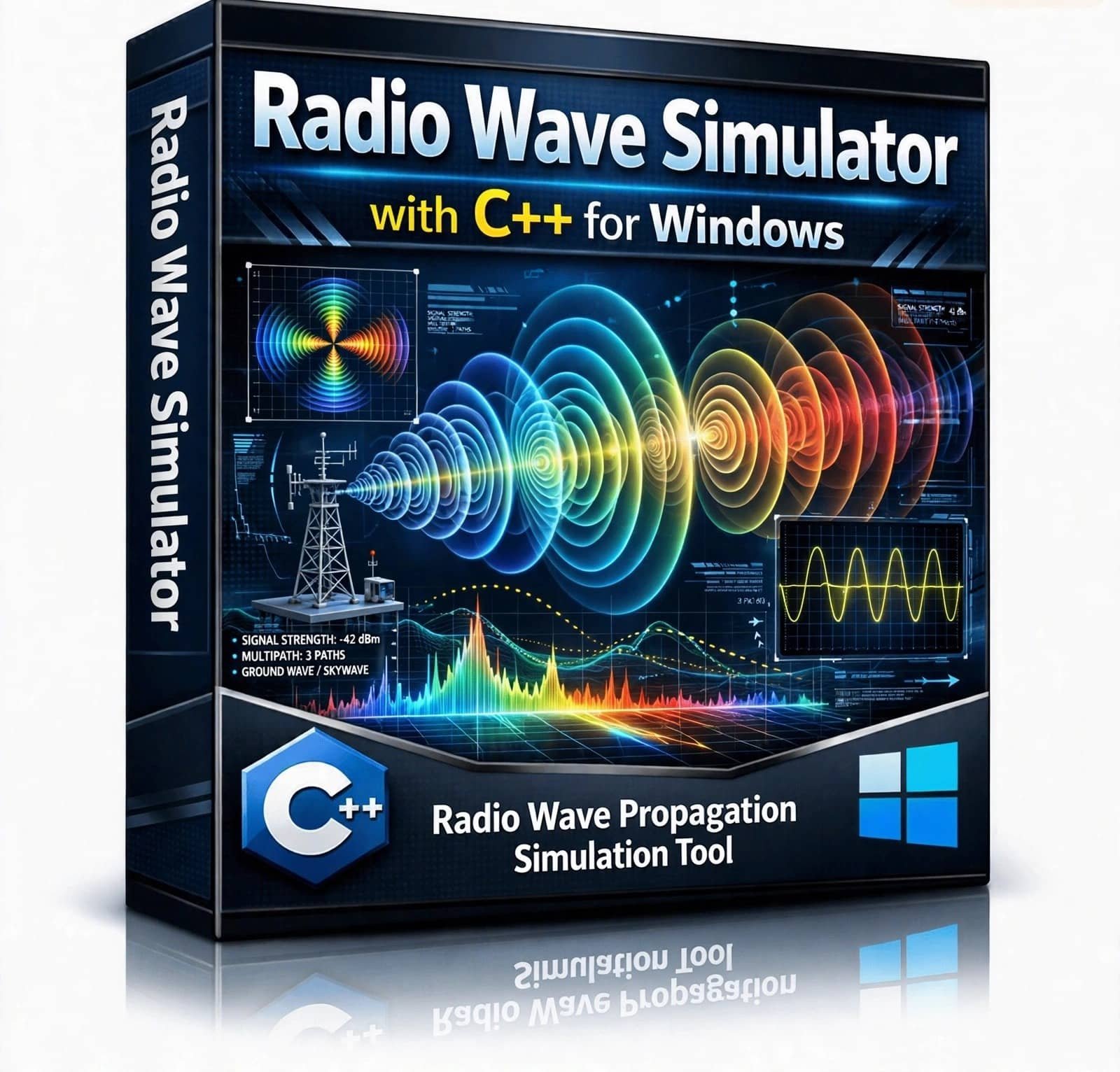
Radio Wave Simulator – Explore and generate a wide range of radio, RF, analog, and digital communication waveforms using this C++-based Radio Wave Simulator. The software is designed for students, researchers, electronics engineers, and communication enthusiasts to visualize and experiment with sine waves, RF signals, AM, FM, PM, ASK, FSK, GSM, and other communication waveforms in a practical simulation environment.
₹1,999.00 -
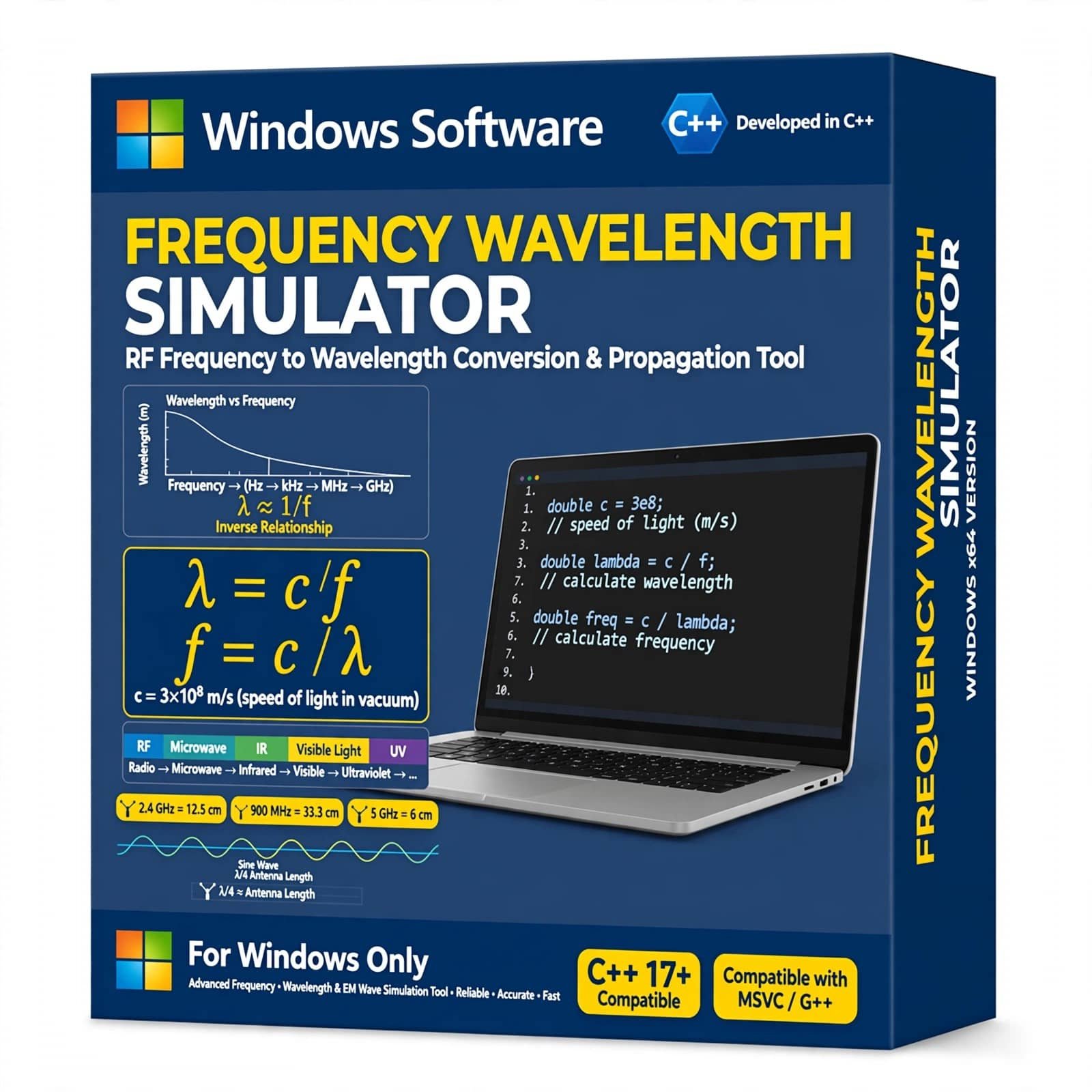
Frequency Wavelength Simulator with C++ is a practical simulation project designed to calculate and analyze the relationship between frequency, wavelength, and wave velocity. Developed using C++, this project provides an easy way to understand fundamental concepts of electromagnetic and communication waves through computer-based calculations.
It is ideal for B.Tech, M.Tech, ECE, electronics, telecommunication, physics, and engineering students looking for a useful C++ academic project. The simulator can be used to calculate wavelength from frequency, explore different frequency values, and understand how frequency and wavelength are related in wireless communication and electromagnetic wave propagation.
₹1,999.00


Reviews
There are no reviews yet.