
40% Off

Complete Basic GSM Network Simulator

Original price was: ₹3,999.00.₹2,399.00Current price is: ₹2,399.00.
In StockComplete Basic GSM Network with C++ is an educational and simulation-based project that demonstrates the fundamental architecture and operation of a GSM network using C++. It helps students and researchers understand GSM components, mobile communication, call and message handling, network signaling, and basic cellular network operations through a practical C++ implementation.
Description
Complete Basic GSM Network
The Complete Basic GSM Network with C++ is a practical educational project designed to demonstrate the fundamental architecture, components, and operating principles of a GSM (Global System for Mobile Communications) network using C++. It provides students, researchers, communication engineering professionals, and developers with an opportunity to explore the basic concepts behind second-generation cellular communication through a software-based implementation.
GSM is one of the most important technologies in the history of mobile communications and introduced standardized methods for voice communication, messaging, subscriber management, authentication, mobility, and radio communication. Understanding the basic structure of a GSM network provides an important foundation for studying modern cellular technologies and telecommunications networks.
The Complete Basic GSM Network C++ project provides a practical environment for exploring these concepts and understanding how different elements of a cellular network interact with one another.
Understand the Basic GSM Network Architecture
A GSM network consists of several functional elements that work together to provide mobile communication services. These include mobile devices, base station-related components, network controllers, switching systems, subscriber databases, and other supporting network elements.
This project helps users understand the basic relationship between different GSM network components and how communication requests can move through the network.
Through the C++ implementation, learners can explore concepts related to mobile stations, base stations, GSM network architecture, call processing, subscriber management, network signaling, and mobile communication.
C++ Based GSM Network Simulation
The project uses C++ to implement the basic functionality of a GSM network. C++ is widely used for system-level programming and provides a strong foundation for understanding how communication and networking systems can be modeled through software.
Working with a GSM network project in C++ allows students to combine their knowledge of programming with telecommunications concepts. It can also help learners understand how different network operations can be represented using software structures, functions, classes, and communication logic.
The project can therefore serve as a useful learning resource for students studying both C++ programming and mobile communication systems.
Key GSM Concepts Covered
Depending on the implementation and available modules, the project can demonstrate fundamental GSM network operations such as:
- Basic GSM network architecture
- Mobile station representation
- Base station functionality
- Subscriber identification
- GSM network registration
- Call initiation and handling
- Basic call routing
- Mobile-to-mobile communication concepts
- SMS and message communication concepts
- Network signaling
- Subscriber management
- Authentication concepts
- Mobility and location management concepts
- GSM network component interaction
These features provide a practical foundation for understanding how a basic cellular network can be represented and simulated using software.

Learn GSM Call Processing
Call processing is one of the fundamental operations of any cellular network. When a mobile subscriber initiates a call, several network elements are involved in establishing and managing the connection.
The Complete Basic GSM Network with C++ can be used to demonstrate the logical sequence involved in basic call handling. Students can study how a communication request is generated, processed, routed, and handled by different components of the simulated network.
This makes the project useful for understanding concepts such as GSM call setup, call routing, subscriber identification, signaling, and network switching.
Explore Subscriber and Mobile Management
A GSM network needs to identify and manage mobile subscribers as they access network services. Subscriber-related information and identification mechanisms are important parts of cellular network operation.
The project provides an opportunity to explore basic concepts associated with mobile subscribers, user identification, registration, and network access. These concepts can help students understand how cellular networks distinguish between different users and manage communication services.
Educational Applications
The Complete Basic GSM Network with C++ is well suited for engineering colleges, universities, telecommunications laboratories, computer science departments, and research environments.
It can be used for:
- GSM laboratory demonstrations
- Mobile communication experiments
- C++ programming projects
- Telecommunication engineering projects
- Final-year engineering projects
- Mini projects
- Academic demonstrations
- Network simulation studies
- GSM architecture learning
- Communication system research
The project allows students to move beyond theoretical descriptions and gain practical exposure to the logical operation of a GSM network.
Benefits of the GSM Network C++ Project
A software-based GSM network model offers an accessible way to study cellular network concepts without requiring a complete physical telecommunications infrastructure.
The project can help users:
- Understand basic GSM network architecture.
- Learn how cellular network components interact.
- Study basic mobile communication processes.
- Understand GSM call processing concepts.
- Explore subscriber and mobile management.
- Learn telecommunications concepts through C++.
- Develop practical C++ programming skills.
- Demonstrate GSM network functionality in an academic environment.
- Support final-year and mini-project development.
- Build a foundation for advanced cellular network studies.
Suitable for Academic and Final-Year Projects
The Complete Basic GSM Network with C++ can be an effective starting point for students developing projects in mobile communication, GSM, telecommunications, wireless networks, computer networks, and C++ programming.
Students can use the project to understand the basic architecture and then explore possible extensions such as additional subscriber management functions, enhanced signaling, authentication mechanisms, mobility management, SMS functionality, network monitoring, or other cellular network features.
Because the project combines programming with telecommunications, it can also demonstrate how software engineering principles can be applied to communication system modeling.
Foundation for Modern Mobile Communication Studies
Although GSM represents an earlier generation of cellular technology, its architecture and fundamental concepts provide valuable background for understanding the evolution of mobile networks. Studying GSM can help learners build a foundation for exploring technologies such as GPRS, EDGE, 3G, 4G LTE, and 5G.
Concepts such as network architecture, subscriber management, mobility, signaling, authentication, and cellular communication remain important when progressing toward more advanced mobile communication technologies.
Conclusion
The Complete Basic GSM Network with C++ provides a practical software-based approach to learning the fundamental concepts of GSM and mobile communication. By combining a basic GSM network model with C++ programming, the project enables students, educators, researchers, and developers to explore network architecture, subscriber management, call processing, signaling, and cellular communication concepts.
It is an excellent resource for GSM network simulation, mobile communication laboratories, C++ projects, telecommunications engineering projects, academic demonstrations, and final-year engineering projects. The project can also serve as a foundation for learners who want to progress from basic GSM concepts toward advanced cellular and wireless communication technologies.
Related products
-
The Beamforming Simulator is a practical wireless communication simulation project designed to demonstrate how antenna arrays can control and direct radio-frequency signals toward desired users or directions. The simulator helps visualize beam patterns, signal direction, antenna-array behavior, and beam steering under different parameters. It is suitable for studying beamforming, antenna arrays, MIMO, 5G communication, wireless networks, and signal processing. This project is ideal for engineering students, researchers, and learners working on wireless communication and advanced antenna technologies.
₹1,999.00 -
dBm Calculator Using C++ is a practical software tool for calculating and converting radio frequency and electrical power values in dBm. It helps students, researchers, and communication engineers understand power measurements, signal strength, dBm-to-watt conversions, and RF calculations through a simple C++ implementation.
Original price was: ₹750.00.₹100.00Current price is: ₹100.00. -
Radio Wave Simulator – Explore and generate a wide range of radio, RF, analog, and digital communication waveforms using this C++-based Radio Wave Simulator. The software is designed for students, researchers, electronics engineers, and communication enthusiasts to visualize and experiment with sine waves, RF signals, AM, FM, PM, ASK, FSK, GSM, and other communication waveforms in a practical simulation environment.
₹1,999.00 -
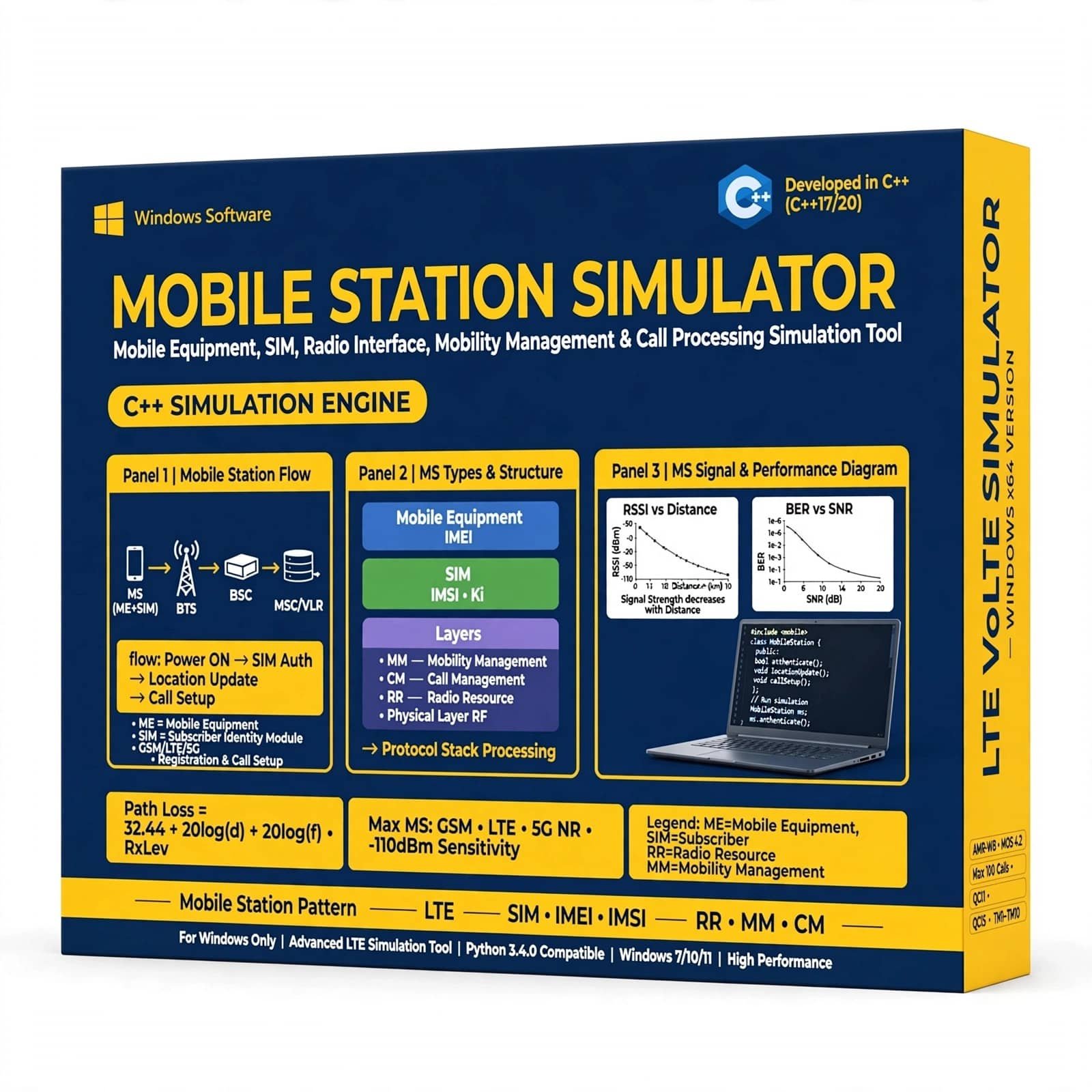
GSM Mobile Station Simulator – C++ Educational Software is an interactive educational simulator designed to demonstrate key GSM mobile station concepts, including MS hardware and identity, SIM card status, battery level, authentication, network registration, cell connectivity, signal strength, mobility, and Call/SMS states. Developed in C++, this simulator provides a simple visual environment for learning and demonstrating GSM network and mobile-station behavior.
Original price was: ₹3,999.00.₹749.00Current price is: ₹749.00. -
OFDM Simulator – C++ Educational Software is an interactive learning and simulation tool for understanding Orthogonal Frequency Division Multiplexing (OFDM) and digital communication concepts. Developed using C++, it allows users to configure FFT/IFFT size, active subcarriers, cyclic prefix length, modulation, SNR, and number of OFDM symbols while visualizing the resulting time-domain waveform, spectrum, and constellation. The simulator also provides measurable results such as PAPR, BER, Eb/N0, simulated bits, and cyclic-prefix overhead.
₹1,999.00 -
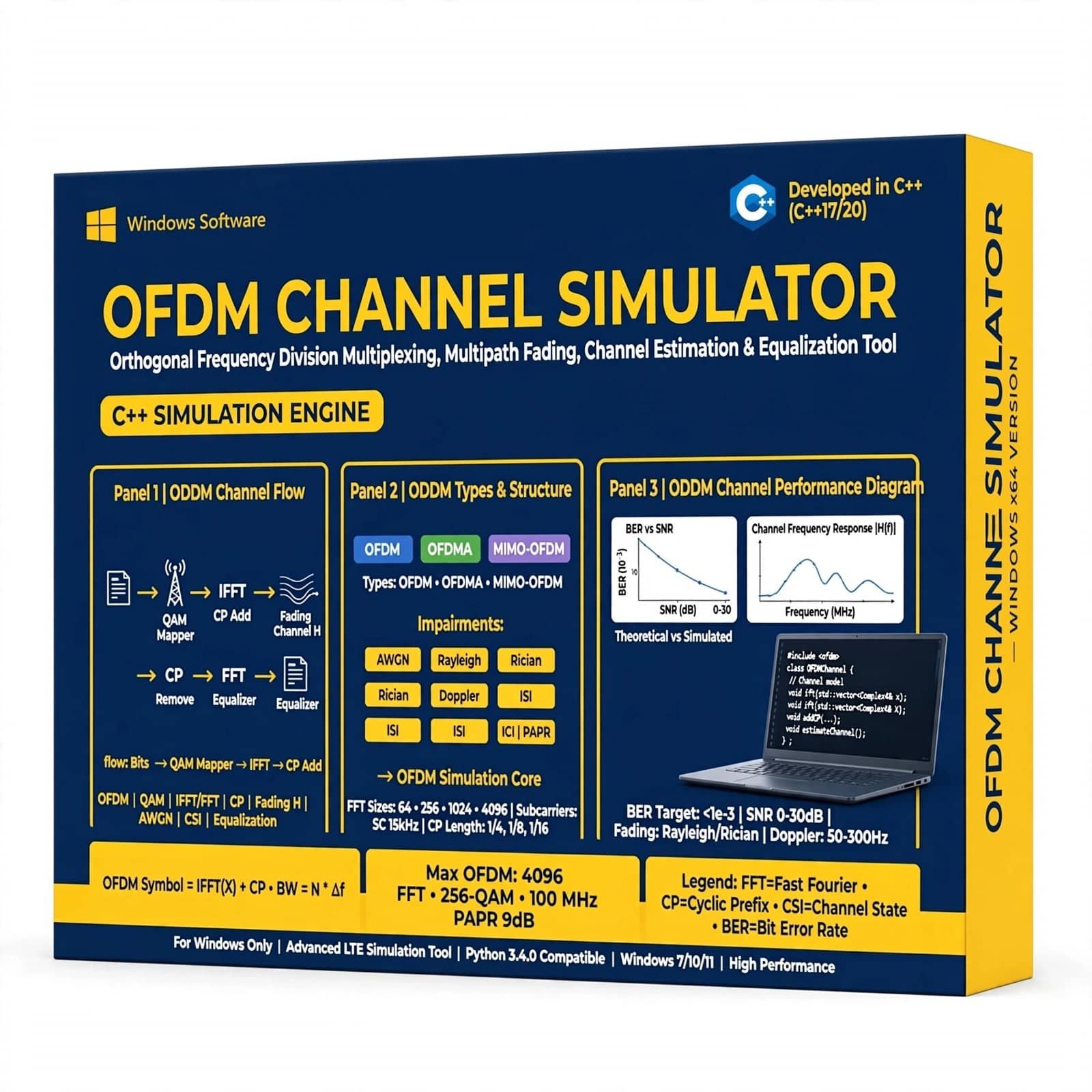
OFDM Channel Simulator – C++ Educational Software is an interactive simulation tool designed to help students, educators, researchers, and communication-engineering learners understand Orthogonal Frequency Division Multiplexing (OFDM) and wireless channel effects. Developed using C++, the simulator demonstrates FFT/IFFT processing, cyclic prefix, QPSK and QAM modulation, multipath channels, delay spread, channel frequency response, equalization, BER, EVM, and constellation diagrams through an intuitive graphical interface.
₹1,999.00


Reviews
There are no reviews yet.