
New
67% Off

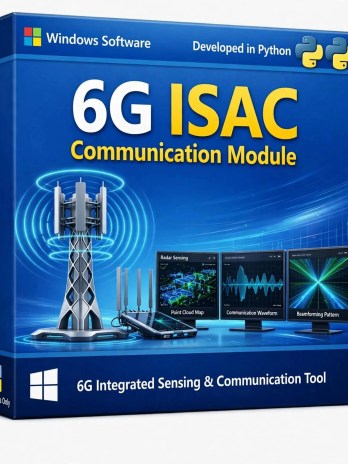
ISAC Simulator – 6G Sensing Module

Original price was: ₹750.00.₹250.00Current price is: ₹250.00.
In StockISAC Simulator – 6G Sensing Module Revolutionize Your 6G Research with India’s Most Advanced ISAC Sensing SimulatorWelcome to the future of wireless communication. The ISAC Simulator – 6G Sensing Module is a powerful, Windows-based simulation tool developed in Python 3.12 that brings Integrated Sensing and Communication (ISAC) technology to your desktop. As per ITU-R M.2160 and 3GPP Release 19 standards, this simulator is specifically designed for M.Tech, B.Tech, PhD scholars, researchers, and telecom R&D labs working on 6G networks, radar sensing, and joint communication-sensing systems.If you are searching for 6G ISAC simulator download, 6G sensing simulation software, ISAC radar simulator for Windows, Python based 6G simulator, or 3GPP compliant ISAC tool, this is the only product you need.
Description
ISAC Simulator – 6G Sensing Module
Are you looking to pioneer the future of wireless technology? The ISAC Simulator – 6G Sensing Module is an industry-leading hardware and software simulation suite engineered specifically for Integrated Sensing and Communication (ISAC) research. As the telecommunications sector shifts toward 6G networks, blending high-speed data transmission with radar-like environmental sensing is no longer a luxury—it is a baseline requirement.
This enterprise-grade evaluation platform allows radio frequency (RF) engineers, cellular network operators, and academic researchers to test, validate, and benchmark 6G waveform designs, beam forming topologies, and spatial sensing algorithms. By unifying radar echo tracking and ultra-reliable low-latency communication (URLLC) streams into a single software-defined workflow, this simulator bridges the gap between conceptual 6G theory and real-world deployment.
Why Choose the ISAC Simulator – 6G Sensing Module?
Traditional network architectures treat wireless data and radar mapping as separate entities, wasting valuable radio spectrum. The ISAC Simulator – 6G Sensing Module eliminates this redundancy. It allows teams to prototype unified waveforms that concurrently map physical environments and transmit massive data payloads. Whether you are developing smart city traffic coordination, high-precision industrial robotics, or autonomous vehicle networks, this module provides the dense, accurate diagnostic telemetry required to accelerate your time-to-market.
Key Technical Capabilities & Core Features
Dual-Function Waveform Modeling
Simulate and analyze joint waveform architectures including OTFS (Orthogonal Time Frequency Space), advanced OFDM adaptations, and customized FMCW radar patterns. Evaluate the structural trade-offs between communication throughput (bit error rate) and sensing metrics (range, velocity, and angular resolution) under severe multi-path fading conditions.
Millimeter-Wave & Sub-Terahertz (Sub-THz) Propagation
Built for ultra-high frequency simulation, the module natively models signal behaviors in the mmWave and Sub-THz bands (ranging from 24 GHz up to 300 GHz). Test how atmospheric absorption, foliage blocking, and complex indoor reflections impact your 6G sensing accuracy and spatial resolution.
Advanced Massive MIMO & Beamforming Emulation
Configure virtual antenna arrays with hundreds of elements. The platform supports dynamic digital, analog, and hybrid beamforming simulation. Model highly directional spatial beams that track moving targets in real-time while maintaining uninterrupted, high-capacity communication links to mobile user equipment (UE).
Real-Time Machine Learning (ML) Environment Mapping
The integrated software suite utilizes deep learning algorithms to process raw simulated radar reflections. Automatically classify objects, track pedestrian velocities, and generate 3D point-cloud maps of simulated urban or industrial testbeds. Ideal for validating AI-driven radio resource management (RRM).
End-to-End Channel Sounding
Gain complete visibility into the physical layer. The simulator reproduces complex channel matrices, Doppler shifts, delay spreads, and cross-channel interference profiles, allowing you to debug physical layer (PHY) and media access control (MAC) layer protocols long before deploying physical prototype hardware.
Comprehensive Technical Specifications
- Supported Frequency Spectrum: 24 GHz to 100 GHz (mmWave Range) | 100 GHz to 300 GHz (Sub-THz Testing)
- Simulated Bandwidths: Scalable configurations up to 2 GHz, 4 GHz, and 10 GHz channels.
- Sensing Metrics: Range resolution up to < 1 cm; Velocity accuracy within ±0.1 m/s; Angular accuracy up to 0.5 degrees.
- Antenna Configurations: Custom configurations including ULA (Uniform Linear Arrays) and UPA (Uniform Planar Arrays) up to 256×256 channels.
- Operating OS Requirements: Windows 7 and above PC
Target Use Cases and Applications
Autonomous Driving & V2X Networks
Simulate how a 6G base station can double as an infrastructure-based radar system. Validate how vehicles receive real-time telemetry while simultaneously feeding spatial localization data back to edge computing nodes to avoid collisions.
Industrial IoT& Automated Warehouses
Model the deployment of indoor 6G networks where automated guided vehicles (AGVs) navigate busy warehouse floors using ambient cellular signals, eliminating the need for expensive standalone laser or optical guidance hardware.

Smart Cities & Pedestrian Safety
Design public cellular networks capable of analyzing traffic volume, tracking micro-mobility assets (e.g., e-scooters), and monitoring pedestrian safety corridors using existing cell-tower real estate without violating user privacy laws.
Frequently Asked Questions (FAQs)
What is an ISAC system in 6G?
ISAC stands for Integrated Sensing and Communication. It is a core pillar of 6G technology where the wireless network does not just transmit data, but actively senses the surrounding physical environment (detecting size, velocity, and shape of objects) using the same radio waves and hardware.
Does this simulator require physical external hardware?
The base software module can run fully virtualized environments on high-performance workstation computers. However, it features extensive PCIe and Ethernet interface hooks to connect seamlessly with leading hardware-in-the-loop (HIL) RF signal generators and spectrum analyzers.
What software tools are compatible with the module’s API?
The module features seamless, native integration with MATLAB, Python scripts, and standard C++ libraries, allowing you to export simulated data matrices or import custom waveform configurations with ease.
Is a maintenance and update plan included?
Yes. Every commercial purchase includes 12 months of priority technical support and free software updates to match the evolving 3GPP 6G standardization releases.
Related products
-
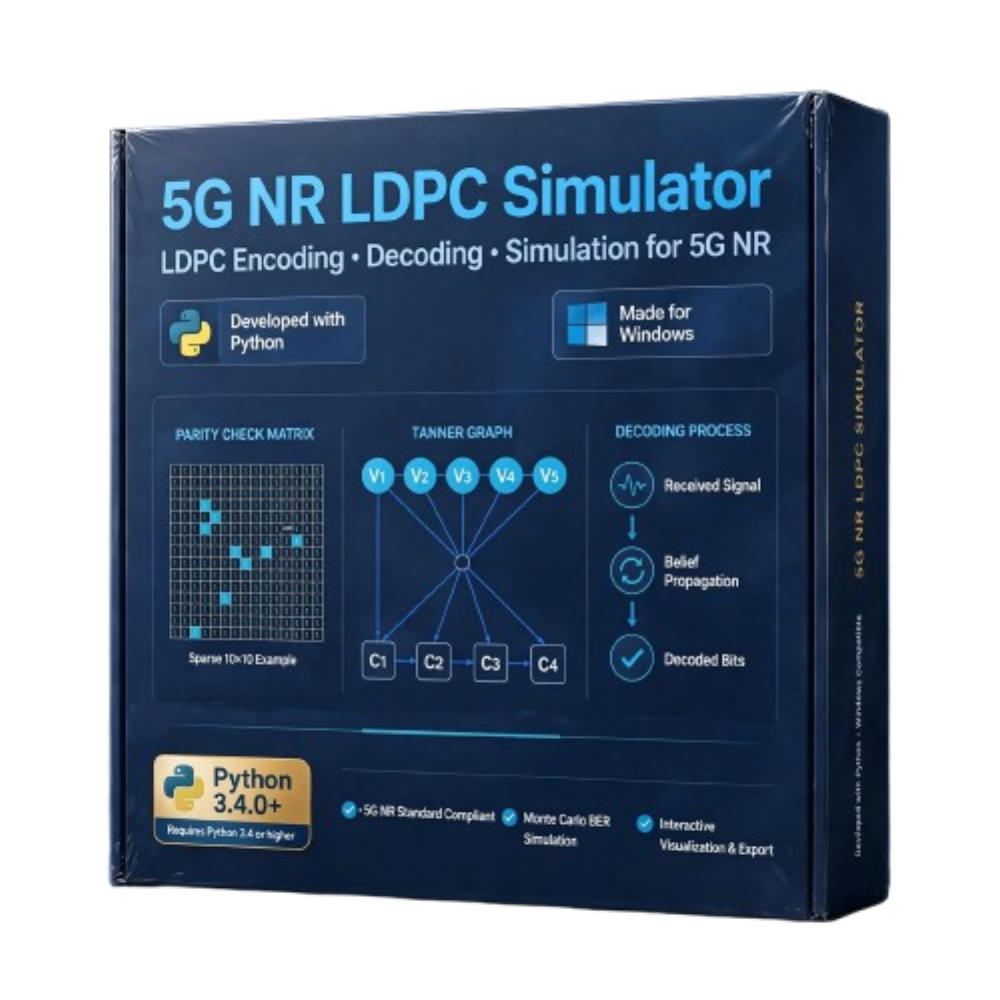
5G NR LDPC Simulator is an advanced simulation solution for modeling and analyzing Low-Density Parity-Check (LDPC) channel coding used in 5G New Radio systems. It enables users to simulate LDPC encoding and decoding, evaluate error correction performance, and analyze BER, BLER, SNR, coding rate, decoding iterations, throughput, and convergence under configurable channel conditions. The simulator is ideal for 5G NR channel coding research, algorithm development, academic projects, decoder performance analysis, and next-generation wireless communication system optimization.
Original price was: ₹750.00.₹250.00Current price is: ₹250.00. -
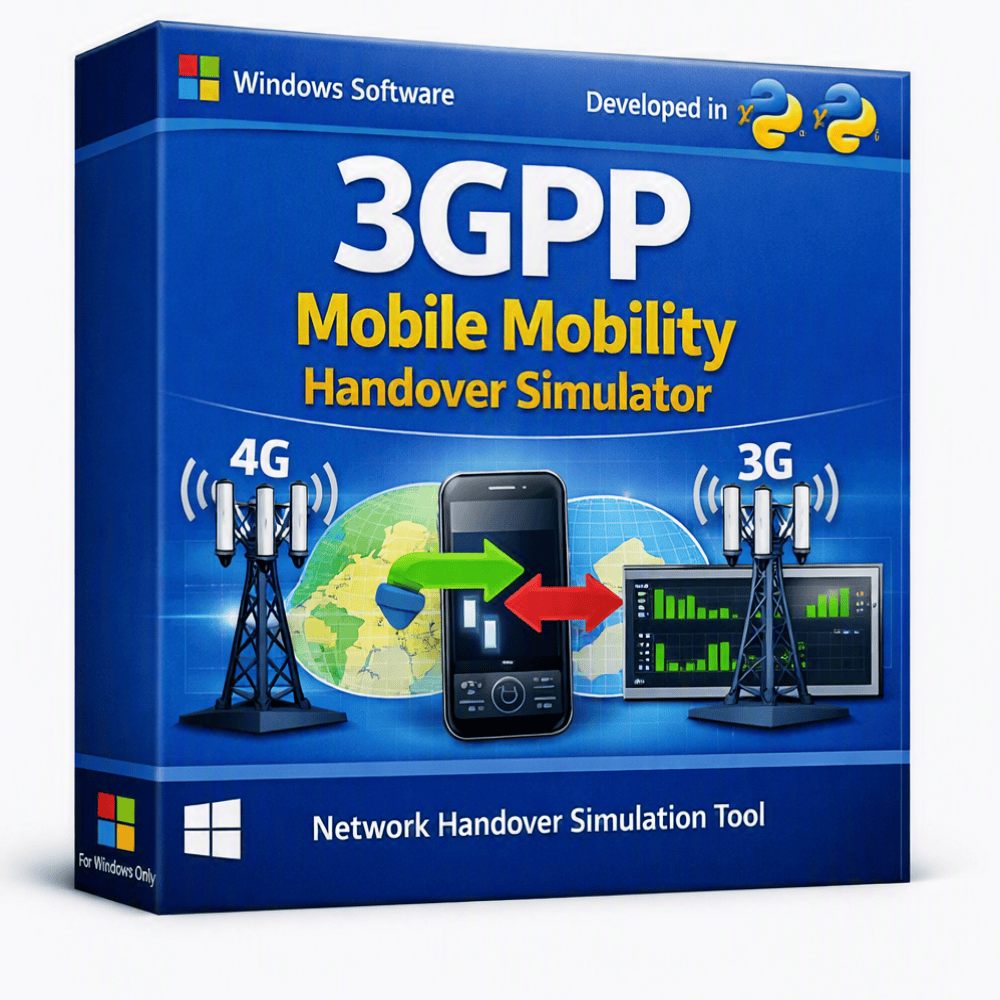
A powerful simulation tool for analyzing and validating 3GPP mobile mobility and handover procedures. The simulator enables users to model mobile network scenarios, study handover behavior, and evaluate mobility performance under different network conditions.
Key Features:
- 3GPP-compliant mobility and handover simulation
- Configurable network and mobility scenarios
- Analysis of handover performance and behavior
- Supports research, testing, and network optimization
- Useful for telecom engineers, researchers, and academic projects
Ideal for 5G/4G/3G mobility research, protocol testing, network planning, and academic simulation studies.
Original price was: ₹750.00.₹250.00Current price is: ₹250.00. -
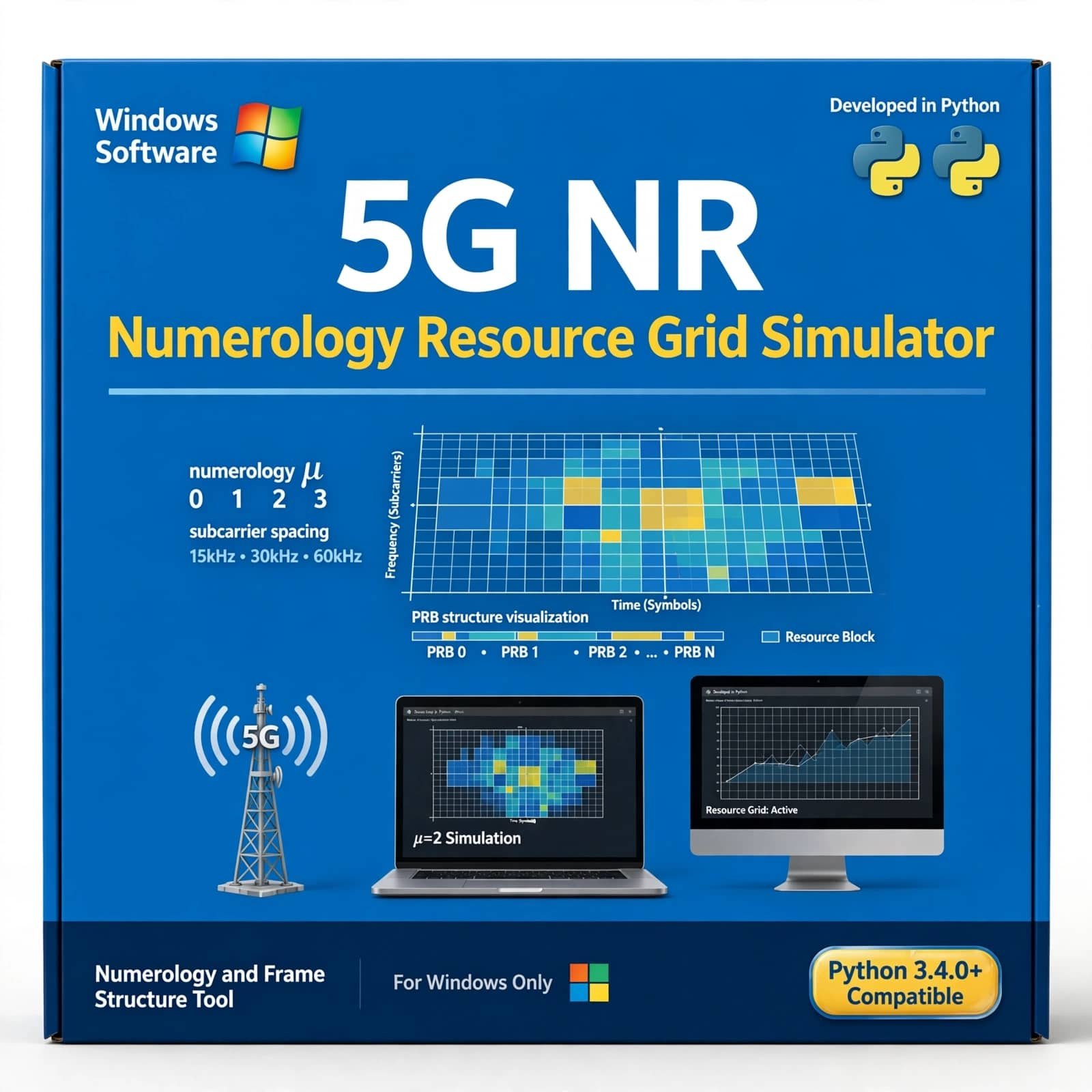
5G NR Numerology Resource Grid Simulator is an advanced simulation solution for modeling and analyzing 5G New Radio numerology and time-frequency resource grid structures. It enables users to study subcarrier spacing, OFDM symbols, slot structure, cyclic prefix, Physical Resource Blocks (PRBs), Resource Elements (REs), bandwidth configurations, and resource mapping. The simulator is ideal for 5G NR physical-layer research, numerology analysis, resource allocation studies, academic projects, waveform development, and 5G/6G wireless communication research.
Original price was: ₹750.00.₹250.00Current price is: ₹250.00. -
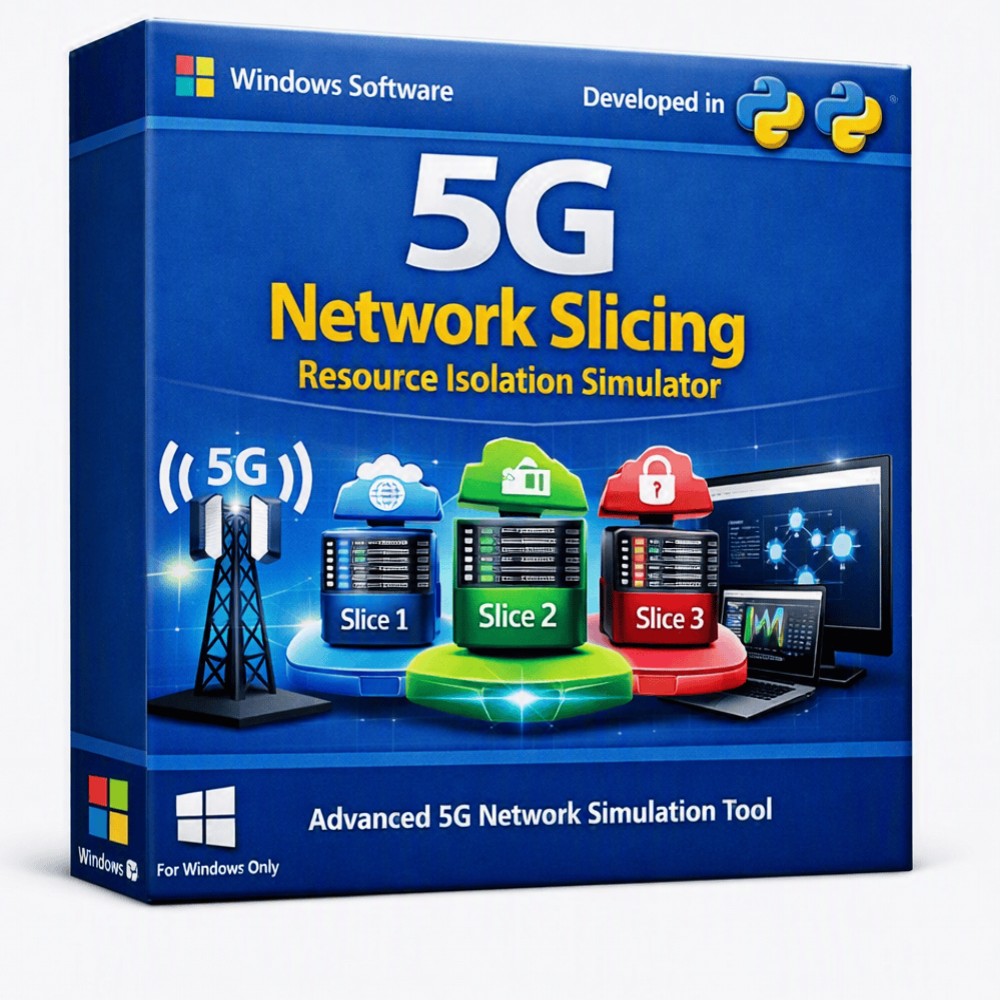
A Python-based 5G Network Slicing and Resource Isolation Simulator designed to model and analyze how multiple logical network slices can share physical 5G infrastructure while maintaining resource isolation. The simulator enables users to study CPU, memory, bandwidth, network capacity, traffic allocation, and resource management across different 5G network slices.
Ideal for 5G research, telecom engineering, academic projects, network optimization, resource allocation studies, and university laboratories.
Original price was: ₹750.00.₹250.00Current price is: ₹250.00. -
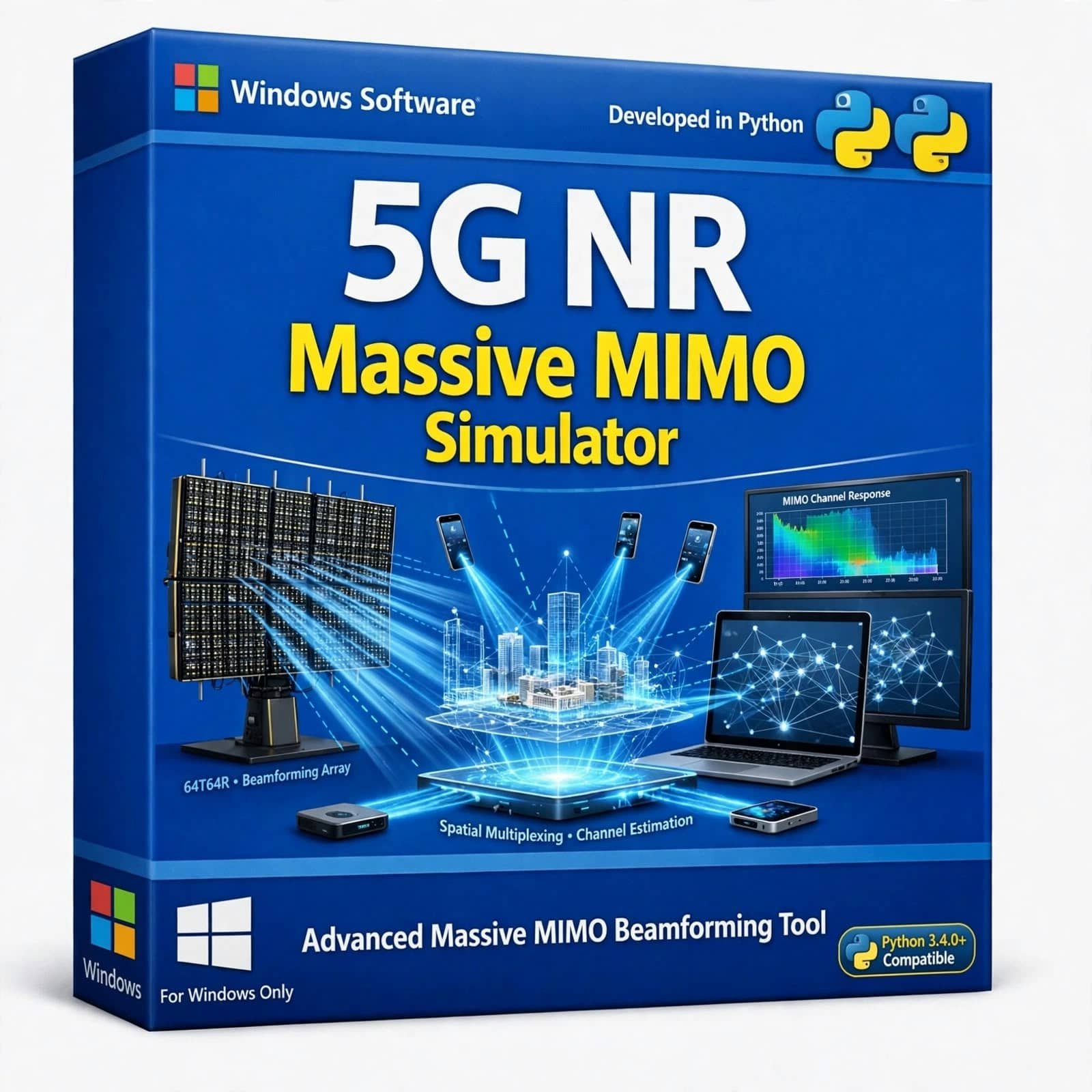
5G NR Massive MIMO Simulator is an advanced simulation solution for modeling and analyzing Massive Multiple-Input Multiple-Output (MIMO) technologies in 5G New Radio networks. It enables users to study large-scale antenna arrays, beamforming, precoding, spatial multiplexing, multi-user MIMO, channel estimation, and interference under configurable channel conditions. The simulator supports analysis of throughput, spectral efficiency, SINR, BER, BLER, MIMO capacity, beamforming gain, and multi-user performance, making it ideal for 5G NR research, algorithm development, academic projects, and 5G/6G wireless system optimization.
Original price was: ₹750.00.₹250.00Current price is: ₹250.00. -
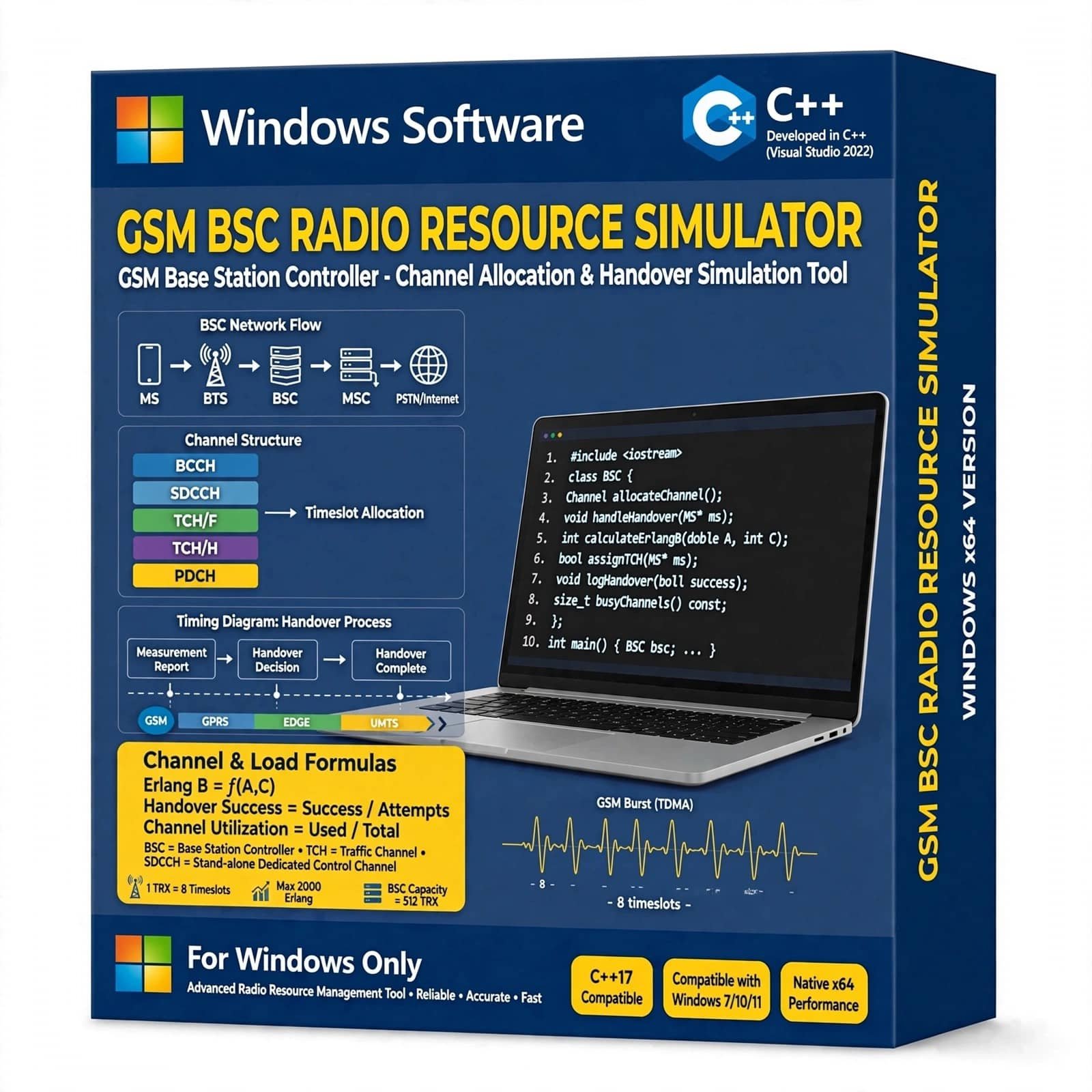
GSM BSC Radio Resource Simulator is a professional telecom training and development solution designed to simulate GSM Base Station Controller (BSC) radio resource management functions. It helps students, telecom engineers, researchers, and network professionals understand GSM radio resource allocation, channel management, call handling, handover concepts, and BSC-related network procedures in a controlled simulation environment.
Original price was: ₹750.00.₹100.00Current price is: ₹100.00.


Reviews
There are no reviews yet.