
New
90% Off

6G Semantic Communication Simulator

Original price was: ₹250,000.00.₹25,000.00Current price is: ₹25,000.00.
In Stock6G Semantic Communication Simulator with Python is an innovative simulation project designed to explore next-generation wireless communication using semantic information processing, intelligent data transmission, and network performance analysis. Developed with Python, this project demonstrates how semantic communication can prioritize meaningful information over conventional bit-level transmission to improve communication efficiency, reduce redundant data, and support intelligent 6G network applications. It provides a foundation for studying semantic similarity, transmission latency, bandwidth utilization, and AI-driven communication systems.
Description
6G Semantic Communication Simulator with Python
The 6G Semantic Communication Simulator with Python is an advanced educational and research-oriented project designed to explore semantic communication concepts in next-generation wireless networks. As communication technologies progress toward sixth-generation (6G) networks, intelligent data transmission, artificial intelligence, and efficient utilization of network resources are becoming important research areas.
Traditional communication systems primarily focus on transmitting data accurately from a sender to a receiver. Semantic communication takes a different approach by emphasizing the meaning and relevance of information. Instead of focusing exclusively on the exact transmission of every bit, semantic communication systems aim to preserve the information needed to accomplish a particular communication task. This project provides a Python-based simulation environment for studying these principles and evaluating their potential benefits.

Project Overview
The 6G Semantic Communication Simulator models the basic workflow of semantic information transmission between communication endpoints. Depending on the implementation, the system can include data generation, semantic feature extraction, information encoding, simulated wireless transmission, semantic decoding, and output comparison.
Python provides a flexible platform for building these simulation components, processing datasets, implementing algorithms, and visualizing performance metrics. Users can experiment with different transmission conditions and compare conventional communication approaches with semantic-oriented strategies.
The simulator can be extended to investigate how artificial intelligence and machine learning techniques may help communication systems identify relevant information, reduce redundancy, and adapt to changing network conditions.

Key Features
- Semantic Information Processing: Explore methods for extracting and representing meaningful information from text, images, or other supported data types.
- 6G Communication Modeling: Simulate selected next-generation wireless communication concepts using configurable network parameters.
- Semantic Encoding and Decoding: Model how information can be represented at the sender and reconstructed at the receiver.
- Transmission Efficiency Analysis: Compare data volume, communication overhead, and reconstruction quality under selected simulation assumptions.
- Latency and Bandwidth Evaluation: Examine how network conditions influence communication delays and resource utilization.
- AI-Based Communication Extensions: Integrate machine learning or deep learning models for semantic feature extraction and task-oriented information processing.
- Performance Visualization: Display simulation results using charts, graphs, and comparative metrics where supported by the implementation.

Technologies Used
Python is the primary programming language for developing the simulator. NumPy can support numerical computations, Pandas can organize experimental results, and Matplotlib can visualize performance comparisons. Depending on the project scope, PyTorch or TensorFlow can be integrated for deep learning-based semantic encoding and decoding.
Natural language processing libraries may support text-based semantic communication, while image-processing tools can be used for image-oriented experiments. These libraries are optional and should be selected according to the implemented features.
Applications of Semantic Communication
Semantic communication is a promising research direction for future intelligent networks. Potential applications include smart healthcare systems, autonomous vehicles, industrial Internet of Things (IoT), intelligent surveillance, remote collaboration, edge computing, and machine-to-machine communication.
For example, an application may prioritize transmitting information relevant to a particular task instead of sending all available raw data. The simulator can help researchers investigate such scenarios and understand the trade-offs between semantic accuracy, transmission efficiency, and computational complexity.

Benefits of the Project
This Python-based simulator offers a practical environment for understanding emerging 6G communication concepts without requiring physical 6G infrastructure. Students, researchers, and developers can use it to test algorithms, compare communication strategies, visualize results, and investigate the role of artificial intelligence in future wireless networks.
Its modular architecture can support additional experiments involving channel noise, semantic similarity metrics, resource allocation, adaptive encoding, and task-oriented communication.
Conclusion
The 6G Semantic Communication Simulator with Python provides a useful starting point for exploring intelligent communication systems and next-generation wireless networking. By combining Python programming, semantic information processing, and configurable simulation scenarios, the project demonstrates key concepts behind meaning-oriented data transmission. It is suitable for academic projects, technology demonstrations, and research experimentation in 6G networks, artificial intelligence, and efficient wireless communication. Actual performance improvements depend on the algorithms, datasets, and network assumptions used in the simulator.
Related products
-
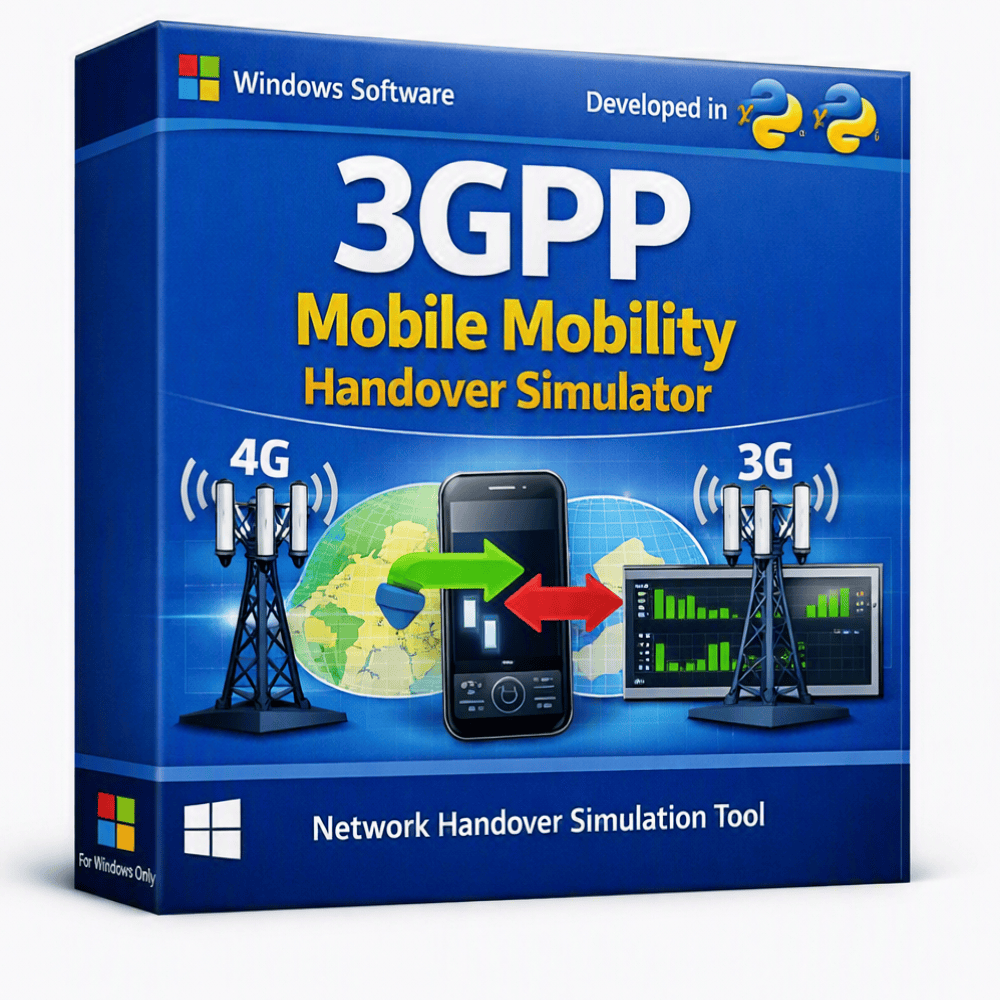
A powerful simulation tool for analyzing and validating 3GPP mobile mobility and handover procedures. The simulator enables users to model mobile network scenarios, study handover behavior, and evaluate mobility performance under different network conditions.
Key Features:
- 3GPP-compliant mobility and handover simulation
- Configurable network and mobility scenarios
- Analysis of handover performance and behavior
- Supports research, testing, and network optimization
- Useful for telecom engineers, researchers, and academic projects
Ideal for 5G/4G/3G mobility research, protocol testing, network planning, and academic simulation studies.
₹3,999.00 -
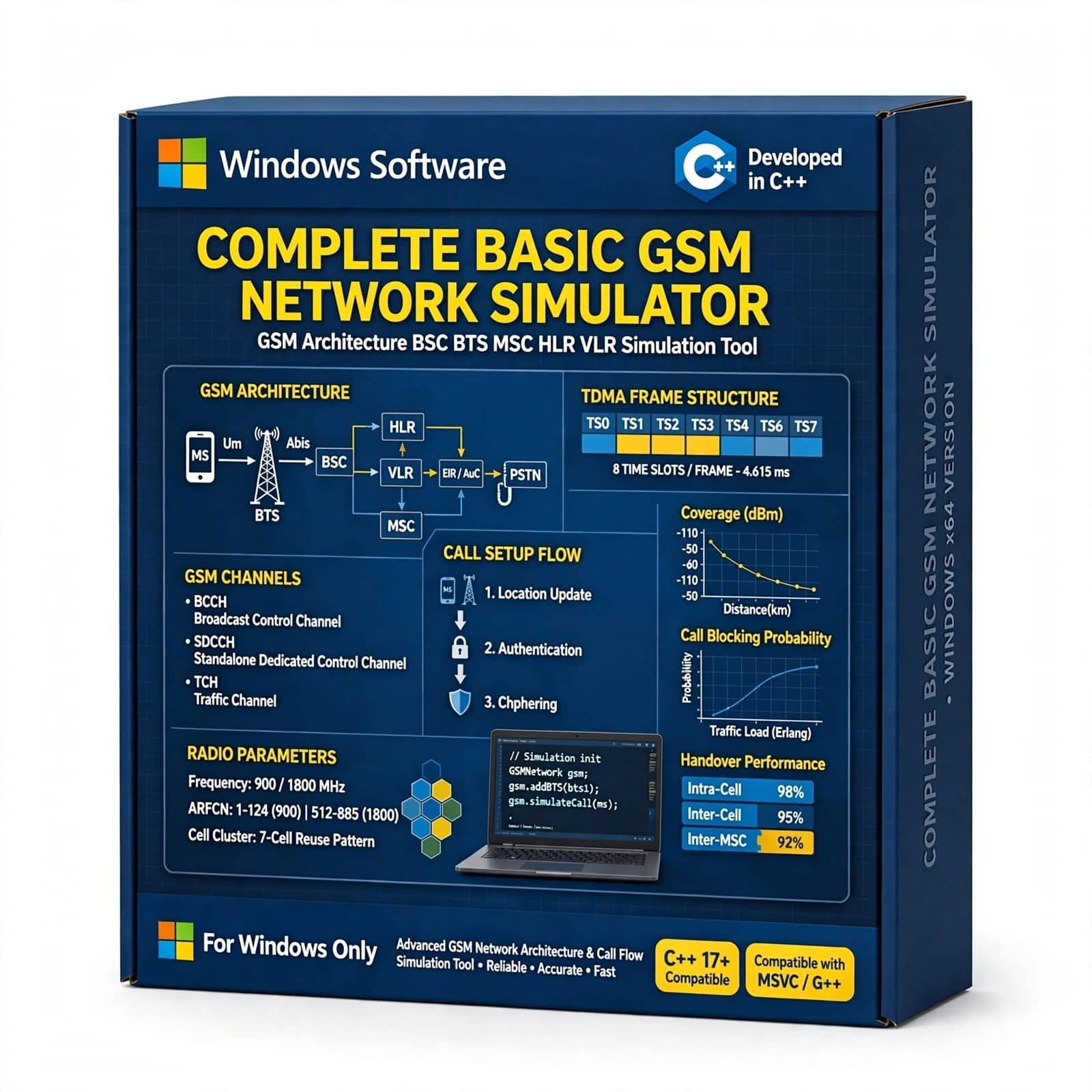
Complete Basic GSM Network with C++ is an educational and simulation-based project that demonstrates the fundamental architecture and operation of a GSM network using C++. It helps students and researchers understand GSM components, mobile communication, call and message handling, network signaling, and basic cellular network operations through a practical C++ implementation.
Original price was: ₹3,999.00.₹2,399.00Current price is: ₹2,399.00. -
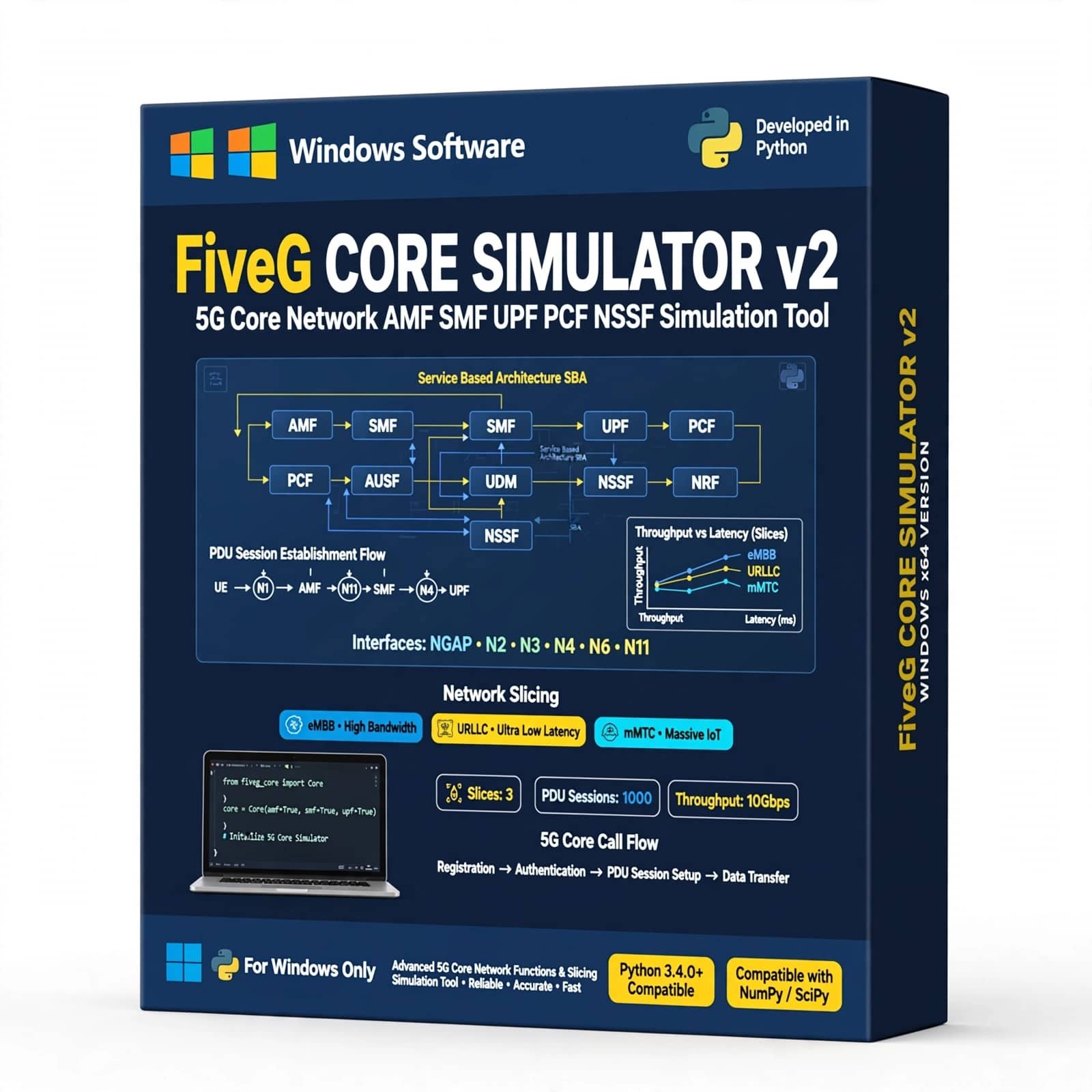
FiveG Core Simulator v2 is an educational 5G Core Network simulation tool designed to help students, educators, researchers, and telecom professionals understand 5G core architecture, network functions, signaling procedures, latency, and protocol interactions through an interactive topology and signaling animation environment.
₹19,999.00 -
A Python-based 5G Digital Twin solution for creating a virtual representation of 5G network environments, components, and operational behavior. Designed for 5G research, network analysis, simulation, optimization, and academic projects, it enables users to model network scenarios, monitor virtualized network behavior, and experiment with different configurations in a controlled software environment.
Ideal for telecom engineers, researchers, developers, students, and academic institutions working on 5G network planning, performance analysis, intelligent network management, and digital twin research.
Original price was: ₹249,999.00.₹24,999.00Current price is: ₹24,999.00. -
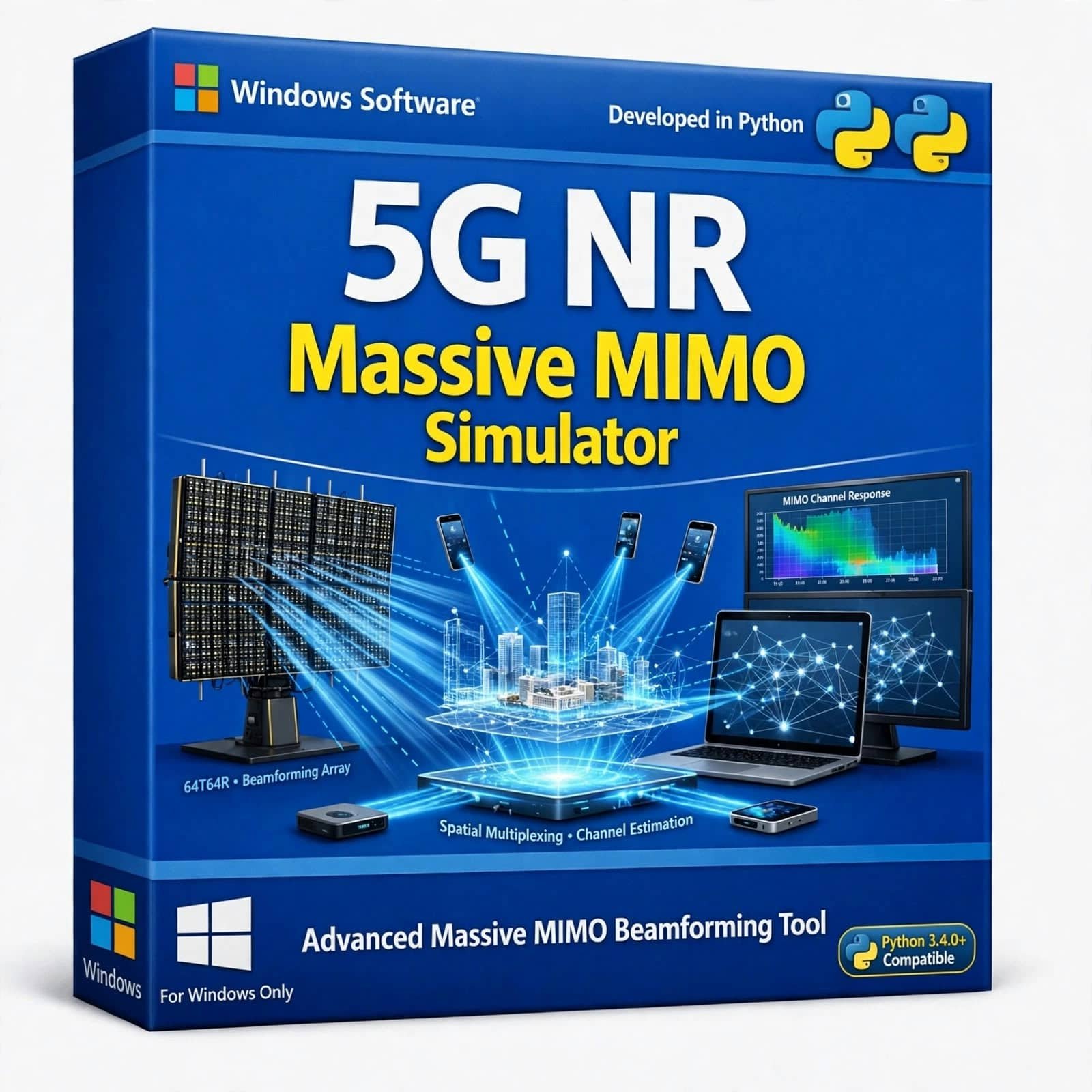
5G NR Massive MIMO Simulator is an advanced simulation solution for modeling and analyzing Massive Multiple-Input Multiple-Output (MIMO) technologies in 5G New Radio networks. It enables users to study large-scale antenna arrays, beamforming, precoding, spatial multiplexing, multi-user MIMO, channel estimation, and interference under configurable channel conditions. The simulator supports analysis of throughput, spectral efficiency, SINR, BER, BLER, MIMO capacity, beamforming gain, and multi-user performance, making it ideal for 5G NR research, algorithm development, academic projects, and 5G/6G wireless system optimization.
Original price was: ₹149,999.00.₹14,999.00Current price is: ₹14,999.00. -
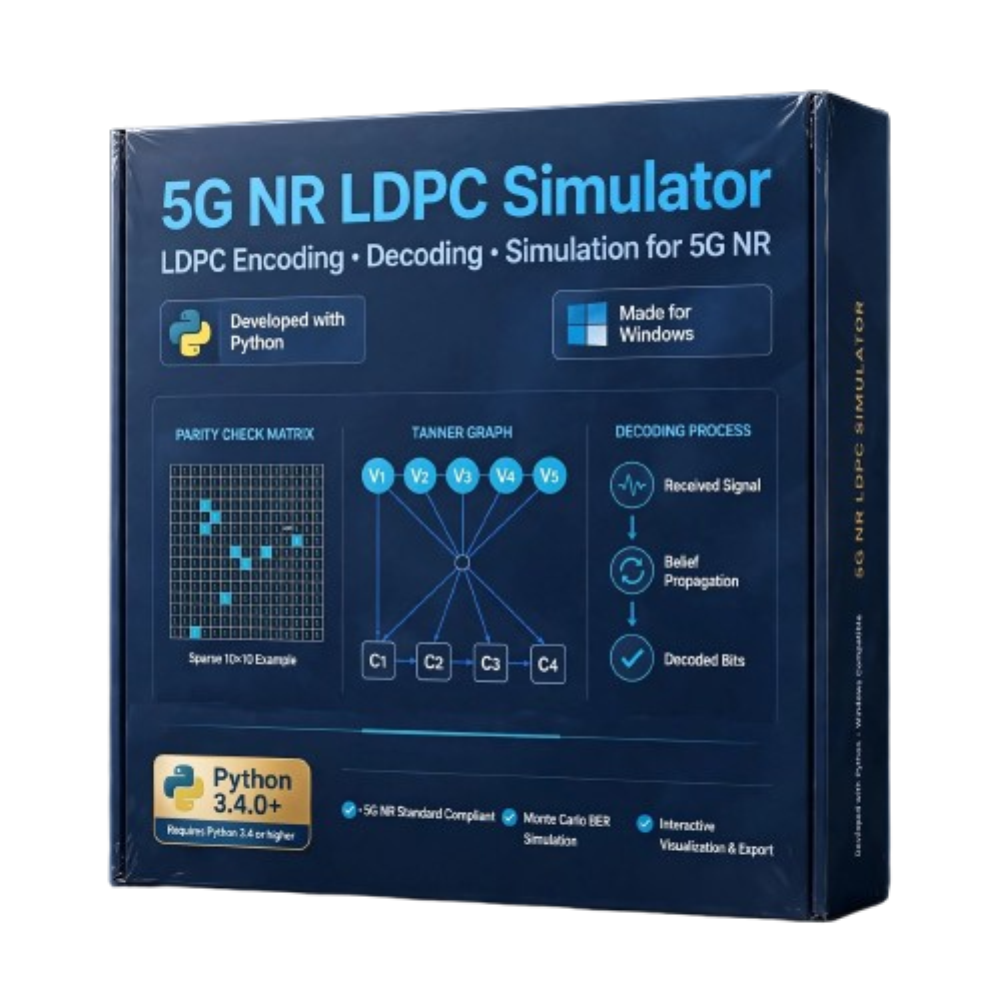
5G NR LDPC Simulator is an advanced simulation solution for modeling and analyzing Low-Density Parity-Check (LDPC) channel coding used in 5G New Radio systems. It enables users to simulate LDPC encoding and decoding, evaluate error correction performance, and analyze BER, BLER, SNR, coding rate, decoding iterations, throughput, and convergence under configurable channel conditions. The simulator is ideal for 5G NR channel coding research, algorithm development, academic projects, decoder performance analysis, and next-generation wireless communication system optimization.
Original price was: ₹129,999.00.₹12,999.00Current price is: ₹12,999.00.



Reviews
There are no reviews yet.