
New
67% Off

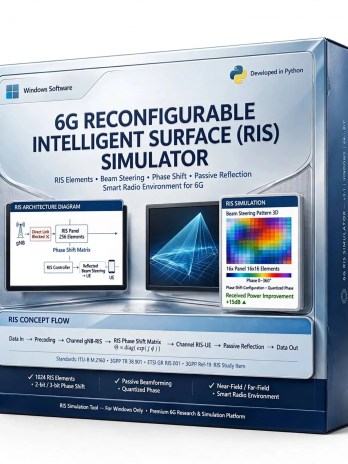
6G Holographic MIMO Simulator

Original price was: ₹750.00.₹250.00Current price is: ₹250.00.
In Stock6G Holographic MIMO Simulator with Python is a software-based simulation tool for exploring advanced wireless communication concepts involving 6G networks, holographic MIMO, large-scale antenna systems, beamforming, propagation, and signal processing. Designed for researchers, communication engineers, students, and Python developers, it provides a practical environment for modeling and analyzing next-generation wireless communication scenarios, algorithms, and MIMO techniques.
Description
6G Holographic MIMO Simulator
The development of 6G wireless communication systems is driving research into new antenna architectures, advanced signal-processing techniques, intelligent radio environments, and extremely high spatial degrees of freedom. Holographic MIMO is one of the emerging concepts being investigated for future wireless networks, offering the possibility of using large electromagnetic apertures with densely distributed antenna elements.
The 6G Holographic MIMO Simulator with Python provides a practical software environment for studying and experimenting with these advanced wireless communication concepts. It is designed for researchers, communication engineers, university students, educators, and developers who want to explore Holographic MIMO and next-generation wireless communication using Python-based simulation.
Explore 6G Wireless Communication
6G research extends beyond simply increasing data rates. Future wireless networks are expected to investigate new approaches to spectrum utilization, spatial processing, intelligent communications, ultra-high-capacity links, sensing, and highly adaptive wireless environments.
Simulation is an important part of this research because many 6G technologies are still being actively investigated. A software-based simulation environment allows researchers and developers to model communication scenarios, test algorithms, evaluate system behavior, and explore different design approaches before implementing them in physical hardware.
The simulator provides a convenient environment for investigating these concepts while using Python for modeling, experimentation, and analysis.
Understand Holographic MIMO
Holographic MIMO refers to emerging MIMO architectures that use very large and densely packed electromagnetic apertures to provide extensive spatial processing capabilities. Compared with conventional antenna-array approaches, holographic MIMO research considers much denser spatial sampling and more flexible electromagnetic signal manipulation.
Understanding these systems requires studying antenna configurations, spatial channels, beamforming, signal propagation, and MIMO processing. The simulator can help users investigate these concepts through configurable software-based experiments.
Python-Based MIMO Simulation
Python is widely used in academic research, wireless communication simulation, signal processing, machine learning, and numerical analysis. Its extensive scientific computing ecosystem makes it suitable for developing and testing communication algorithms.
Using a Python-based simulation environment, researchers can investigate MIMO signal-processing concepts and integrate communication simulations with other Python-based analysis tools.
The 6G Holographic MIMO Simulator with Python can therefore be useful as a foundation for experimentation with next-generation wireless communication models and algorithms.
Study Beamforming and Spatial Processing
Beamforming is an important component of advanced MIMO communication systems. By controlling the amplitude and phase of signals across an antenna or electromagnetic aperture, communication systems can manipulate the spatial characteristics of transmitted and received signals.
Holographic MIMO introduces interesting research opportunities for studying spatial beamforming and signal processing across densely distributed apertures.
The simulator can be used to explore these concepts and investigate how changes in antenna configurations, channel conditions, and processing techniques can influence communication-system behavior.
Research Next-Generation Wireless Systems
The evolution from 5G toward 6G involves research into a broad range of technologies and architectures. Researchers need flexible simulation environments to investigate theoretical models and evaluate potential system designs.
A 6G Holographic MIMO simulation platform can support research involving:
- Holographic MIMO systems
- Large-scale MIMO
- Massive MIMO concepts
- Beamforming algorithms
- Wireless channel modeling
- Spatial signal processing
- 6G communication research
- Antenna-array simulations
- Spectral and energy efficiency studies
- Next-generation wireless system design
Useful for Academic Projects
Advanced MIMO and 6G topics are increasingly relevant to communication engineering and wireless research programs. Students working on dissertations, thesis projects, research papers, and communication-system assignments can use simulation to develop a practical understanding of emerging technologies.
Instead of relying solely on theoretical equations, users can experiment with system parameters and observe simulated communication behavior. This approach can make complex concepts such as spatial channels, beamforming, and MIMO processing easier to investigate.

Research and Algorithm Prototyping
For researchers, simulation provides an efficient way to prototype and test algorithms before considering hardware implementation.
Python-based simulation can be particularly useful when experimenting with different mathematical models, channel assumptions, antenna configurations, or signal-processing techniques. Researchers can modify simulation parameters, run experiments, analyze results, and iterate on their designs.
This makes the simulator suitable for early-stage research and algorithm development related to emerging 6G technologies.
Explore Future Wireless Communication Concepts
6G is expected to involve highly integrated communication, sensing, computing, and intelligent network technologies. While many aspects of future 6G systems remain areas of active research, simulation provides a useful way to investigate candidate technologies and communication architectures.
The 6G Holographic MIMO Simulator with Python gives users a practical environment for studying one of the emerging research directions in advanced MIMO and wireless communications.
Key Benefits
- Python-based 6G wireless communication simulation
- Holographic MIMO system modeling
- Useful for advanced MIMO research
- Suitable for beamforming and spatial-processing experiments
- Useful for wireless channel simulation
- Supports academic and research projects
- Suitable for communication algorithm prototyping
- Helps explore next-generation wireless communication concepts
- Useful for researchers, engineers, and students
- Provides a software environment for Holographic MIMO experimentation
Who Can Use This Product?
The 6G Holographic MIMO Simulator with Python is designed for wireless communication researchers, RF engineers, electronics and communication engineering students, university professors, PhD researchers, Python developers, and professionals exploring next-generation wireless technologies.
It is particularly useful for users working on research involving 6G, MIMO, beamforming, antenna arrays, wireless channels, signal processing, and advanced communication-system modeling.
Product Summary
The 6G Holographic MIMO Simulator with Python combines Python-based simulation with emerging research concepts in Holographic MIMO and next-generation wireless communications. It provides a practical environment for studying spatial signal processing, beamforming, MIMO architectures, wireless channels, and 6G communication scenarios.
Whether you are developing a university project, conducting research, prototyping a communication algorithm, or studying future wireless technologies, the simulator provides a flexible environment for experimentation and analysis.
Explore Holographic MIMO and next-generation 6G wireless communication concepts with Python and build practical simulation experience for advanced wireless research and development.
Related products
-
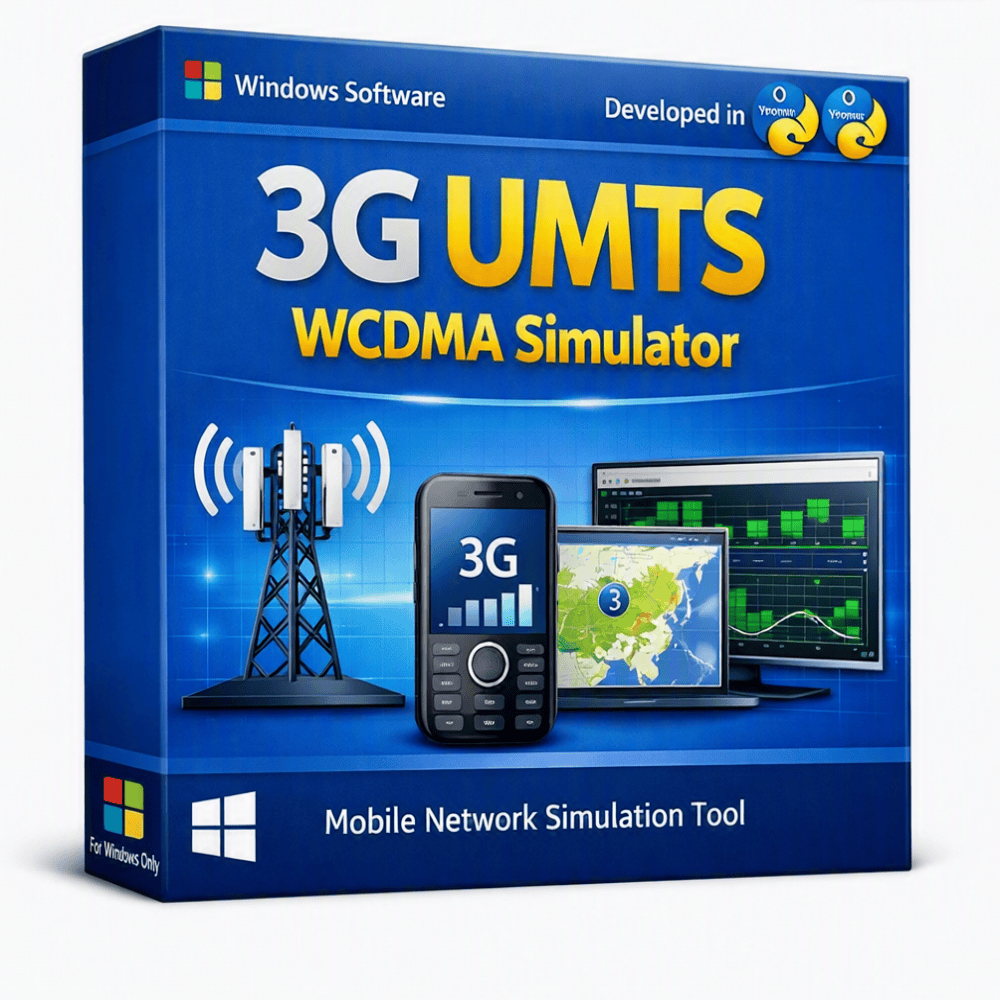
The 3G UMTS – WCDMA Simulator is a software-based simulation project designed to demonstrate the fundamental concepts of 3G Universal Mobile Telecommunications System (UMTS) and Wideband Code Division Multiple Access (WCDMA) technology. It provides a practical environment for studying cellular communication, spreading codes, signal transmission, mobile users, network connectivity, and WCDMA-based communication principles. The simulator is suitable for students, researchers, and developers working on telecommunications and wireless communication projects. It can be used for academic demonstrations, engineering projects, research, experimentation, and learning about 3G mobile communication and WCDMA network technologies.
Original price was: ₹750.00.₹250.00Current price is: ₹250.00. -
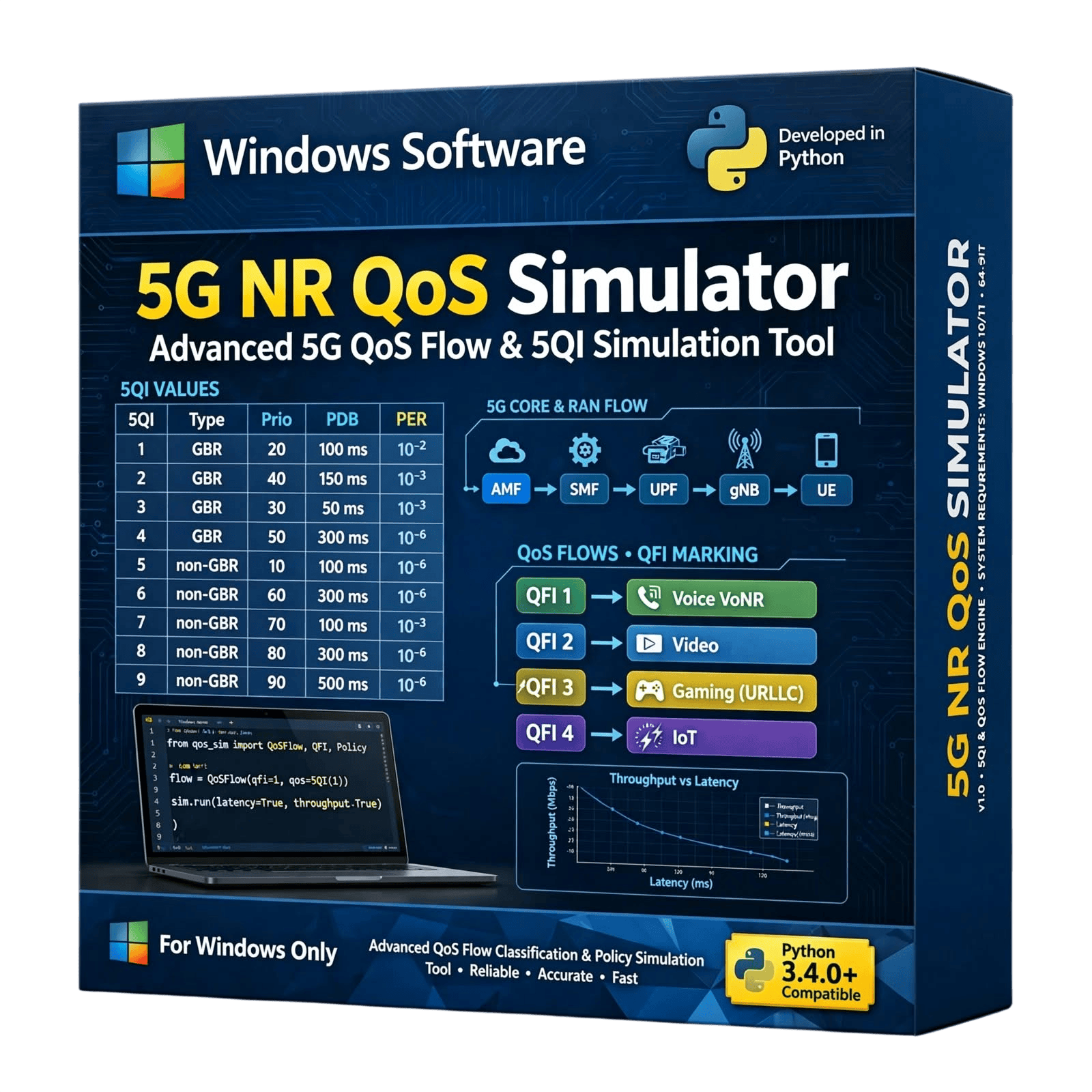
The 5G QoS Simulator is a Python-based software solution designed for researchers, engineers, students, developers, and telecommunications professionals working with 5G Quality of Service (QoS) concepts. The simulator provides a software-based environment for studying and analyzing QoS-related aspects of 5G communication networks, including service performance, traffic behavior, resource management, and network performance evaluation.
Developed using Python, the simulator is suitable for academic research, telecommunications projects, demonstrations, experimentation, algorithm development, and educational applications.
Available for sale as a software product. Contact us for pricing, licensing, features, customization, and purchase information.
Original price was: ₹750.00.₹250.00Current price is: ₹250.00. -
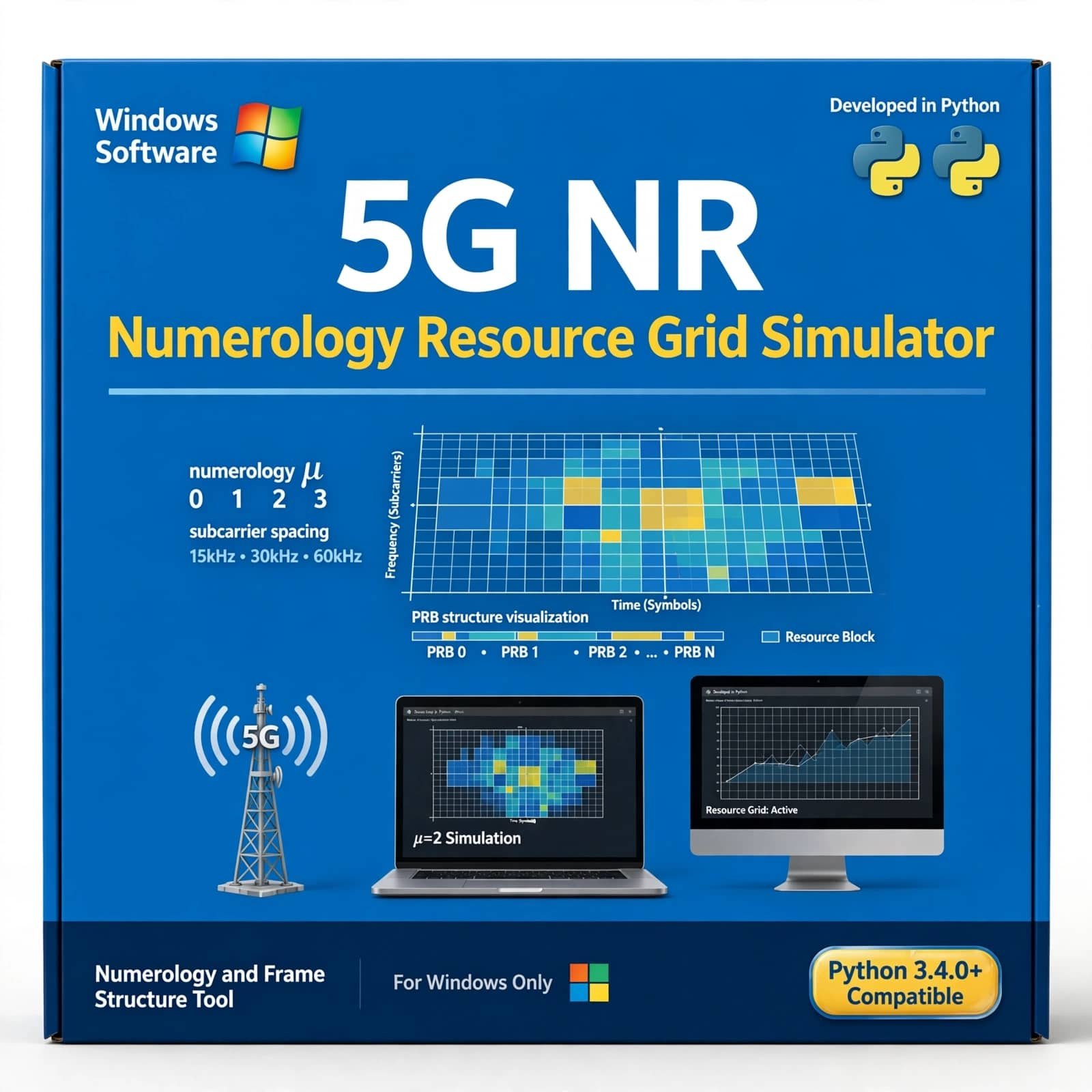
5G NR Numerology Resource Grid Simulator is an advanced simulation solution for modeling and analyzing 5G New Radio numerology and time-frequency resource grid structures. It enables users to study subcarrier spacing, OFDM symbols, slot structure, cyclic prefix, Physical Resource Blocks (PRBs), Resource Elements (REs), bandwidth configurations, and resource mapping. The simulator is ideal for 5G NR physical-layer research, numerology analysis, resource allocation studies, academic projects, waveform development, and 5G/6G wireless communication research.
Original price was: ₹750.00.₹250.00Current price is: ₹250.00. -
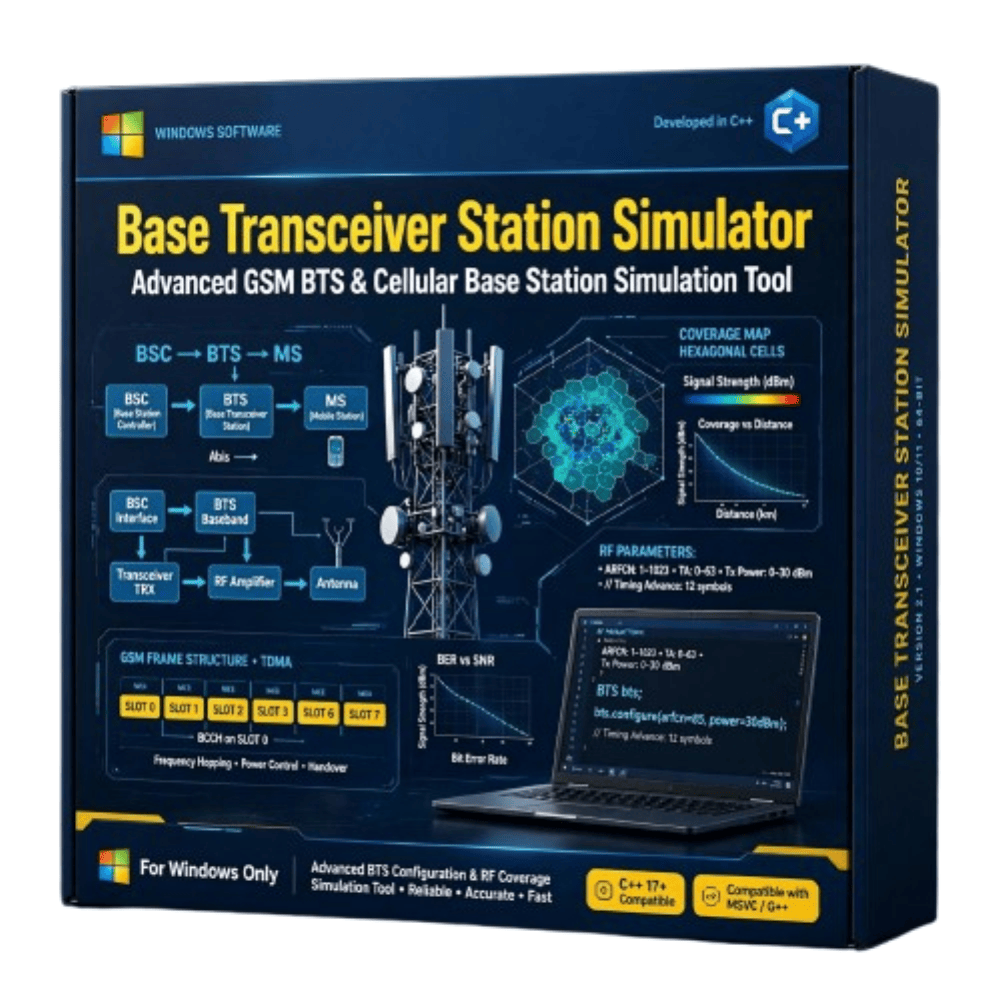
The Base Transceiver Station Simulator Using C++ is a practical cellular communication simulation project designed to demonstrate the basic operation of a BTS in a mobile communication network. Developed using C++, the simulator can model communication between mobile users and a base station, including signal handling, user connectivity, channel allocation, and basic network operations. This BTS Simulator project is suitable for engineering students, researchers, and learners working on GSM, wireless communication, cellular networks, and C++ programming projects.
Original price was: ₹750.00.₹250.00Current price is: ₹250.00. -
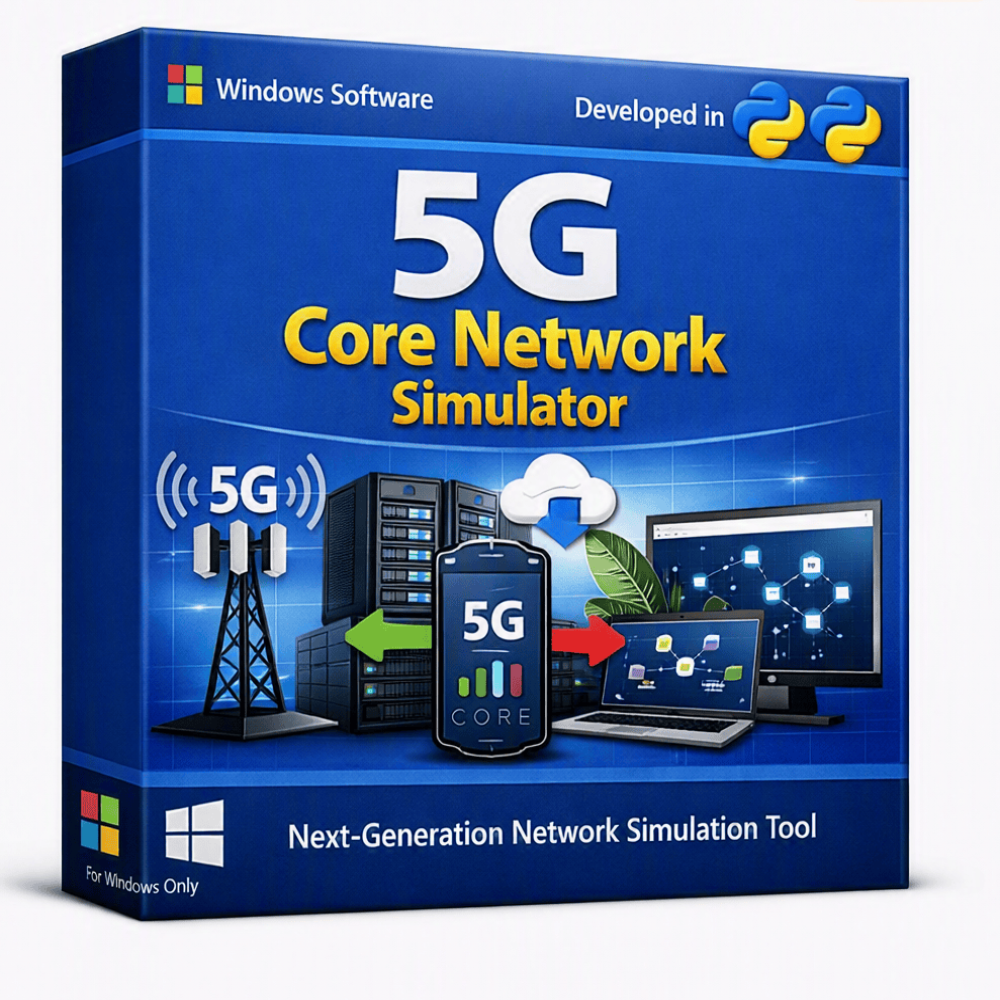
A Python-based 5G Core Network Simulator designed for studying, analyzing, and demonstrating 5G Core network architecture and procedures. Explore key 5G Network Functions such as AMF, SMF, UPF, AUSF, UDM, PCF, NRF, and NSSF, along with UE registration, authentication, session management, mobility, and signaling procedures.
Ideal for 5G research, telecom engineering, academic projects, university laboratories, protocol development, and network simulation. Provides a flexible software environment for experimenting with 5G Core concepts without requiring a complete commercial 5G network infrastructure.
Original price was: ₹750.00.₹250.00Current price is: ₹250.00. -
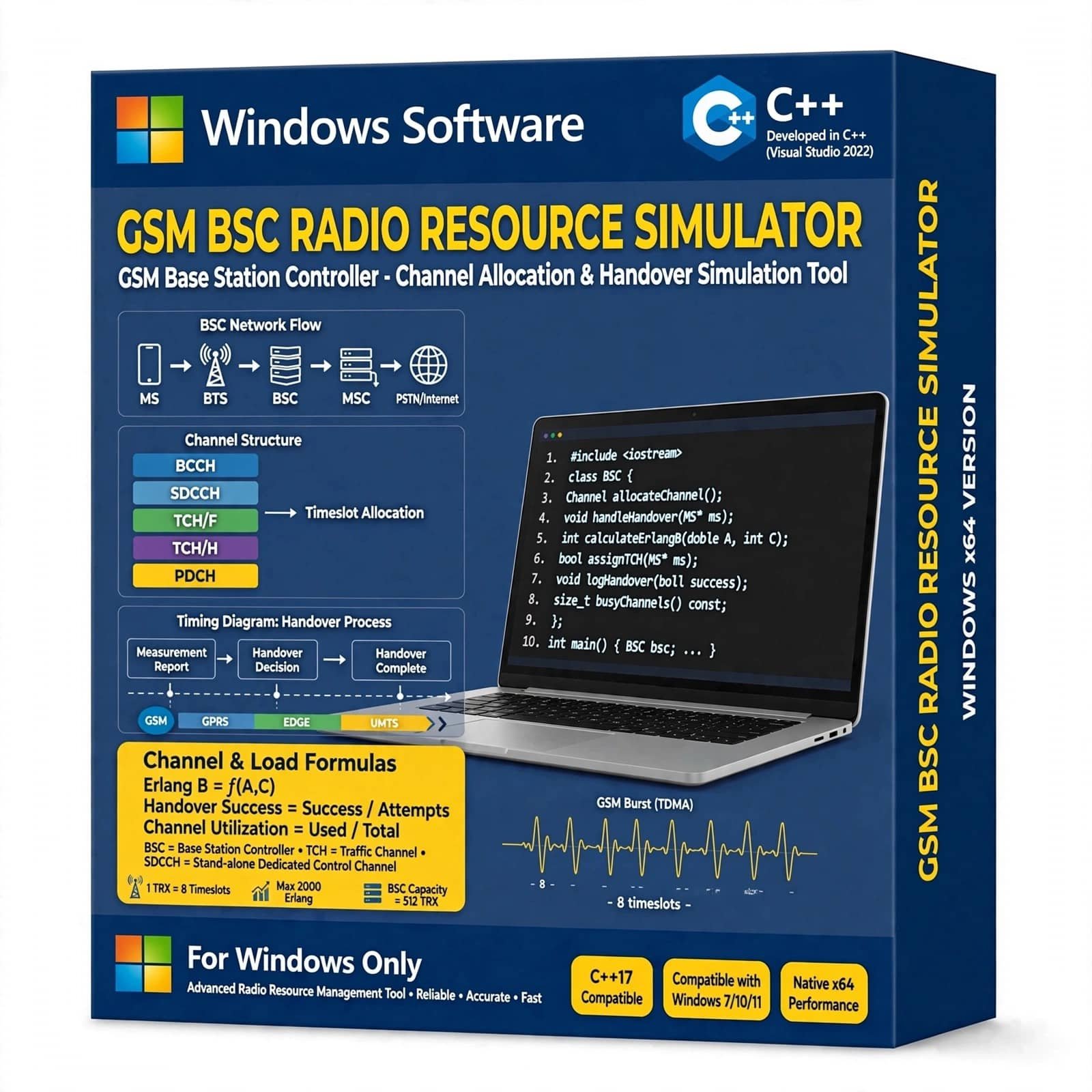
GSM BSC Radio Resource Simulator is a professional telecom training and development solution designed to simulate GSM Base Station Controller (BSC) radio resource management functions. It helps students, telecom engineers, researchers, and network professionals understand GSM radio resource allocation, channel management, call handling, handover concepts, and BSC-related network procedures in a controlled simulation environment.
Original price was: ₹750.00.₹100.00Current price is: ₹100.00.


Reviews
There are no reviews yet.