
New
90% Off

6G 0.1ms Latency (Sub-ms) Simulator


Original price was: ₹250,000.00.₹25,000.00Current price is: ₹25,000.00.
In StockThe 6G 0.1ms Latency (Sub-ms) Simulator with Python is a simulation solution designed to analyze ultra-low-latency communication in next-generation wireless networks. Using Python-based modeling and performance analysis, it helps researchers and students explore latency, packet transmission delays, network responsiveness, and communication efficiency for emerging 6G technologies. Ideal for academic research, wireless network simulation, real-time communication studies, and next-generation networking projects targeting sub-millisecond latency.
Description
6G 0.1ms Latency (Sub-ms) Simulator with Python
The 6G 0.1ms Latency (Sub-ms) Simulator with Python is a simulation-based solution for exploring ultra-low-latency communication in sixth-generation wireless networks. As wireless technology advances beyond 5G, 6G research focuses on faster communication, highly reliable connectivity, intelligent network management, and improved responsiveness for demanding applications. A latency target of 0.1 milliseconds (ms) represents an ambitious research objective that can be investigated through Python-based modeling and network performance analysis.
Python provides a flexible environment for developing communication models, analyzing simulation results, visualizing performance metrics, and evaluating different network configurations. This makes it a useful tool for students, researchers, and engineers studying next-generation wireless communication systems.

Key Features of the 6G Latency Simulator
The 6G 0.1ms Latency Simulator can be designed to model important network parameters, including packet transmission delay, processing delay, propagation delay, queuing delay, and end-to-end latency. By changing simulation settings, users can investigate how different network conditions influence communication responsiveness and overall performance.
Python libraries for numerical computing, data analysis, plotting, and discrete-event simulation can support the development of these experiments. Depending on the implementation, the simulator may include configurable traffic patterns, communication channels, network nodes, latency measurements, and graphical representations of simulation results.
These capabilities enable users to explore the factors that affect ultra-low-latency communication and compare alternative network configurations.

Explore 0.1ms Sub-Millisecond Latency
Ultra-low latency is an important research objective for future wireless networks. Applications such as industrial automation, real-time robotics, connected transportation, immersive extended reality (XR), and time-sensitive control systems can benefit from highly responsive communication.
A 0.1ms latency target corresponds to 100 microseconds. Achieving this level of delay depends on several factors, including the definition of latency, network architecture, physical distance, processing requirements, radio conditions, and the communication protocol. It is important to distinguish a simulated latency target from a guaranteed real-world 6G performance level.
Using Python-based simulation, researchers can evaluate theoretical scenarios, estimate delays, and identify potential bottlenecks that may prevent a network from meeting strict latency requirements.

Applications of Python-Based 6G Simulation
The simulator can support academic projects and research in wireless communication, network engineering, and next-generation telecommunications. Potential applications include ultra-reliable low-latency communication (URLLC) studies, real-time data exchange, edge computing, intelligent transportation systems, industrial Internet of Things (IIoT), and AI-assisted network optimization.
Python-based experiments can also help users compare different traffic loads, packet sizes, processing assumptions, and network configurations. Charts and statistical summaries can make it easier to understand latency distributions, average delays, percentile performance, and variations under changing network conditions.
Benefits for Students and Researchers
One of the major advantages of Python simulation is flexibility. Users can customize parameters, automate experiments, process output data, and generate visualizations without requiring a complete physical wireless testbed. This approach can simplify early-stage research and help students understand the relationship between network design and communication delay.
The simulator can be extended with additional models for edge processing, scheduling algorithms, resource allocation, or network traffic management, depending on project requirements and software architecture.
Conclusion
The 6G 0.1ms Latency (Sub-ms) Simulator with Python offers a practical starting point for studying ultra-low-latency communication and future wireless network performance. By modeling delay components and analyzing simulation results, users can investigate the challenges associated with achieving highly responsive communication in emerging 6G environments.

Whether used for academic research, Python programming projects, network performance evaluation, or next-generation communication studies, this simulator can help users explore latency optimization techniques and the future possibilities of wireless connectivity.
Related products
-
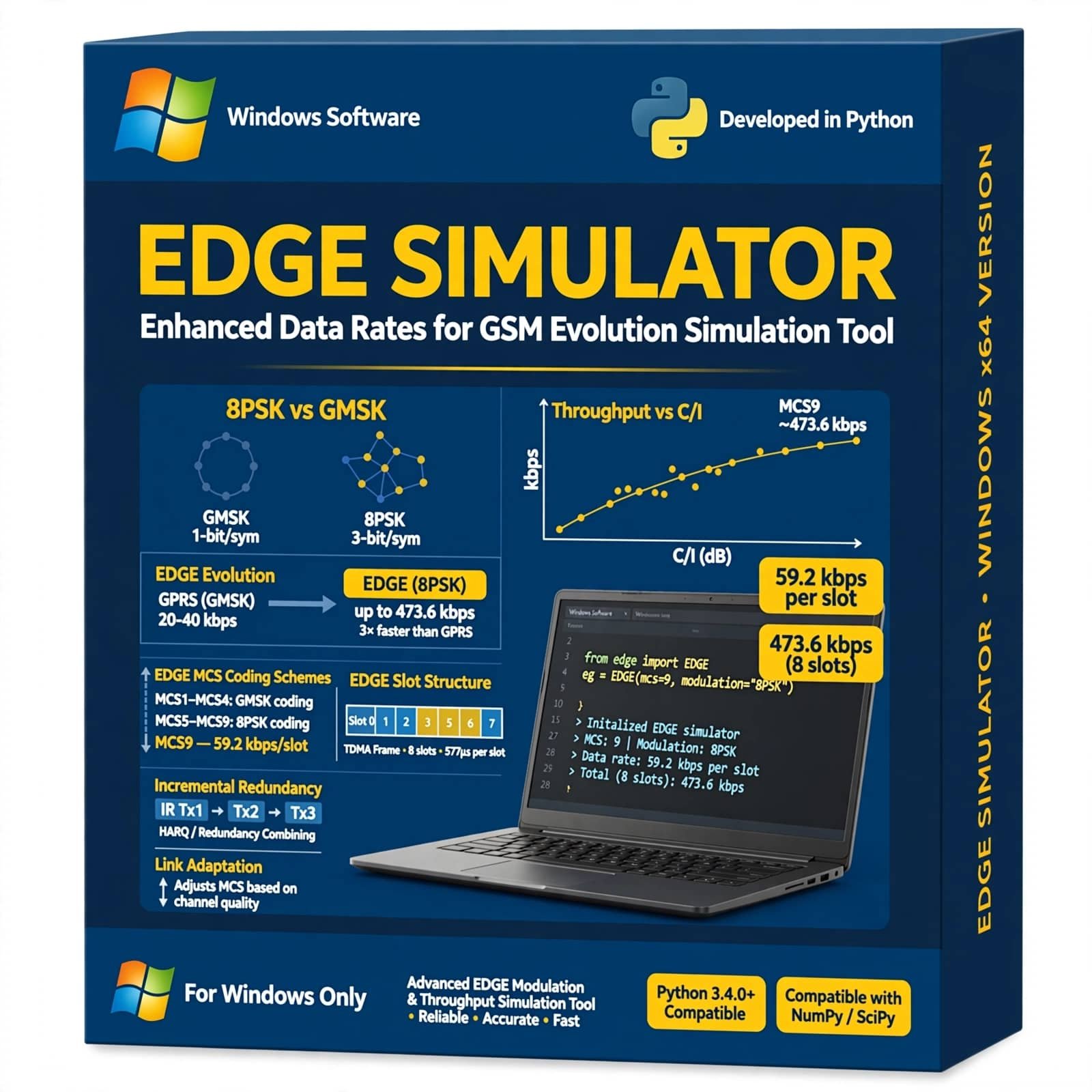
EDGE Simulator Using Python is a practical mobile communication simulation tool designed to demonstrate and analyze Enhanced Data rates for GSM Evolution (EDGE) technology. It helps students, researchers, and communication engineers study GSM/EDGE data transmission, modulation, channel conditions, bit error rate, data rates, and wireless communication performance using Python-based simulation.
₹3,499.00 -
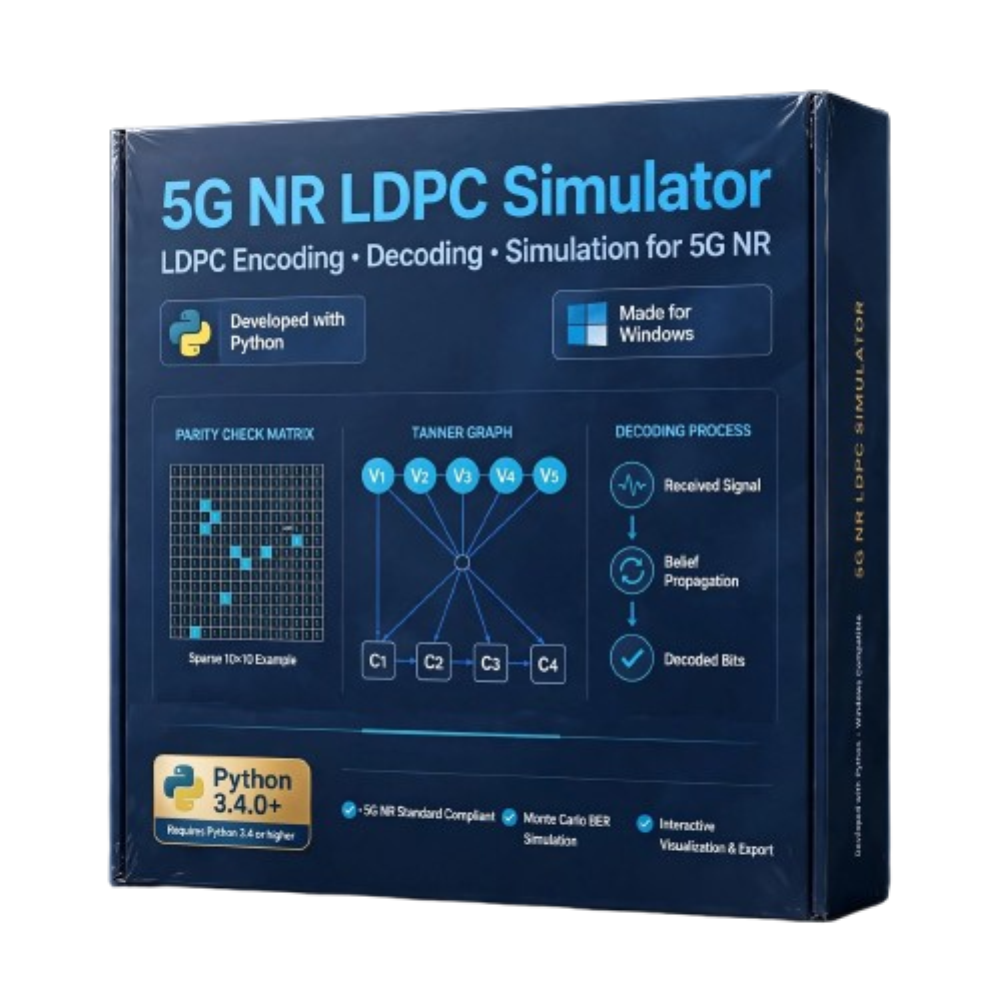
5G NR LDPC Simulator is an advanced simulation solution for modeling and analyzing Low-Density Parity-Check (LDPC) channel coding used in 5G New Radio systems. It enables users to simulate LDPC encoding and decoding, evaluate error correction performance, and analyze BER, BLER, SNR, coding rate, decoding iterations, throughput, and convergence under configurable channel conditions. The simulator is ideal for 5G NR channel coding research, algorithm development, academic projects, decoder performance analysis, and next-generation wireless communication system optimization.
Original price was: ₹129,999.00.₹12,999.00Current price is: ₹12,999.00. -
The 16QAM Modem Simulator is a C++-based software application designed to simulate and analyze a 16-QAM digital communication system. It demonstrates the complete modulation and demodulation process, including symbol mapping, signal generation, transmission, and data recovery. The simulator helps users understand key concepts of digital communication and evaluate system performance under different channel conditions.
₹1,999.00 -
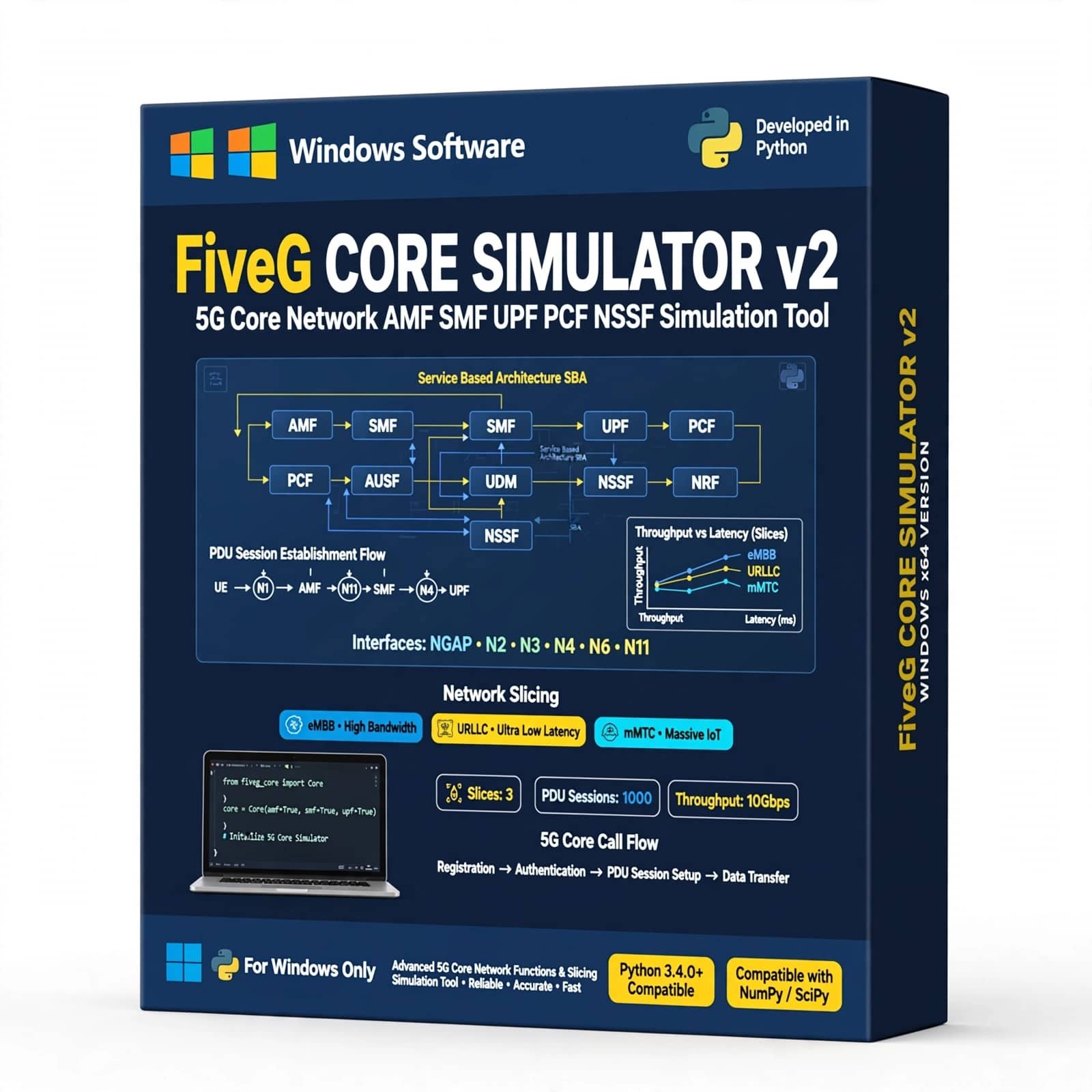
FiveG Core Simulator v2 is an educational 5G Core Network simulation tool designed to help students, educators, researchers, and telecom professionals understand 5G core architecture, network functions, signaling procedures, latency, and protocol interactions through an interactive topology and signaling animation environment.
₹19,999.00 -
The 3G UMTS – WCDMA Simulator is a software-based simulation project designed to demonstrate the fundamental concepts of 3G Universal Mobile Telecommunications System (UMTS) and Wideband Code Division Multiple Access (WCDMA) technology. It provides a practical environment for studying cellular communication, spreading codes, signal transmission, mobile users, network connectivity, and WCDMA-based communication principles. The simulator is suitable for students, researchers, and developers working on telecommunications and wireless communication projects. It can be used for academic demonstrations, engineering projects, research, experimentation, and learning about 3G mobile communication and WCDMA network technologies.
₹3,999.00 -
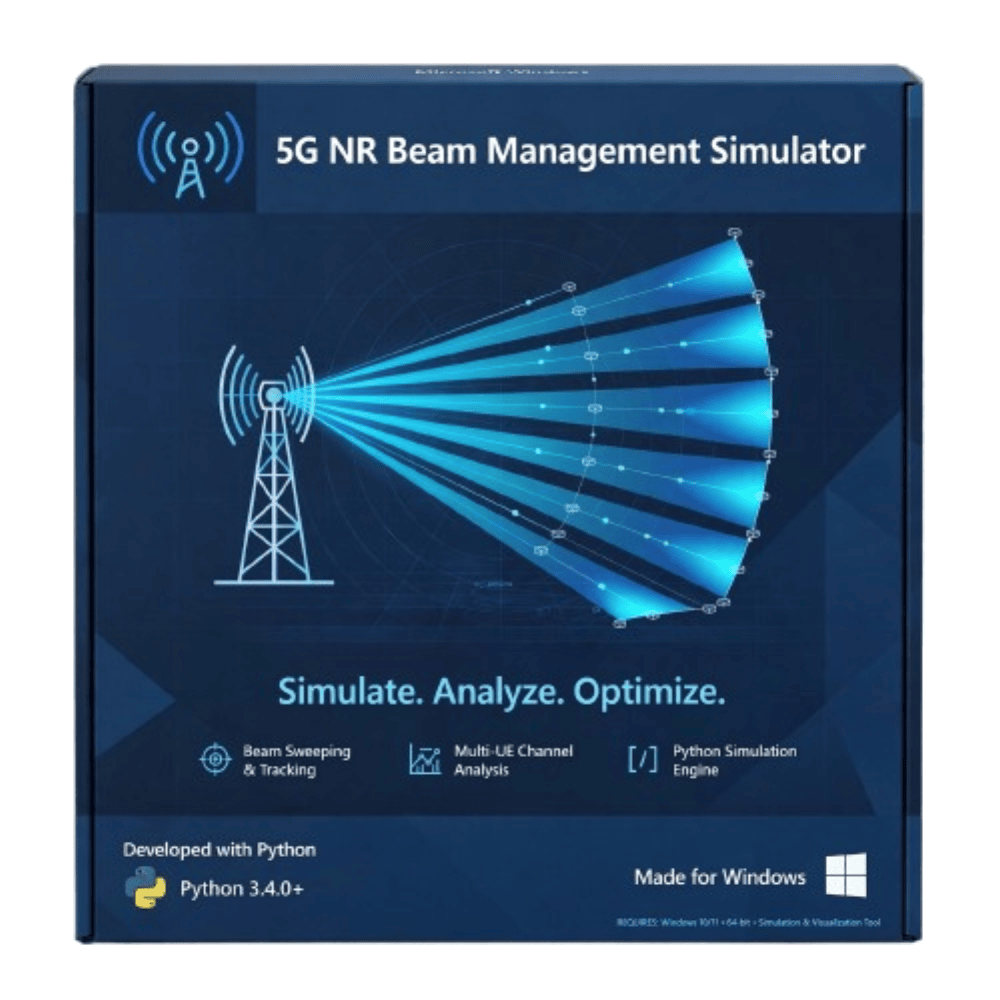
5G NR Beam Management Simulator is an advanced simulation solution designed to model, analyze, and optimize beam management procedures in 5G New Radio (NR) networks. It enables engineers and researchers to evaluate beam sweeping, beam measurement, beam selection, beam reporting, and beam recovery under diverse network and channel conditions. The simulator supports performance analysis of directional communication, helping users assess beamforming strategies, mobility scenarios, link reliability, and system-level performance before real-world deployment.
Original price was: ₹74,999.00.₹12,999.00Current price is: ₹12,999.00.


Reviews
There are no reviews yet.