
87% Off

5G QoS Simulator


Original price was: ₹74,999.00.₹9,999.00Current price is: ₹9,999.00.
In StockThe 5G QoS Simulator is a Python-based software solution designed for researchers, engineers, students, developers, and telecommunications professionals working with 5G Quality of Service (QoS) concepts. The simulator provides a software-based environment for studying and analyzing QoS-related aspects of 5G communication networks, including service performance, traffic behavior, resource management, and network performance evaluation.
Developed using Python, the simulator is suitable for academic research, telecommunications projects, demonstrations, experimentation, algorithm development, and educational applications.
Available for sale as a software product. Contact us for pricing, licensing, features, customization, and purchase information.
Description
5G QoS Simulator
The 5G QoS Simulator is a specialized simulation software solution developed in Python for studying and analyzing Quality of Service (QoS) concepts in 5G New Radio and next-generation wireless communication networks. The software provides a practical environment for researchers, students, engineers, developers, and telecommunications professionals who want to investigate how different network conditions and traffic requirements can affect the performance of 5G communication systems.
Quality of Service is an important aspect of modern wireless networks because different applications have different performance requirements. Applications such as high-speed data services, video communication, industrial applications, IoT services, and other latency-sensitive or bandwidth-intensive services may require different levels of network performance. A 5G QoS simulator can help users study these requirements through a controlled and repeatable simulation environment.
Python-Based Simulation Platform
A key characteristic of this product is that the 5G QoS Simulator is written in Python. Python is widely used in research, engineering, scientific computing, data analysis, and telecommunications because of its flexibility and extensive software ecosystem.
The Python-based implementation makes the simulator suitable for users who already work with Python for communication-system research and development. It can also provide a convenient foundation for experimentation, analysis, visualization, and further development based on individual project requirements.
Researchers and developers can use the simulator to investigate QoS-related concepts without requiring access to a complete commercial 5G network or specialized physical network infrastructure.
5G Quality of Service Simulation
The simulator is designed around the study of Quality of Service in 5G networks. QoS evaluation can involve several important performance parameters, depending on the simulation scenario and application requirements.
These parameters may include aspects such as:
- Network throughput
- Latency and delay
- Packet delivery behavior
- Traffic performance
- Resource utilization
- Service performance
- Network capacity
- Application-specific requirements
By working with these concepts in a simulated environment, users can develop a better understanding of how network conditions, traffic characteristics, and resource-management strategies can influence the overall performance experienced by different services.
Useful for 5G Research and Development
The 5G QoS Simulator can be used as a research and development tool for projects involving wireless communication, mobile networks, network optimization, traffic management, and 5G technologies.
Researchers can use simulation-based approaches to test concepts before implementing them in real-world environments. This can make it easier to compare different approaches, evaluate scenarios, identify performance trends, and develop proof-of-concept solutions.
The simulator can also serve as a foundation for students and developers who want to gain practical experience with QoS concepts in next-generation wireless communication systems.

Academic and Educational Applications
The software can be particularly useful for universities, engineering colleges, research laboratories, students, and academic researchers.
It may be used for:
- Final-year engineering projects
- Master’s and PhD research
- 5G network simulation studies
- Telecommunications laboratory exercises
- Wireless communication assignments
- QoS performance analysis
- Network optimization research
- Research demonstrations
- Academic presentations
- Proof-of-concept implementations
Because the simulator is developed in Python, students and researchers can work within a familiar programming environment while exploring 5G QoS concepts.
Applications of the 5G QoS Simulator
Potential applications include 5G network performance evaluation, QoS analysis, traffic-management studies, resource-allocation research, network optimization, wireless communication research, and educational demonstrations.
The simulator can also be useful when developing research prototypes where different network or service conditions need to be evaluated systematically.
By using simulation rather than immediately relying on real network infrastructure, researchers can perform controlled experiments and investigate different scenarios in a repeatable manner.
Benefits of a Simulation-Based Approach
Simulation provides an effective way to explore communication-network concepts before moving toward real-world deployment. A software simulator allows users to modify scenarios, repeat experiments, compare results, and investigate the effects of different parameters.
For 5G QoS research, this approach can help users understand the relationship between network performance and service requirements. It can also support the development and evaluation of new ideas related to network management, resource utilization, and service performance.
Key Highlights
- 5G QoS simulation software
- Designed for studying Quality of Service in 5G networks
- Developed using Python
- Suitable for research and development
- Useful for academic and educational projects
- Suitable for telecommunications engineers and researchers
- Can be used for QoS and network-performance studies
- Useful for simulation-based experimentation
- Suitable for demonstrations and proof-of-concept development
- Python-based environment for further analysis and development
- Available for sale
- Licensing and customization options can be discussed with the seller
Software Product – Available for Sale
The 5G QoS Simulator is available for sale as a software product for users interested in studying and experimenting with Quality of Service concepts in 5G communication networks.
It is suitable for researchers, telecommunications professionals, engineers, students, universities, academic institutions, and developers working on 5G, wireless communication, network performance, and QoS-related projects.
Customers can contact the seller for further information regarding **pricing, licensing, installation, source-code availability, technical specifications, supported simulation features, customization
Related products
-
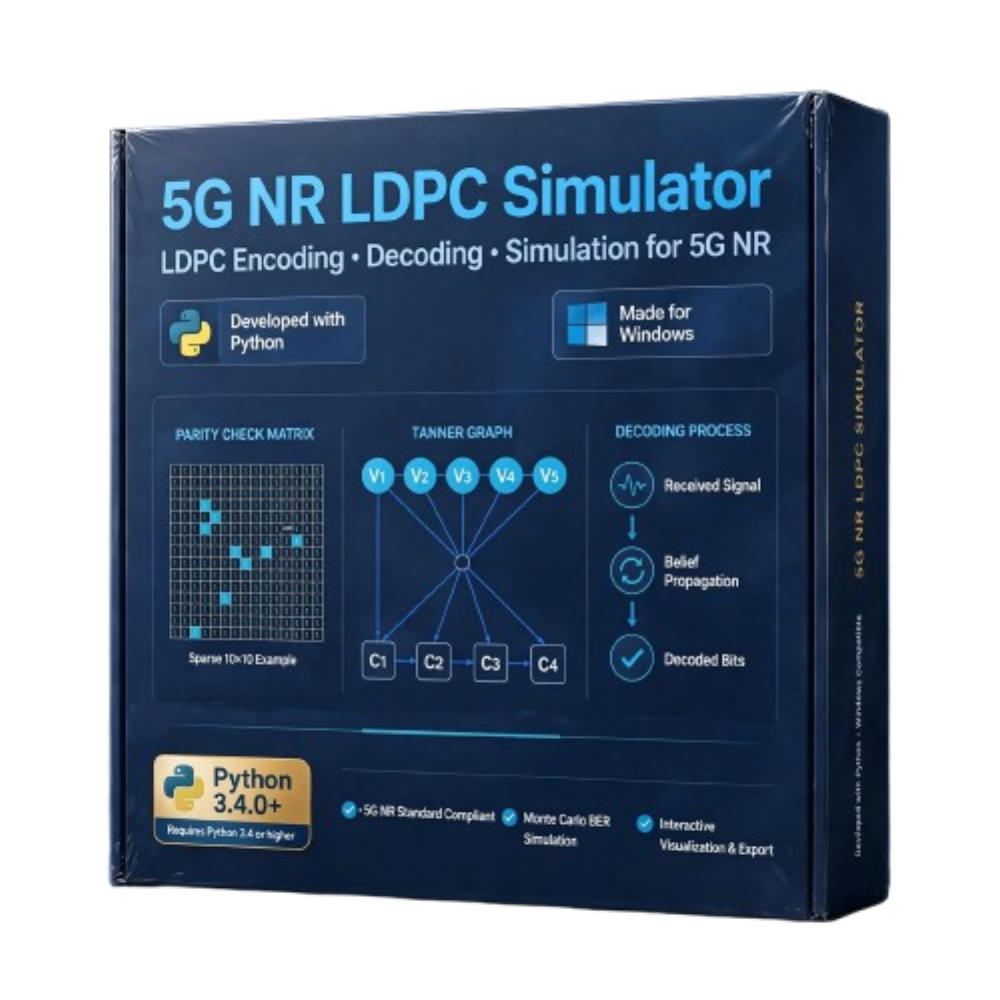
5G NR LDPC Simulator is an advanced simulation solution for modeling and analyzing Low-Density Parity-Check (LDPC) channel coding used in 5G New Radio systems. It enables users to simulate LDPC encoding and decoding, evaluate error correction performance, and analyze BER, BLER, SNR, coding rate, decoding iterations, throughput, and convergence under configurable channel conditions. The simulator is ideal for 5G NR channel coding research, algorithm development, academic projects, decoder performance analysis, and next-generation wireless communication system optimization.
Original price was: ₹129,999.00.₹12,999.00Current price is: ₹12,999.00. -
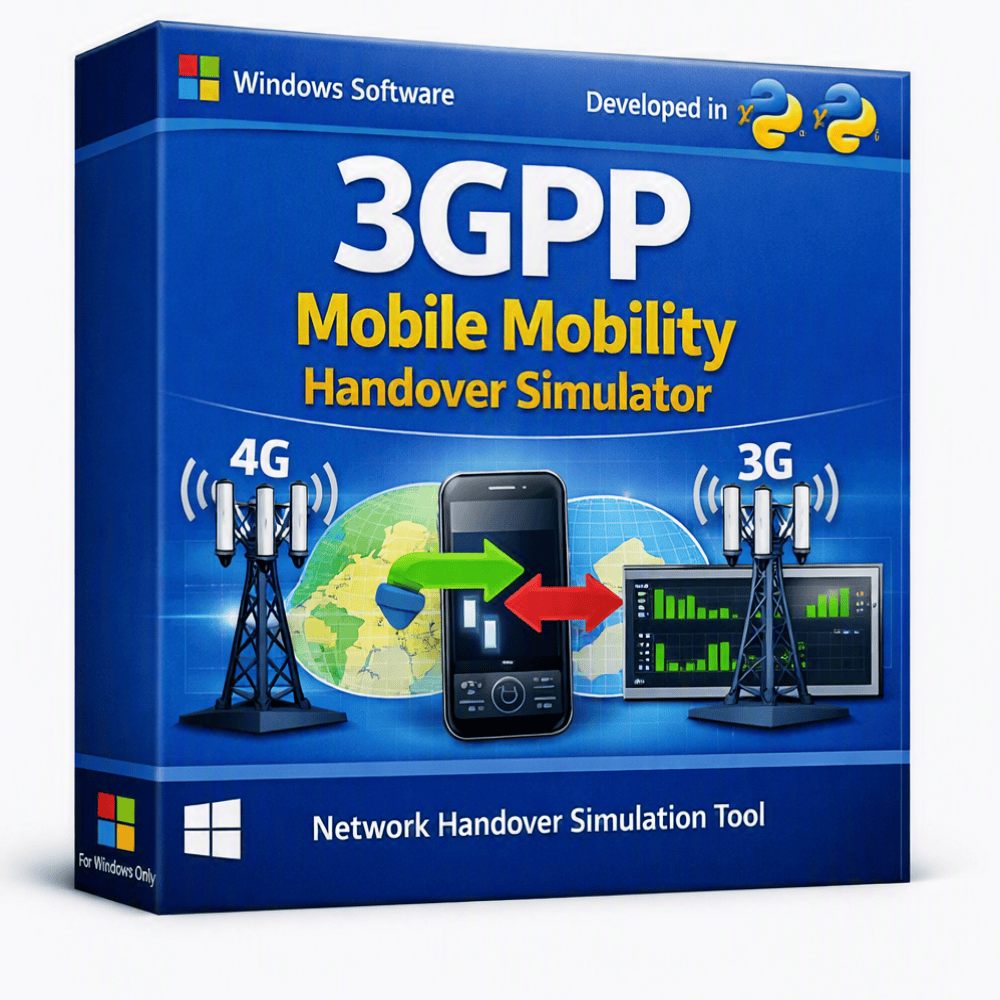
A powerful simulation tool for analyzing and validating 3GPP mobile mobility and handover procedures. The simulator enables users to model mobile network scenarios, study handover behavior, and evaluate mobility performance under different network conditions.
Key Features:
- 3GPP-compliant mobility and handover simulation
- Configurable network and mobility scenarios
- Analysis of handover performance and behavior
- Supports research, testing, and network optimization
- Useful for telecom engineers, researchers, and academic projects
Ideal for 5G/4G/3G mobility research, protocol testing, network planning, and academic simulation studies.
₹3,999.00 -
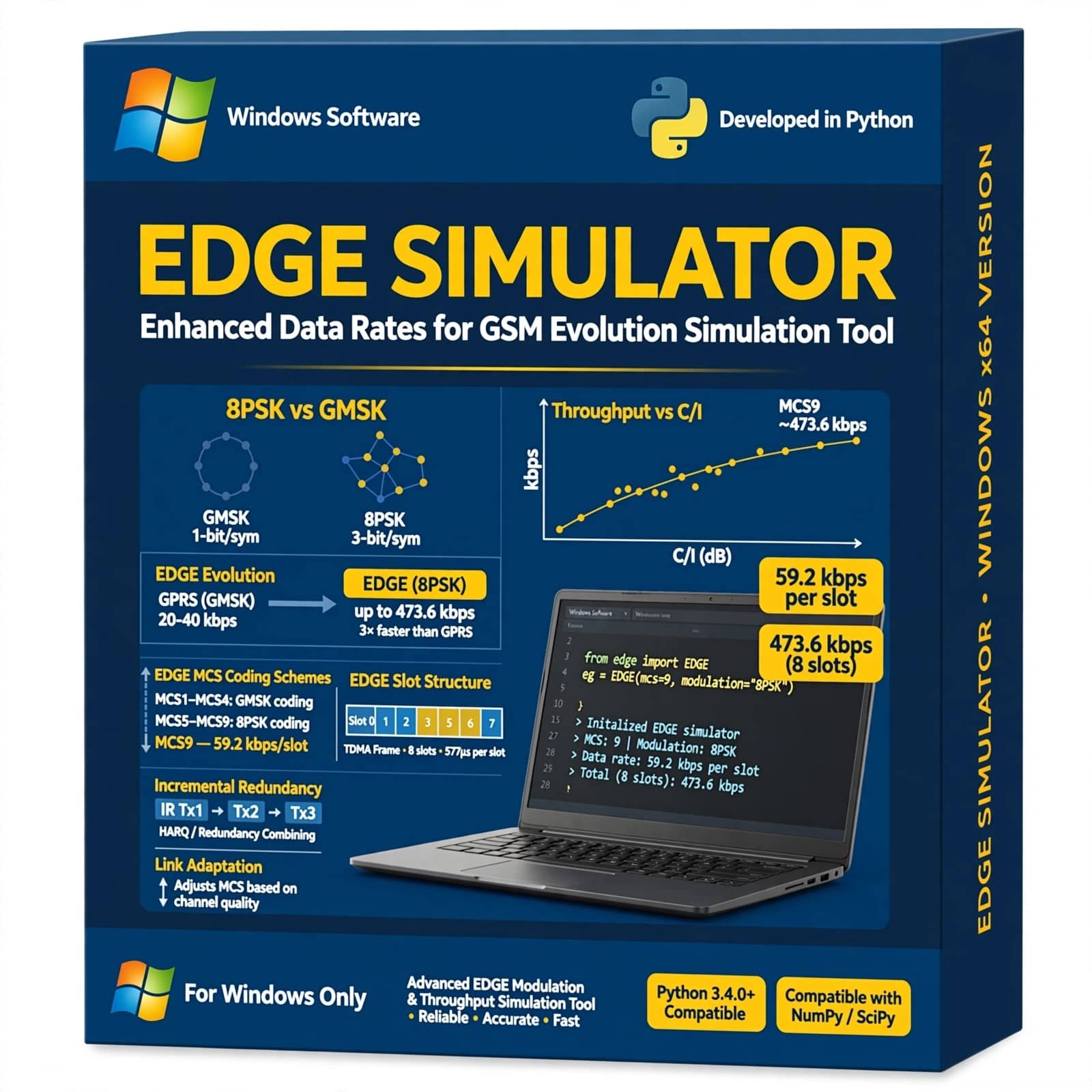
EDGE Simulator Using Python is a practical mobile communication simulation tool designed to demonstrate and analyze Enhanced Data rates for GSM Evolution (EDGE) technology. It helps students, researchers, and communication engineers study GSM/EDGE data transmission, modulation, channel conditions, bit error rate, data rates, and wireless communication performance using Python-based simulation.
₹3,499.00 -
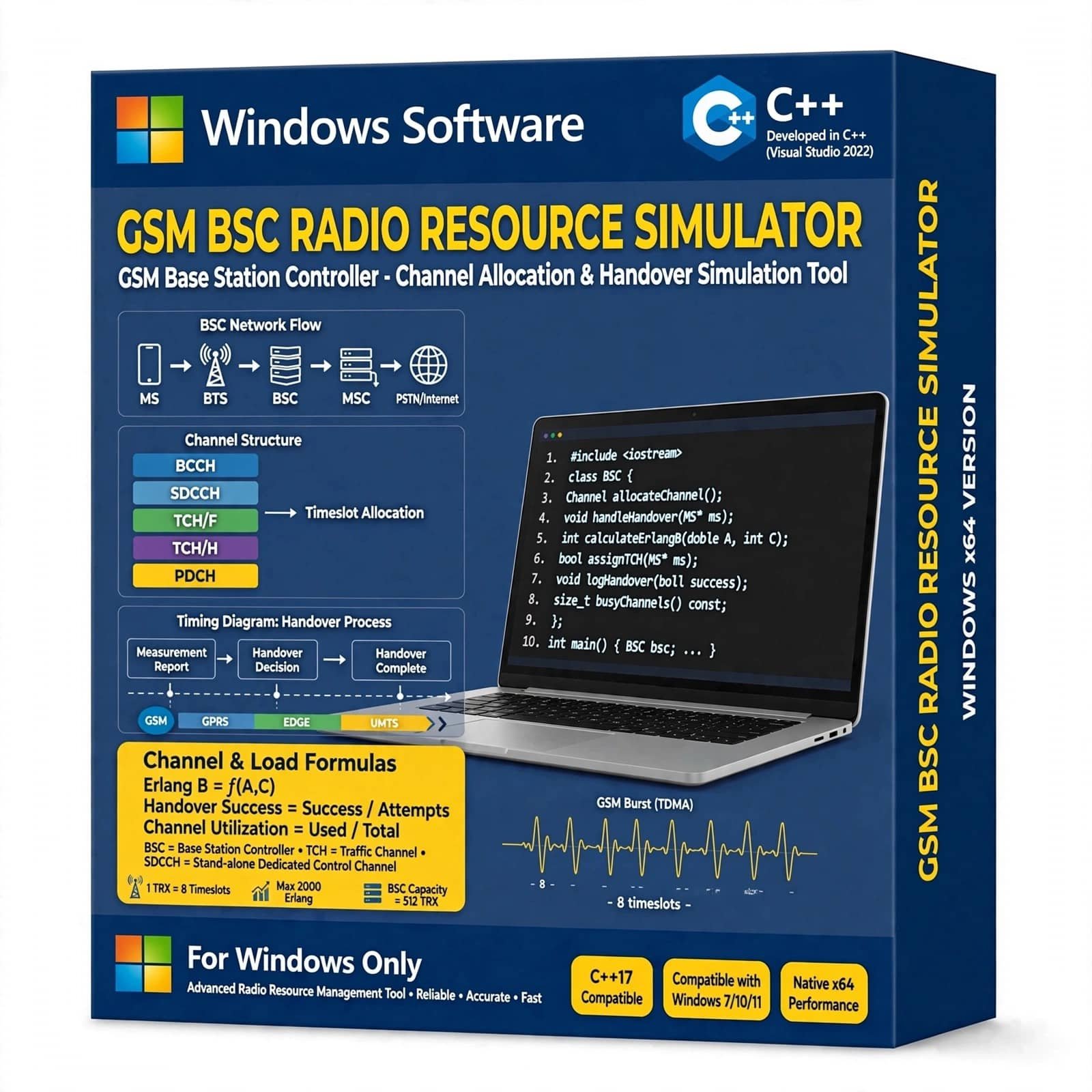
GSM BSC Radio Resource Simulator is a professional telecom training and development solution designed to simulate GSM Base Station Controller (BSC) radio resource management functions. It helps students, telecom engineers, researchers, and network professionals understand GSM radio resource allocation, channel management, call handling, handover concepts, and BSC-related network procedures in a controlled simulation environment.
Original price was: ₹750.00.₹100.00Current price is: ₹100.00. -
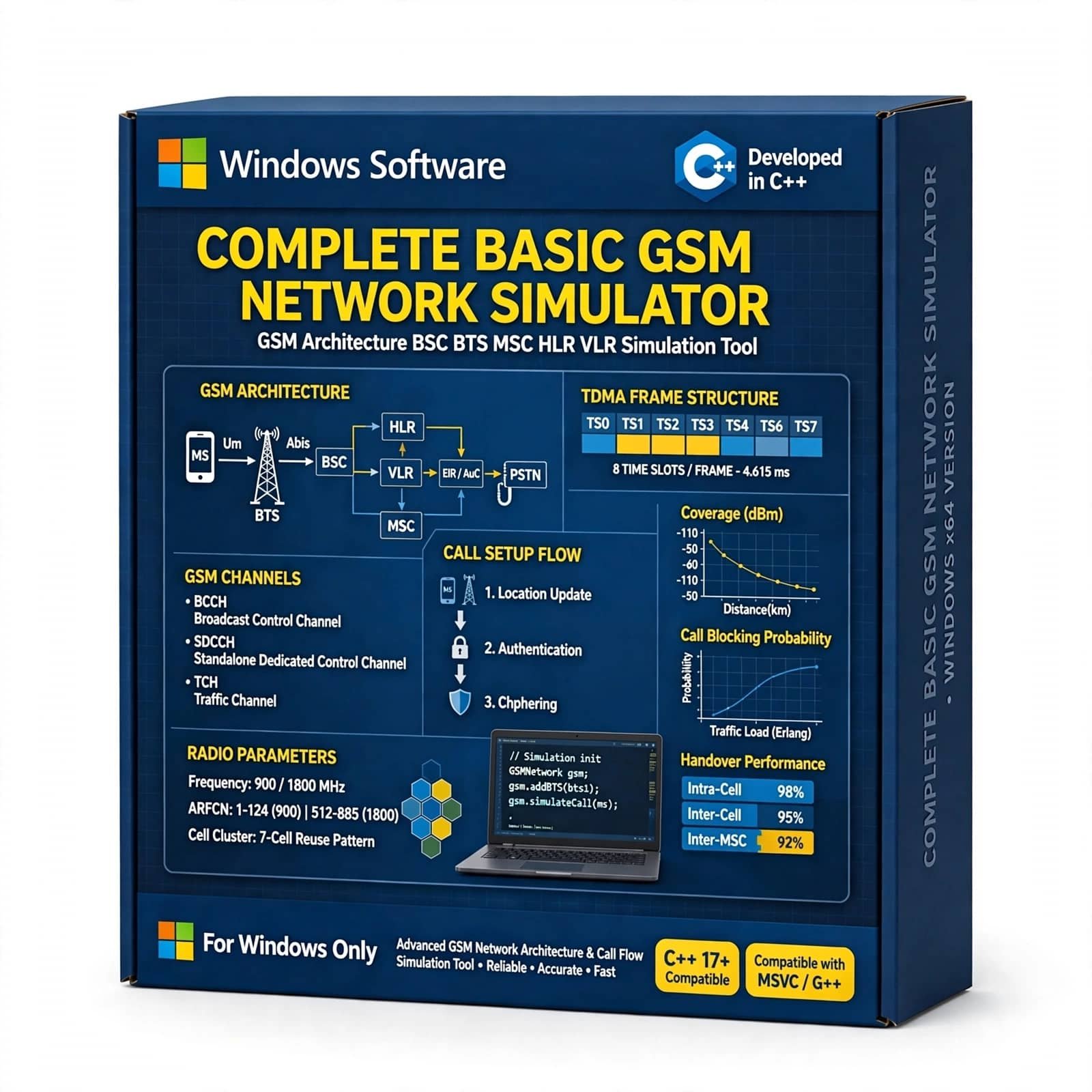
Complete Basic GSM Network with C++ is an educational and simulation-based project that demonstrates the fundamental architecture and operation of a GSM network using C++. It helps students and researchers understand GSM components, mobile communication, call and message handling, network signaling, and basic cellular network operations through a practical C++ implementation.
Original price was: ₹3,999.00.₹2,399.00Current price is: ₹2,399.00. -
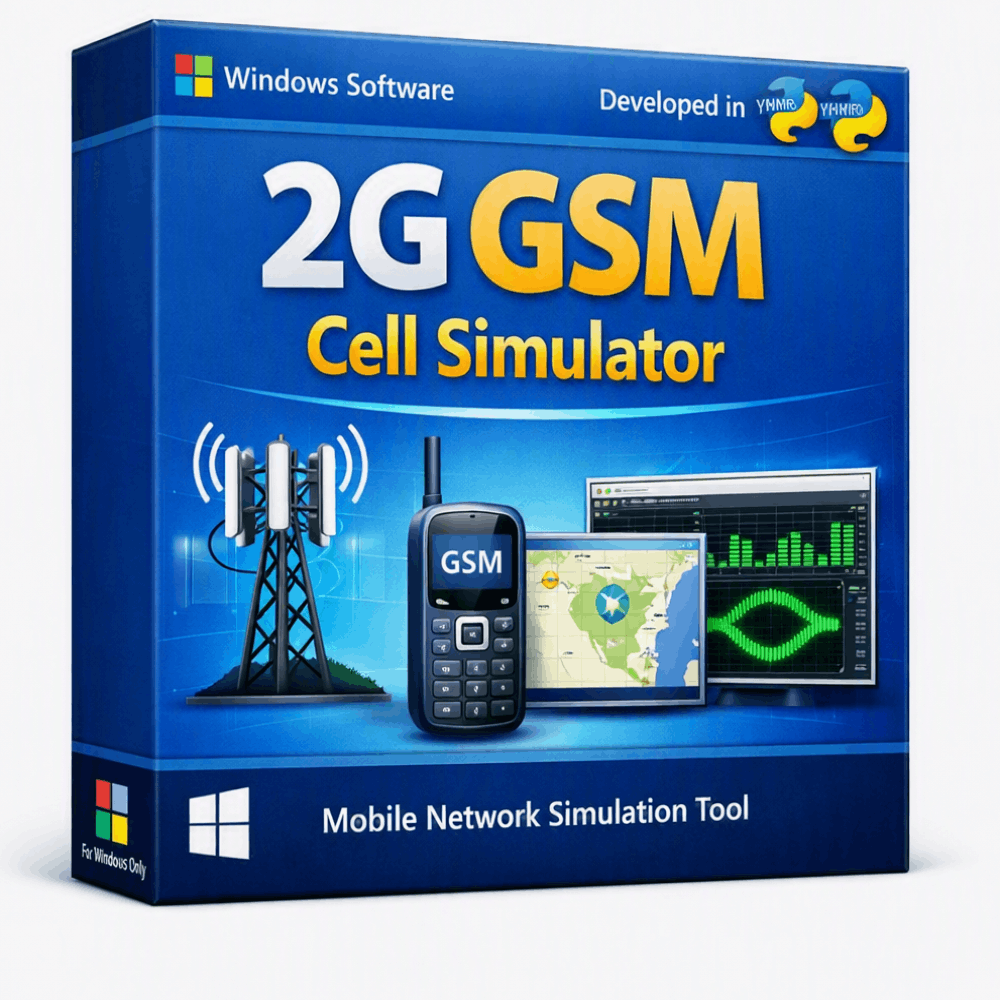
The 2G GSM Cell Simulator is a Python-based software project designed to simulate fundamental GSM cellular-network concepts. It provides a practical environment for understanding mobile stations, GSM cells, base stations, cellular coverage, mobility, communication channels, and basic network behavior. The project includes Python source code that can be studied, customized, and extended for academic projects, demonstrations, research, and learning. It is ideal for Electronics & Communication Engineering, Telecommunications, Computer Science, and related students looking to explore 2G GSM technology and cellular network simulation through a software-based implementation.
₹3,999.00


Reviews
There are no reviews yet.