
90% Off

5G NR PDSCH PUSCH Simulator


Original price was: ₹129,999.00.₹12,999.00Current price is: ₹12,999.00.
In StockThe 5G NR PDSCH PUSCH Simulator is a Python-based simulation software solution designed for researchers, engineers, students, and telecommunications professionals working with 5G New Radio (NR) physical-layer technologies. The simulator provides a practical environment for studying and experimenting with PDSCH (Physical Downlink Shared Channel) and PUSCH (Physical Uplink Shared Channel) transmission concepts.
Developed using Python, the simulator is suitable for academic research, algorithm development, demonstrations, testing, and educational applications related to 5G NR communication systems.
Available for sale as a software product. Contact us for product details, licensing, and purchase information.
Description
5G NR PDSCH PUSCH Simulator
The 5G NR PDSCH PUSCH Simulator is a specialized software solution developed in Python for simulation and experimentation with important physical-layer components of 5G New Radio (NR) communication systems. It is designed to provide users with a practical software environment for understanding, analyzing, developing, and demonstrating concepts associated with PDSCH (Physical Downlink Shared Channel) and PUSCH (Physical Uplink Shared Channel).
As 5G networks continue to evolve, simulation tools have become increasingly important for researchers, students, engineers, developers, and telecommunications professionals who need to evaluate communication algorithms and understand the behavior of modern wireless systems. This Python-based simulator provides a convenient platform for working with 5G NR PDSCH and PUSCH concepts without requiring access to a complete physical 5G network or dedicated laboratory hardware.
Python-Based 5G NR Simulation
One of the key features of this product is that it is written in Python. Python is widely used in engineering, scientific computing, research, data analysis, and communication-system development because of its flexibility and extensive ecosystem of libraries and tools.
A Python-based implementation makes the simulator particularly useful for users who want to integrate 5G NR simulation concepts with their existing Python-based research or development workflows. Researchers can use the software as a starting point for experimentation, analysis, demonstrations, and further development according to their specific requirements.
PDSCH and PUSCH Simulation
The simulator focuses on two important channels within the 5G NR physical layer:
- PDSCH – Physical Downlink Shared Channel: Used for carrying downlink user data from the network to the user equipment (UE).
- PUSCH – Physical Uplink Shared Channel: Used for transmitting uplink user data from the UE toward the network.
By providing simulation capabilities around these channels, the software can be useful for exploring the basic processing and transmission concepts involved in 5G NR downlink and uplink communication.
The simulator can serve as an effective platform for studying signal-processing workflows, communication-system behavior, parameter variations, and other aspects associated with PDSCH and PUSCH-based transmission.
Suitable for Research and Education
The 5G NR PDSCH PUSCH Simulator can be particularly valuable for academic and research applications. Universities, laboratories, students, and researchers can use the software as part of projects involving 5G communication, wireless systems, signal processing, digital communications, and next-generation mobile networks.
It can also be used for educational demonstrations and laboratory exercises where users need to understand how different 5G NR physical-layer concepts work in a simulated environment.
For researchers, the Python implementation can provide a foundation for experimenting with algorithms, modifying simulation parameters, analyzing results, and extending the software for specific research requirements.

Applications
Potential applications of the 5G NR PDSCH PUSCH Simulator include:
- 5G NR research and development
- Wireless communication research
- PDSCH and PUSCH studies
- Physical-layer algorithm development
- 5G NR academic projects
- University and engineering laboratory work
- Communication-system demonstrations
- Signal-processing experimentation
- 5G technology training and education
- Simulation-based testing and analysis
- Research publications and thesis projects
- Proof-of-concept development
Why Choose This Simulator?
A major advantage of this product is its combination of 5G NR-focused functionality and Python-based development. Instead of starting a 5G simulation project completely from scratch, users can work with an existing simulator and adapt their experimentation around the provided functionality.
The software can be useful for users who need a practical way to investigate PDSCH and PUSCH concepts while working within a familiar Python programming environment. It can also help reduce development time when preparing demonstrations, research prototypes, or educational projects related to 5G NR.
Software Product – Available for Sale
The 5G NR PDSCH PUSCH Simulator is available for sale as a software product. It is intended for customers looking for a Python-based solution for 5G NR PDSCH and PUSCH simulation, research, education, and development.
Whether you are a 5G researcher, telecommunications engineer, university student, academic institution, communication-systems developer, or technology professional, this simulator can provide a useful starting point for working with 5G NR physical-layer simulation concepts.
For information about software licensing, installation, source-code availability, supported features, customization, pricing, and purchase options, please contact the product provider before ordering.
Key Highlights
- 5G NR PDSCH and PUSCH simulator
- Developed using Python
- Suitable for 5G NR research and experimentation
- Useful for academic and educational projects
- Supports study of downlink and uplink physical-layer concepts
- Suitable for researchers, students, engineers, and developers
- Can be used for demonstrations and proof-of-concept development
- Python environment allows further analysis and development
- Available for sale
- Licensing and product details available from the seller
The 5G NR PDSCH PUSCH Simulator offers a practical software-based approach for users interested in exploring key 5G New Radio physical-layer concepts. With its Python-based implementation and focus on PDSCH and PUSCH simulation, it can be used as a valuable resource for research, education, experimentation, algorithm development, and 5G communication-system studies.
Related products
-
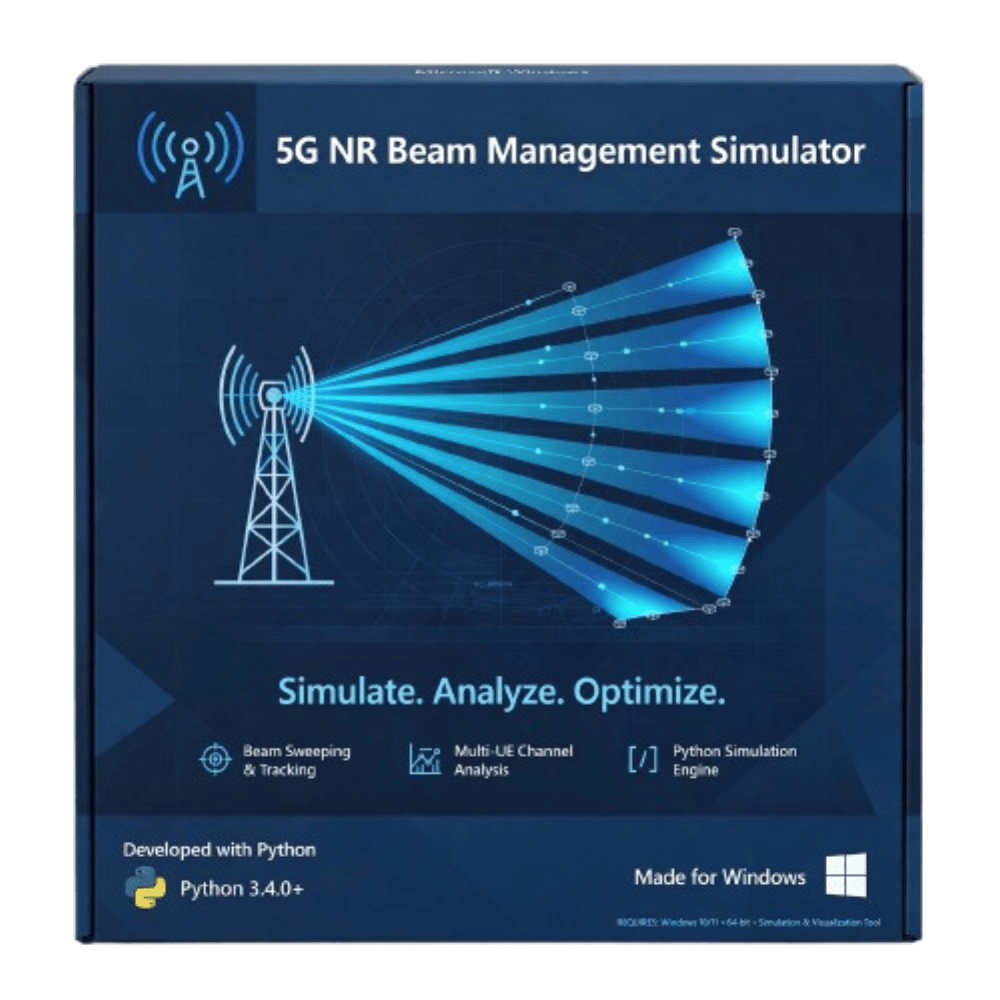
5G NR Beam Management Simulator is an advanced simulation solution designed to model, analyze, and optimize beam management procedures in 5G New Radio (NR) networks. It enables engineers and researchers to evaluate beam sweeping, beam measurement, beam selection, beam reporting, and beam recovery under diverse network and channel conditions. The simulator supports performance analysis of directional communication, helping users assess beamforming strategies, mobility scenarios, link reliability, and system-level performance before real-world deployment.
Original price was: ₹74,999.00.₹12,999.00Current price is: ₹12,999.00. -
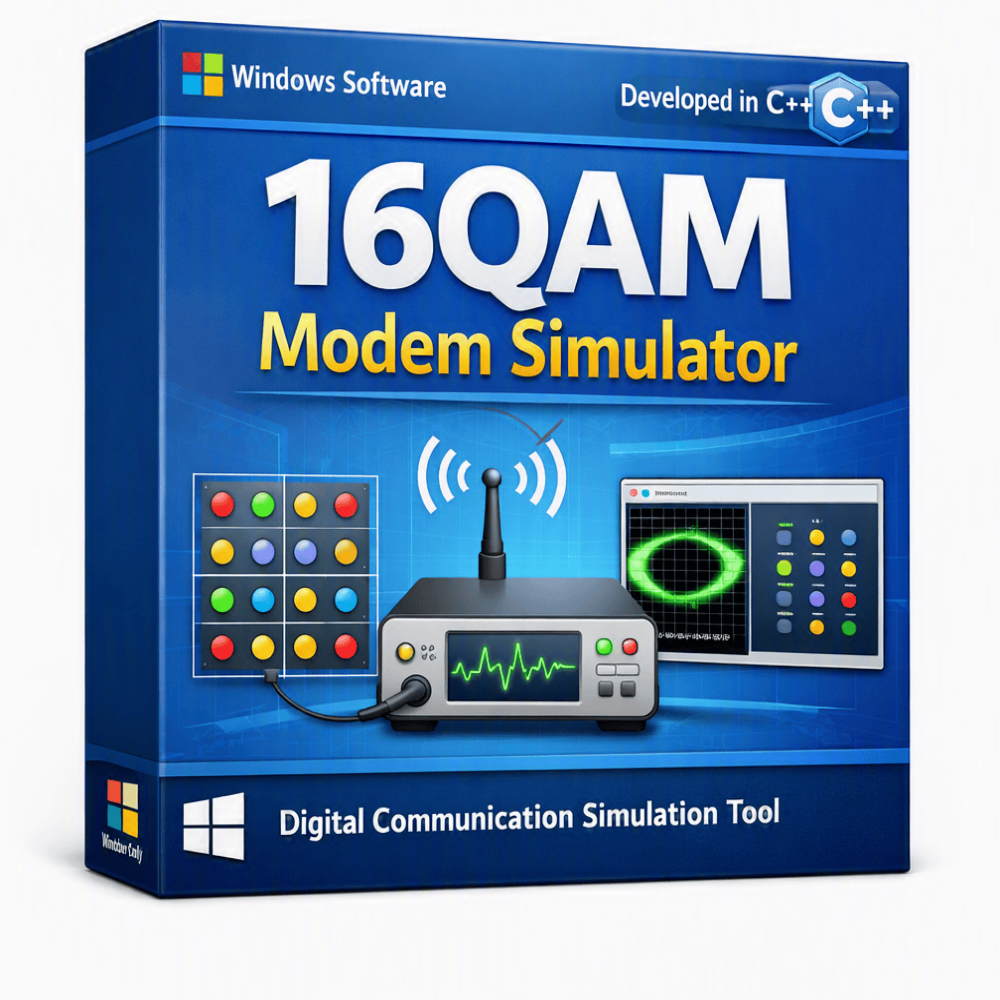
The 16QAM Modem Simulator is a C++-based software application designed to simulate and analyze a 16-QAM digital communication system. It demonstrates the complete modulation and demodulation process, including symbol mapping, signal generation, transmission, and data recovery. The simulator helps users understand key concepts of digital communication and evaluate system performance under different channel conditions.
₹1,999.00 -
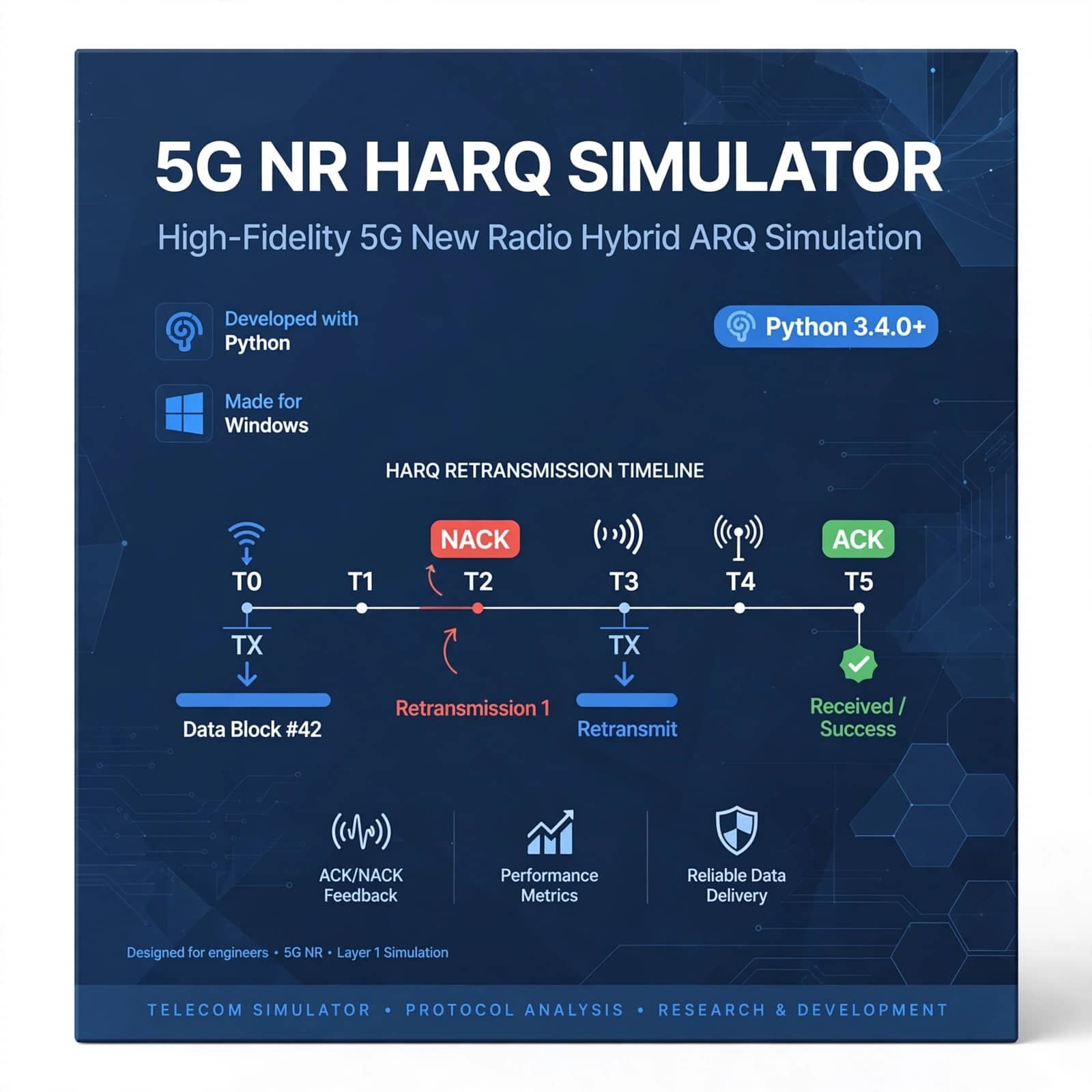
5G NR HARQ Simulator is an advanced simulation solution for modeling and analyzing Hybrid Automatic Repeat Request (HARQ) mechanisms in 5G New Radio networks. It enables users to study HARQ processes, ACK/NACK feedback, retransmissions, link adaptation, channel errors, and communication reliability under configurable network conditions. The simulator supports analysis of throughput, BLER, latency, retransmission rate, packet errors, spectral efficiency, and other key performance metrics, making it suitable for 5G NR research, algorithm development, academic projects, and wireless communication system optimization.
Original price was: ₹74,999.00.₹9,999.00Current price is: ₹9,999.00. -
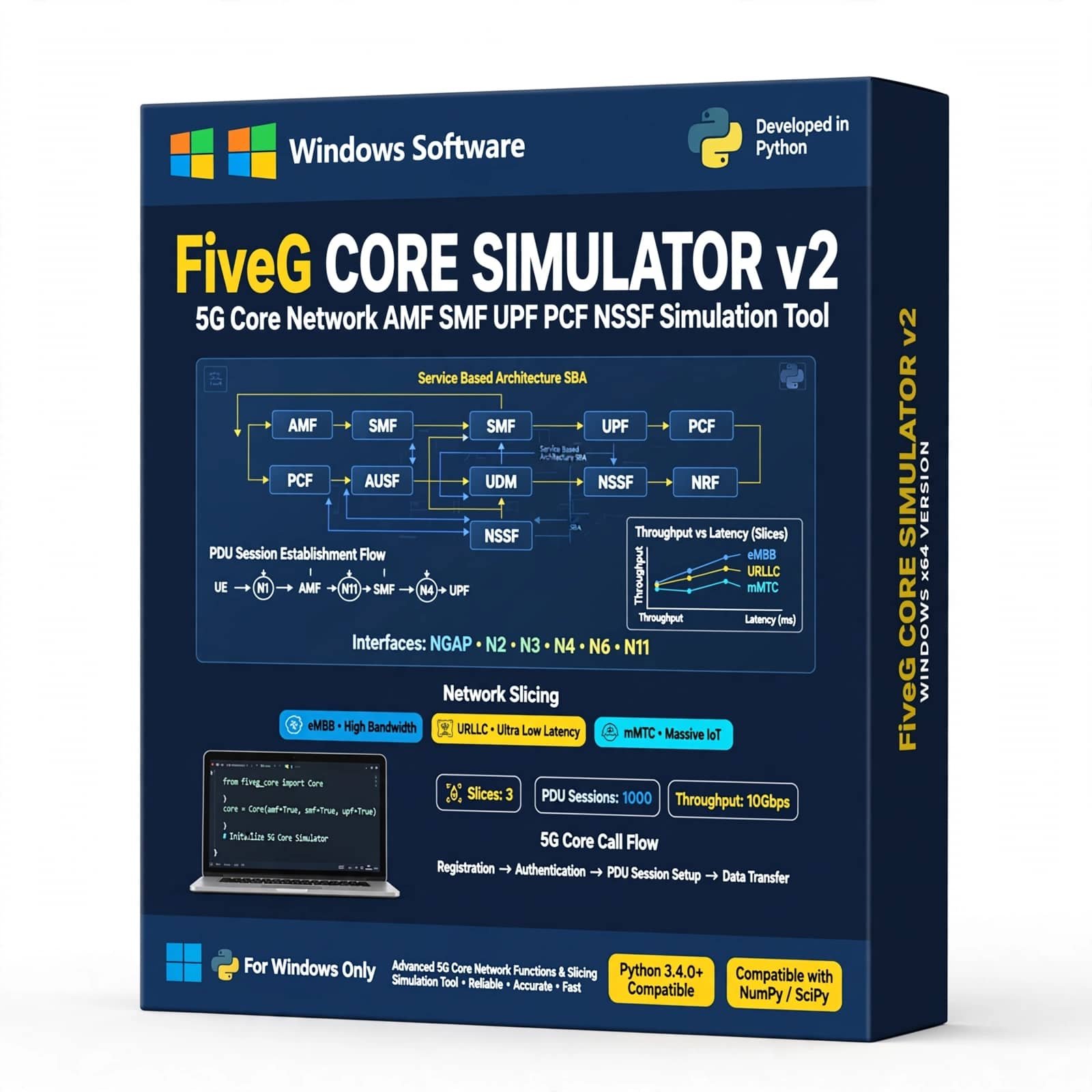
FiveG Core Simulator v2 is an educational 5G Core Network simulation tool designed to help students, educators, researchers, and telecom professionals understand 5G core architecture, network functions, signaling procedures, latency, and protocol interactions through an interactive topology and signaling animation environment.
₹19,999.00 -
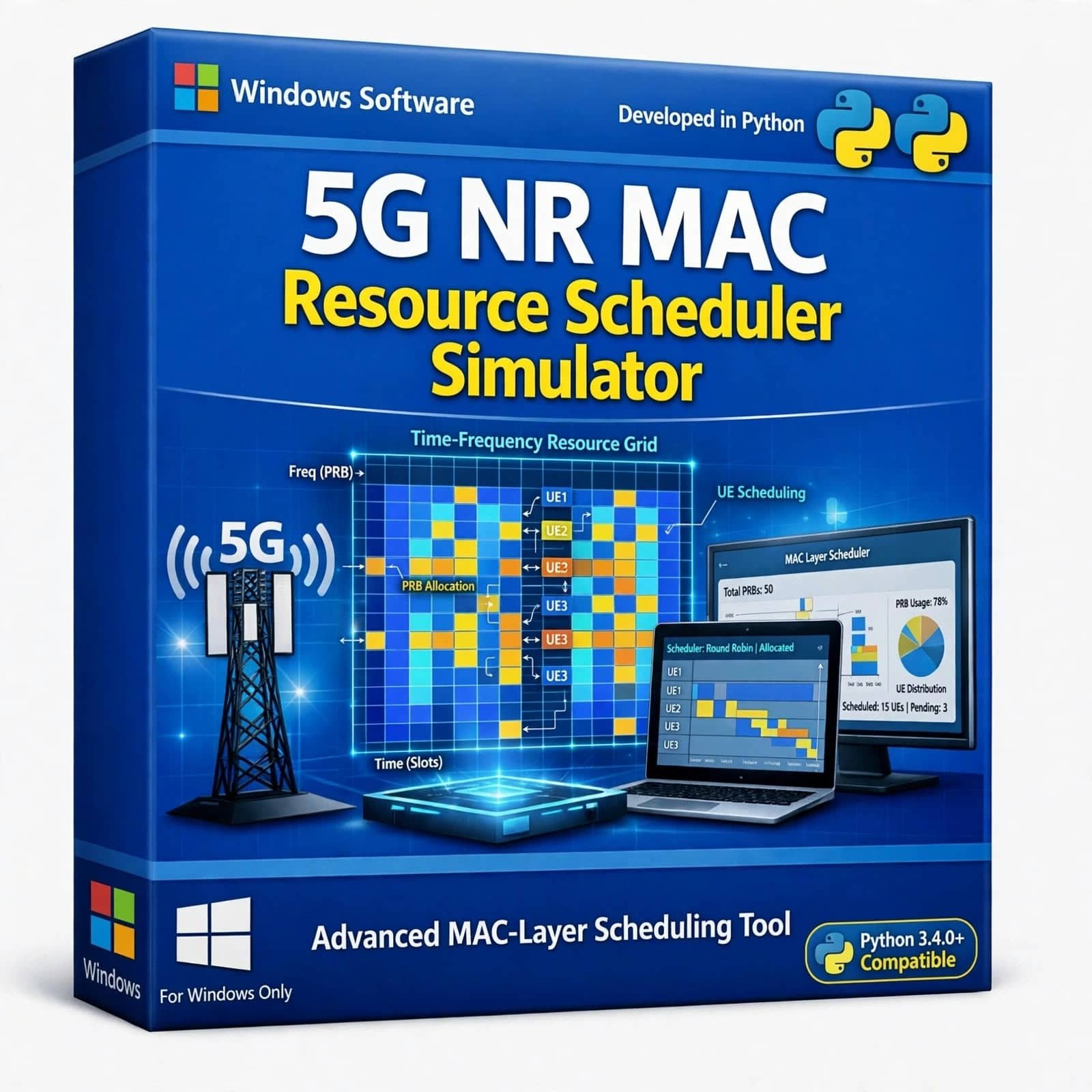
5G NR MAC Resource Scheduler Simulator is an advanced simulation solution for modeling and analyzing Medium Access Control (MAC) layer resource scheduling in 5G New Radio networks. It enables users to evaluate dynamic resource allocation, multi-UE scheduling, uplink and downlink resource management, QoS-aware scheduling, traffic conditions, and scheduling algorithms. The simulator supports analysis of throughput, latency, fairness, spectral efficiency, resource utilization, packet loss, and QoS performance, making it ideal for 5G NR research, scheduler algorithm development, academic projects, and wireless network optimization.
Original price was: ₹129,999.00.₹12,999.00Current price is: ₹12,999.00. -
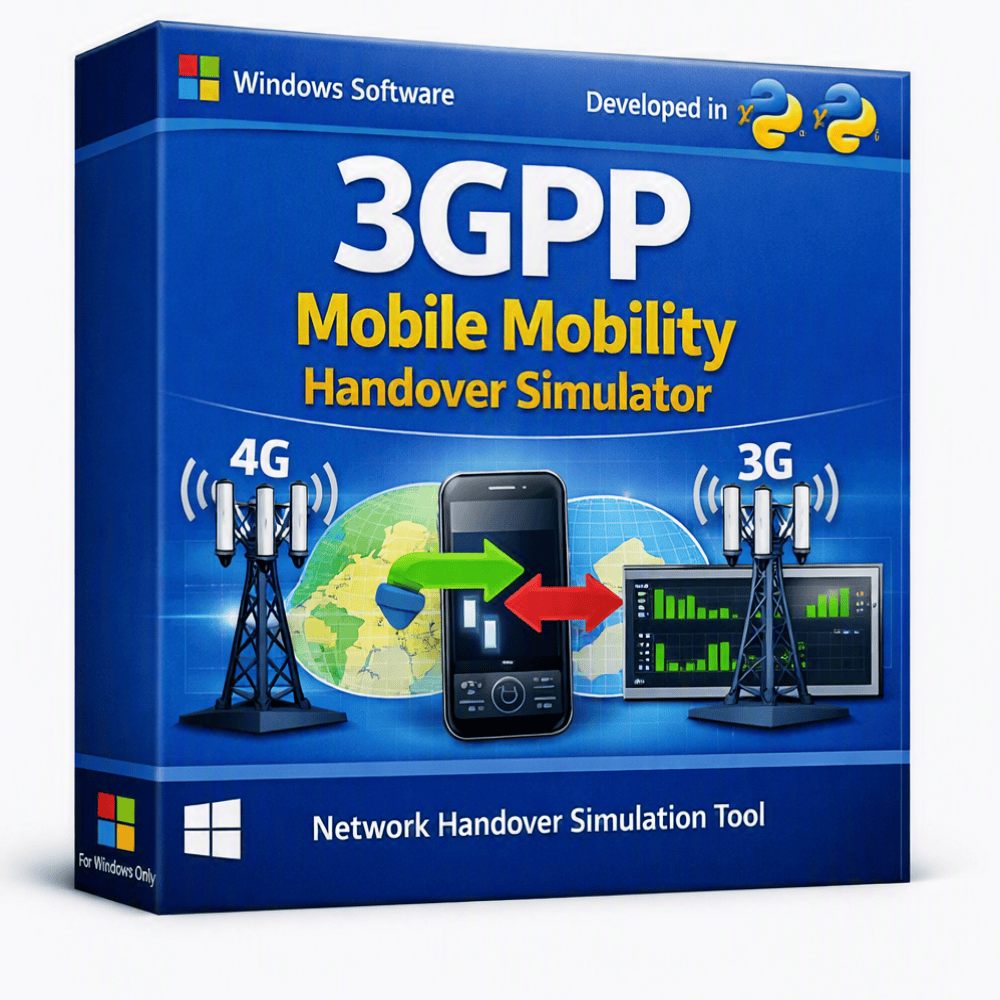
A powerful simulation tool for analyzing and validating 3GPP mobile mobility and handover procedures. The simulator enables users to model mobile network scenarios, study handover behavior, and evaluate mobility performance under different network conditions.
Key Features:
- 3GPP-compliant mobility and handover simulation
- Configurable network and mobility scenarios
- Analysis of handover performance and behavior
- Supports research, testing, and network optimization
- Useful for telecom engineers, researchers, and academic projects
Ideal for 5G/4G/3G mobility research, protocol testing, network planning, and academic simulation studies.
₹3,999.00


Reviews
There are no reviews yet.