
90% Off

5G NR Numerology Resource Grid Simulator


Original price was: ₹99,999.00.₹9,999.00Current price is: ₹9,999.00.
In Stock5G NR Numerology Resource Grid Simulator is an advanced simulation solution for modeling and analyzing 5G New Radio numerology and time-frequency resource grid structures. It enables users to study subcarrier spacing, OFDM symbols, slot structure, cyclic prefix, Physical Resource Blocks (PRBs), Resource Elements (REs), bandwidth configurations, and resource mapping. The simulator is ideal for 5G NR physical-layer research, numerology analysis, resource allocation studies, academic projects, waveform development, and 5G/6G wireless communication research.
Description
5G NR Numerology Resource Grid Simulator
The 5G NR Numerology Resource Grid Simulator is an advanced simulation software solution designed for researchers, wireless communication engineers, telecom developers, students, and academic professionals working with 5G New Radio (NR), OFDM numerology, resource grids, subcarrier spacing, cyclic prefix, time-frequency resource allocation, and physical-layer communication systems. The simulator provides a flexible environment for modeling, visualizing, and analyzing 5G NR numerology and resource grid structures under different transmission configurations.
5G NR introduces a flexible numerology framework that allows communication systems to adapt their physical-layer parameters to different deployment scenarios and service requirements. The 5G NR Numerology Resource Grid Simulator enables users to understand and evaluate how parameters such as subcarrier spacing, OFDM symbol duration, slot structure, cyclic prefix, bandwidth, and resource blocks influence the organization and utilization of the NR resource grid.
Key Features
- 5G NR Numerology Simulation: Model and analyze different NR numerology configurations and physical-layer parameters.
- Configurable Subcarrier Spacing: Evaluate resource grid behavior using different subcarrier spacing configurations.
- Resource Grid Generation: Generate and analyze 5G NR time-frequency resource grids for different bandwidth and numerology settings.
- OFDM Symbol Analysis: Study OFDM symbols, symbol duration, slot structure, and time-domain organization.
- Cyclic Prefix Modeling: Analyze normal and extended cyclic prefix configurations where applicable.
- Resource Block Visualization: Examine physical resource blocks (PRBs), resource elements (REs), slots, and OFDM symbols.
- Time-Frequency Mapping: Analyze how data and reference signals are mapped onto the 5G NR resource grid.
- Bandwidth Configuration: Study resource grid structures for different channel bandwidth and resource allocation configurations.
- Parameter Comparison: Compare different numerologies and understand their impact on time-frequency resources.
- Performance Analysis: Evaluate resource utilization, spectral efficiency, transmission timing, and related physical-layer parameters.
5G NR Numerology Simulation
The 5G NR Numerology Resource Grid Simulator provides a dedicated environment for studying the flexible numerology architecture introduced in 5G New Radio. Unlike earlier wireless systems with more fixed physical-layer configurations, 5G NR supports multiple numerologies to address the requirements of different frequency ranges, deployment scenarios, and communication services.
Users can configure key numerology parameters and observe their impact on the resulting resource grid. This allows researchers to study how subcarrier spacing affects OFDM symbol duration, slot timing, resource allocation, and overall time-frequency organization.
The simulator is particularly useful for understanding the relationship between numerology, bandwidth, resource blocks, OFDM symbols, slots, and resource elements.

Resource Grid Generation and Visualization
A major capability of the simulator is the generation and analysis of 5G NR resource grids. The resource grid represents the organization of physical resources across frequency and time, allowing users to visualize how information is mapped into the NR physical layer.
Researchers can analyze physical resource blocks, resource elements, OFDM symbols, slots, and configured bandwidths. Different grid configurations can be generated to examine how changes in numerology affect the number and arrangement of available resources.
The simulator can also support studies involving the mapping of data and reference signals onto the resource grid, helping users understand practical NR physical-layer transmission structures.
Subcarrier Spacing and OFDM Analysis
Subcarrier spacing is one of the key parameters defining NR numerology. The 5G NR Numerology Resource Grid Simulator allows users to investigate how different subcarrier spacing configurations influence OFDM timing and resource allocation.
By comparing different numerology configurations, users can study changes in OFDM symbol duration, slot duration, and time-domain resource organization. This makes the simulator useful for understanding how 5G NR can support diverse applications with different latency, bandwidth, and deployment requirements.
Researchers can also use the simulator to study the relationship between subcarrier spacing, cyclic prefix, frequency-domain resource allocation, and overall system design.
Physical Resource Block and Resource Element Analysis
The simulator enables detailed analysis of Physical Resource Blocks (PRBs) and Resource Elements (REs) within the 5G NR resource grid. Users can investigate how available time-frequency resources are organized and allocated for transmission.
This functionality is useful for research involving physical-layer resource allocation, signal mapping, scheduling, reference signals, and NR waveform design.
By examining the resource grid at different levels, users can develop a clearer understanding of how higher-layer scheduling decisions translate into physical-layer resource usage.
Performance and Configuration Analysis
The 5G NR Numerology Resource Grid Simulator can be used to compare different configurations and evaluate their impact on resource utilization and transmission characteristics.
Important parameters and analysis areas include:
- Subcarrier spacing
- OFDM symbol duration
- Slot duration
- Number of OFDM symbols
- Physical Resource Blocks (PRBs)
- Resource Elements (REs)
- Channel bandwidth
- Cyclic prefix configuration
- Time-frequency resource utilization
- Spectral efficiency
- Resource allocation
- Transmission timing
These capabilities allow users to examine the practical implications of different NR numerology configurations.
Applications
The 5G NR Numerology Resource Grid Simulator can be used for:
- 5G NR numerology research
- Resource grid generation and analysis
- OFDM waveform studies
- Subcarrier spacing analysis
- Physical-layer research
- PRB and RE mapping studies
- Time-frequency resource allocation
- NR slot and symbol structure analysis
- 5G physical-layer education
- Academic projects and thesis research
- Wireless communication algorithm development
- 5G/6G technology research
Ideal for Research and Education
The simulator is suitable for universities, research laboratories, telecom companies, wireless communication engineers, students, and developers working on 5G NR physical-layer technologies.
Students can use the simulator to understand numerology, OFDM, resource blocks, resource elements, slots, symbols, and time-frequency resource mapping through configurable simulation scenarios. Researchers can use it to investigate new waveform configurations, resource allocation approaches, and physical-layer optimization techniques.
The simulation environment provides a convenient way to experiment with different configurations without requiring specialized RF hardware or physical 5G test equipment for every experiment.
Why Choose the 5G NR Numerology Resource Grid Simulator?
The 5G NR Numerology Resource Grid Simulator provides a practical and configurable platform for understanding and analyzing the flexible physical-layer structure of 5G New Radio. It enables users to generate resource grids, configure numerology parameters, examine time-frequency resources, and evaluate the effects of different subcarrier spacing and bandwidth configurations.
Whether you are studying 5G NR numerology, developing physical-layer algorithms, analyzing OFDM resource structures, teaching wireless communication concepts, or conducting academic research, this simulator provides an effective environment for 5G NR numerology simulation, resource grid analysis, physical-layer research, and 5G/6G wireless communication development.
Related products
-
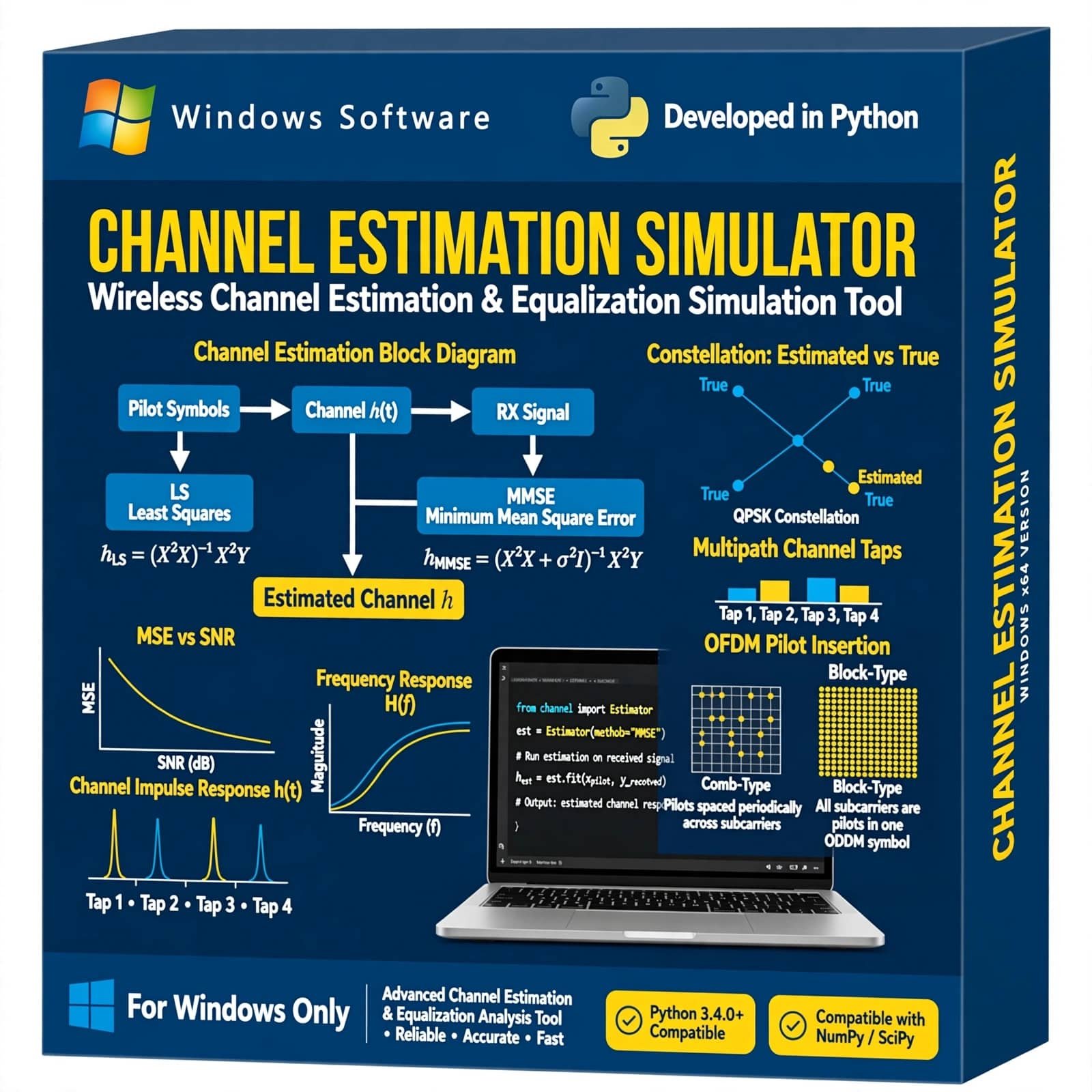
Channel Estimation Simulator is a wireless communication simulation tool designed to demonstrate and analyze channel estimation techniques in digital communication systems. It helps students, researchers, and communication engineers study channel effects, pilot-based estimation, signal distortion, and estimation performance through practical simulation.
Original price was: ₹750.00.₹250.00Current price is: ₹250.00. -
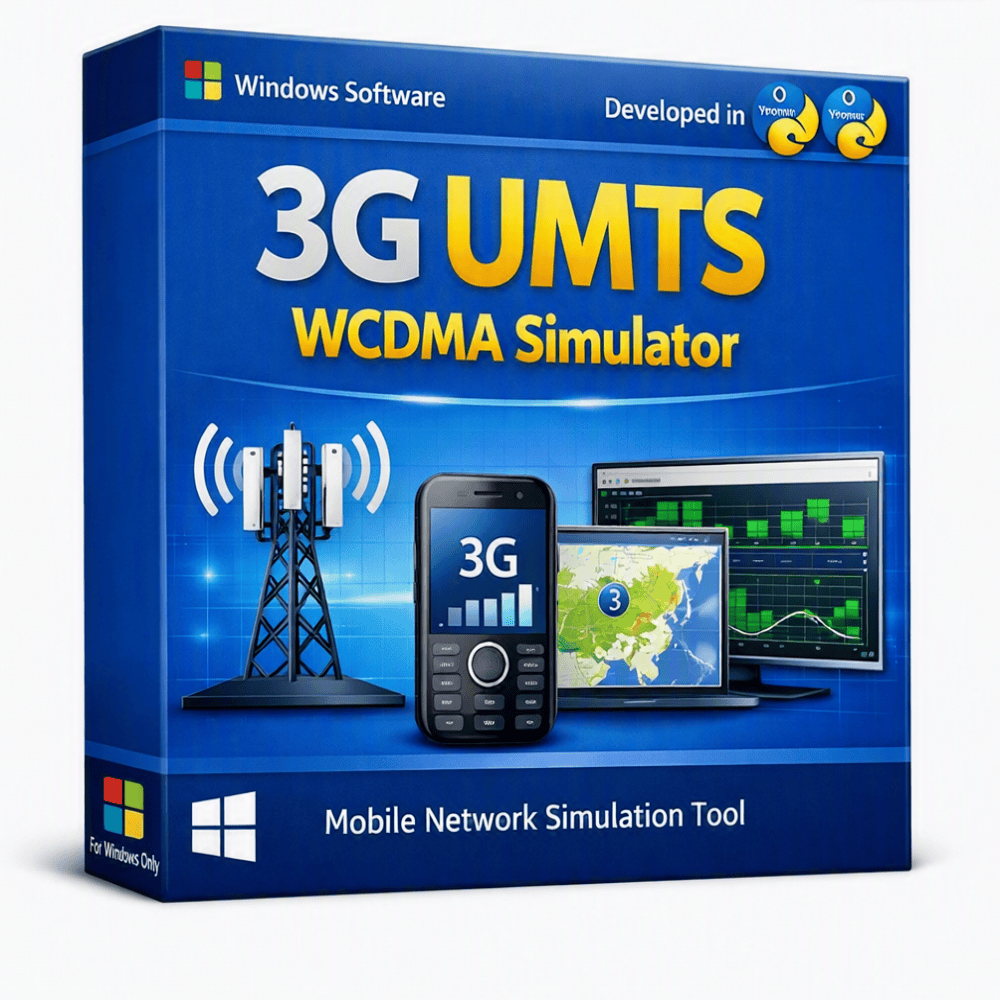
The 3G UMTS – WCDMA Simulator is a software-based simulation project designed to demonstrate the fundamental concepts of 3G Universal Mobile Telecommunications System (UMTS) and Wideband Code Division Multiple Access (WCDMA) technology. It provides a practical environment for studying cellular communication, spreading codes, signal transmission, mobile users, network connectivity, and WCDMA-based communication principles. The simulator is suitable for students, researchers, and developers working on telecommunications and wireless communication projects. It can be used for academic demonstrations, engineering projects, research, experimentation, and learning about 3G mobile communication and WCDMA network technologies.
₹3,999.00 -
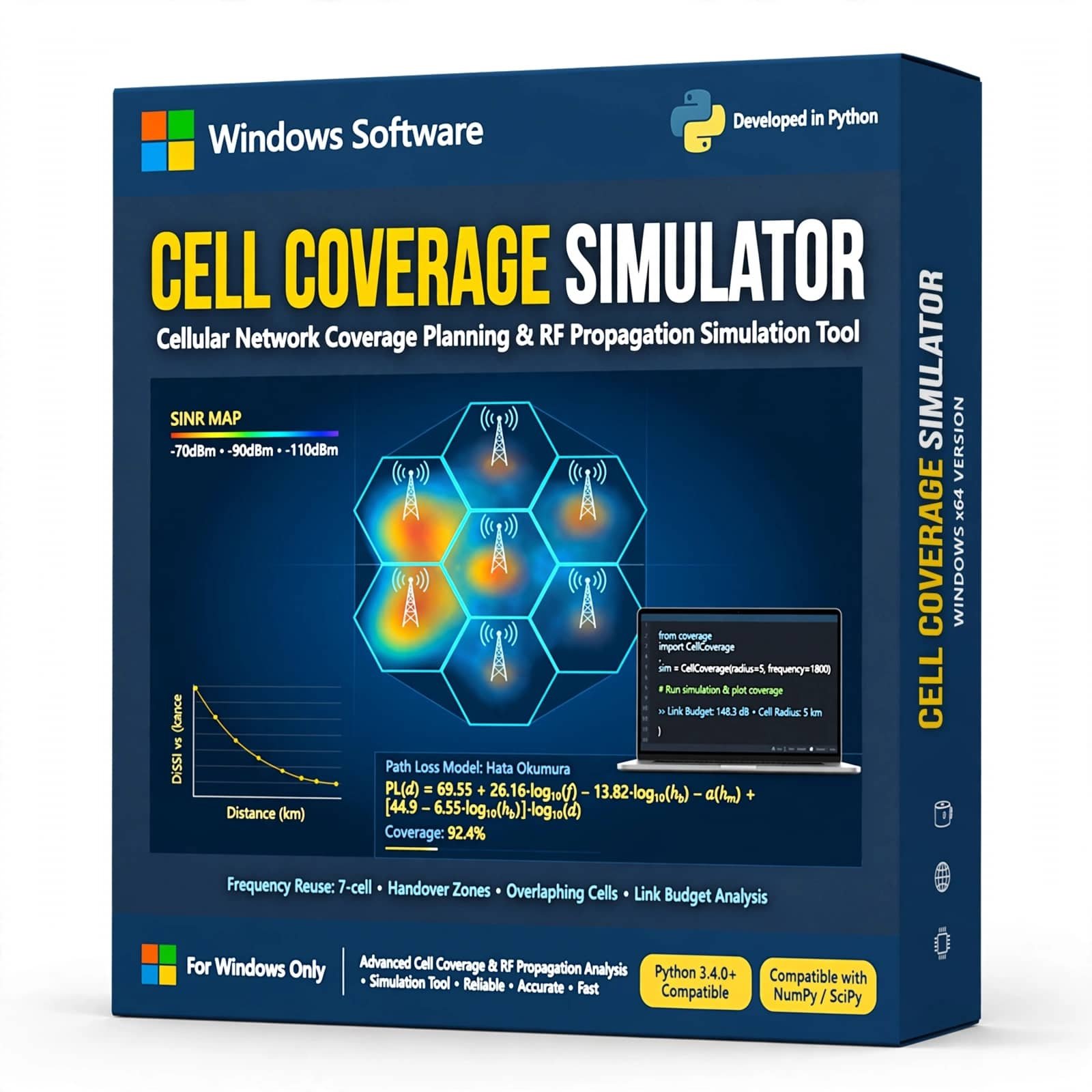
Cell Coverage Simulator is a wireless communication simulation tool designed to model and analyze cellular network coverage using Python. It helps students, researchers, and telecom professionals visualize cell coverage, signal propagation, coverage areas, and network planning concepts through practical simulation and analysis.
₹6,999.00 -
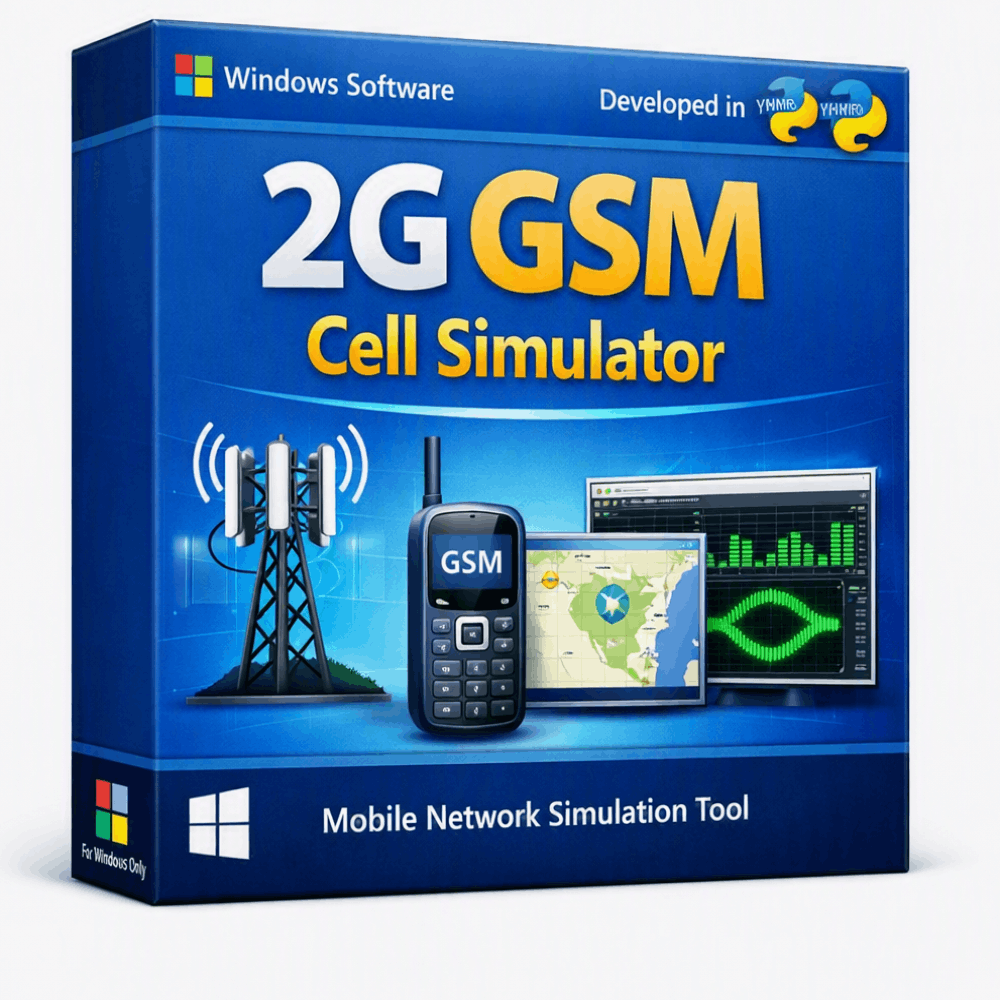
The 2G GSM Cell Simulator is a Python-based software project designed to simulate fundamental GSM cellular-network concepts. It provides a practical environment for understanding mobile stations, GSM cells, base stations, cellular coverage, mobility, communication channels, and basic network behavior. The project includes Python source code that can be studied, customized, and extended for academic projects, demonstrations, research, and learning. It is ideal for Electronics & Communication Engineering, Telecommunications, Computer Science, and related students looking to explore 2G GSM technology and cellular network simulation through a software-based implementation.
₹3,999.00 -
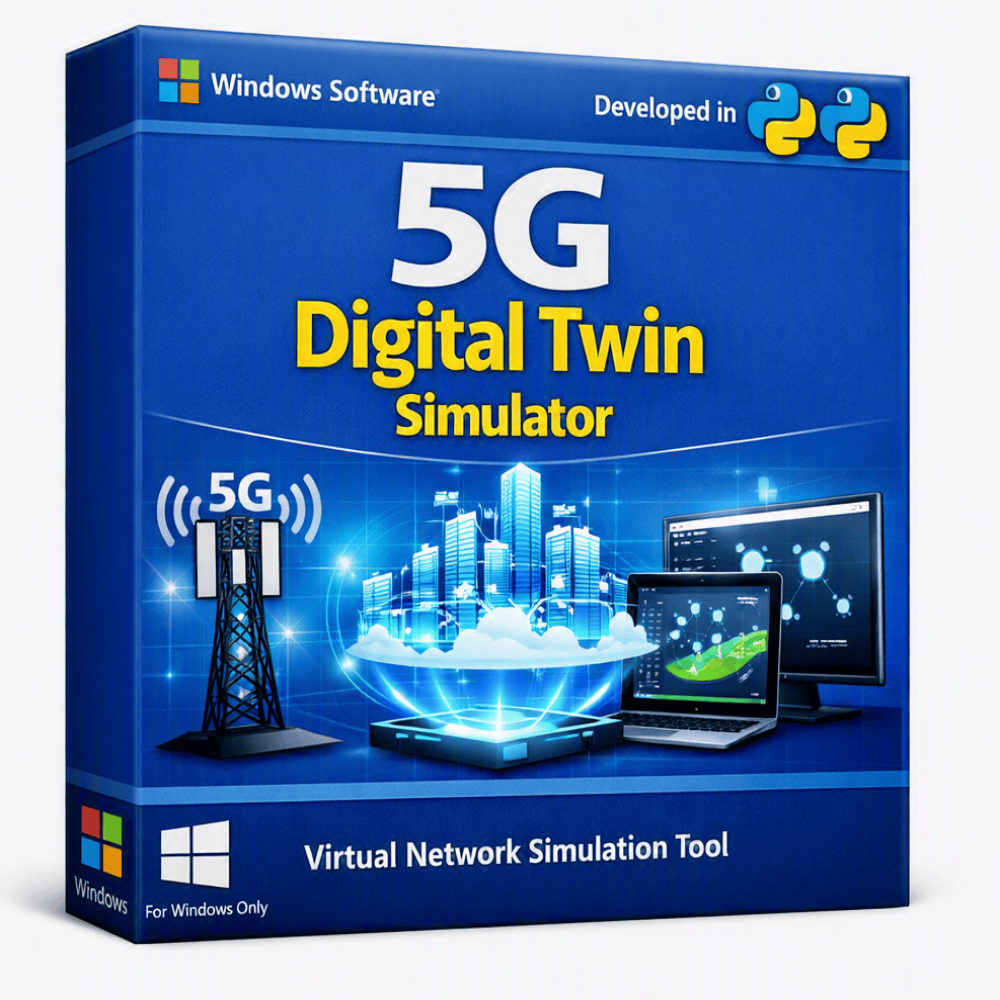
A Python-based 5G Digital Twin solution for creating a virtual representation of 5G network environments, components, and operational behavior. Designed for 5G research, network analysis, simulation, optimization, and academic projects, it enables users to model network scenarios, monitor virtualized network behavior, and experiment with different configurations in a controlled software environment.
Ideal for telecom engineers, researchers, developers, students, and academic institutions working on 5G network planning, performance analysis, intelligent network management, and digital twin research.
Original price was: ₹249,999.00.₹24,999.00Current price is: ₹24,999.00. -
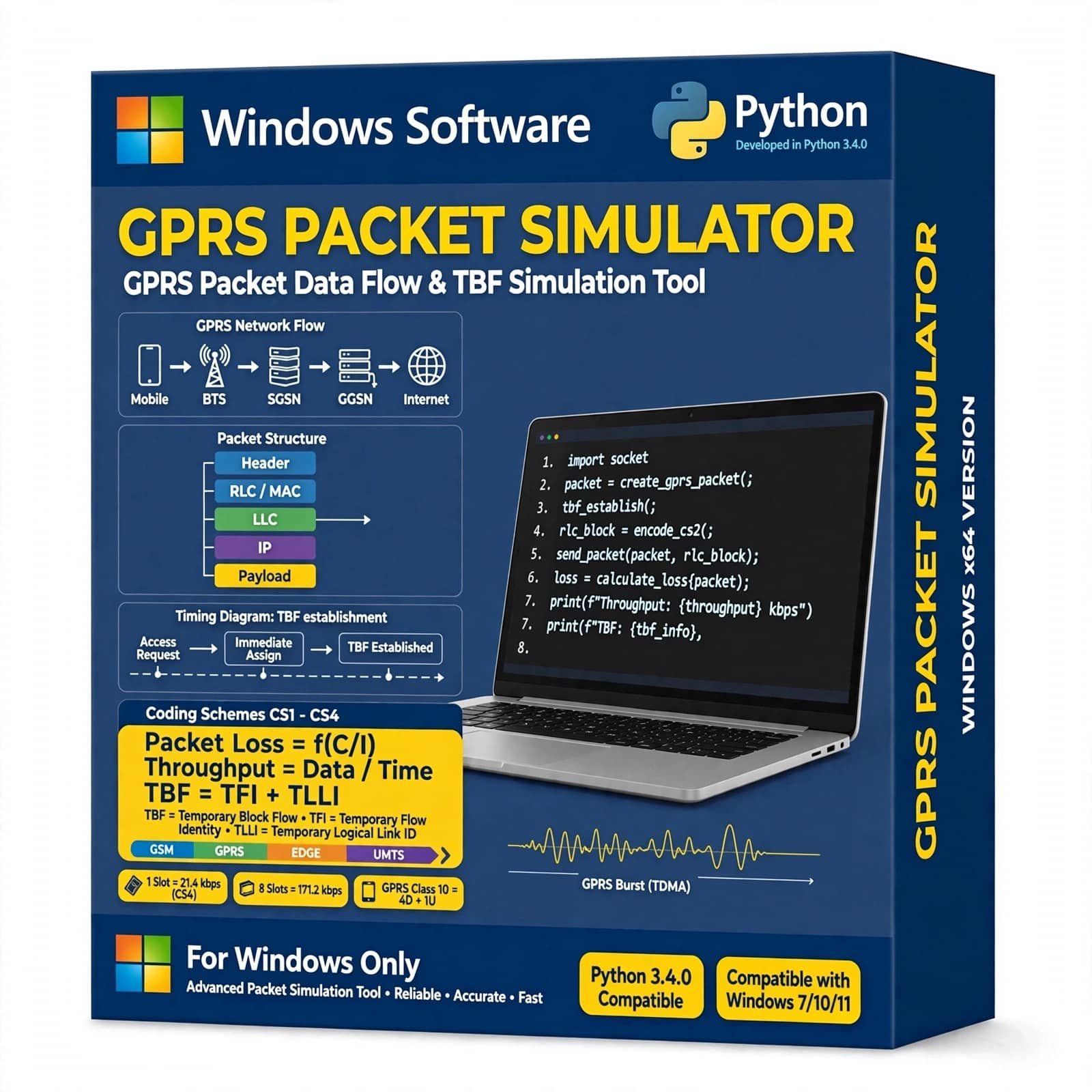
GPRS Packet Simulator is a powerful software solution for simulating GPRS data packets and testing GSM/GPRS communication systems. It helps developers, engineers, and testing teams generate, analyze, and validate packet-based communication in a controlled environment without requiring extensive physical network infrastructure. Ideal for GPRS testing, protocol development, IoT applications, and telecom system validation.
₹3,999.00


Reviews
There are no reviews yet.