
90% Off

5G Network Slicing – Resource Isolation Simulator


Original price was: ₹199,999.00.₹19,999.00Current price is: ₹19,999.00.
In StockA Python-based 5G Network Slicing and Resource Isolation Simulator designed to model and analyze how multiple logical network slices can share physical 5G infrastructure while maintaining resource isolation. The simulator enables users to study CPU, memory, bandwidth, network capacity, traffic allocation, and resource management across different 5G network slices.
Ideal for 5G research, telecom engineering, academic projects, network optimization, resource allocation studies, and university laboratories.
Description
5G Network Slicing – Resource Isolation Simulator
The 5G Network Slicing – Resource Isolation Simulator is a Python-based simulation software designed for studying the principles of network slicing, resource allocation, and resource isolation in 5G networks. The simulator provides a practical environment for researchers, telecom engineers, students, developers, and academic institutions to model multiple logical network slices operating over shared physical network infrastructure.
Network slicing is one of the key technologies introduced to support diverse services and applications in 5G networks. Different applications can have significantly different requirements for bandwidth, latency, reliability, processing capacity, and availability. Network slicing allows a common physical infrastructure to be logically divided into multiple independent or isolated virtual network environments, each optimized for a particular service or use case.
This simulator provides a controlled software environment for understanding and experimenting with these concepts.
Python-Based Simulation Platform
The simulator is developed using Python, providing a flexible environment for implementing network slicing models, resource allocation algorithms, traffic scenarios, and performance analysis.
Python is widely used in research and engineering because of its flexibility and extensive ecosystem for simulation, numerical analysis, data processing, visualization, optimization, and artificial intelligence. The Python-based implementation makes the simulator suitable for academic research as well as experimental development.
Researchers and developers can use the simulation environment to investigate different resource management strategies and study how network resources are distributed between competing slices.
5G Network Slicing
The simulator enables users to model multiple logical network slices operating simultaneously on shared infrastructure. Each slice can represent a different service or application with its own resource requirements and performance objectives.
For example, a simulation can represent slices designed for:
- Enhanced Mobile Broadband (eMBB)
- Ultra-Reliable Low-Latency Communications (URLLC)
- Massive Machine-Type Communications (mMTC)
These service categories have different network requirements. By creating multiple slices, users can investigate how resources are allocated and how isolation between slices can influence network performance.
Resource Isolation Simulation
A primary focus of the software is resource isolation. In a sliced 5G network, resources must be managed so that excessive traffic or resource consumption in one slice does not unnecessarily degrade the performance of other slices.
The simulator can be used to study the allocation and isolation of resources such as:
- CPU resources
- Memory
- Bandwidth
- Network capacity
- Processing resources
- Traffic allocation
- Virtualized infrastructure resources
Users can experiment with different allocation policies and observe how resource usage changes between network slices.
Resource Allocation and Management
The simulator provides an environment for investigating how shared network resources can be distributed among multiple slices. Researchers can use different traffic conditions and resource requirements to analyze the behavior of allocation strategies.
For example, one slice may experience increased traffic demand while another slice has relatively low utilization. The simulation can be used to examine how available resources are managed and how resource isolation affects the performance of each slice.
This makes the software useful for research into dynamic resource allocation, resource optimization, load management, and network slice performance.
Performance Analysis
The simulator can be used to evaluate different network slicing scenarios and analyze important performance characteristics. Depending on the implemented simulation model, users may study resource utilization, throughput, traffic distribution, slice performance, resource contention, and isolation behavior.
These experiments can help researchers understand the trade-offs between efficient resource utilization and strict resource isolation.

Research and Academic Applications
The 5G Network Slicing – Resource Isolation Simulator is particularly suitable for universities, research laboratories, telecommunications projects, and students working on 5G and next-generation networking technologies.
Potential applications include:
- 5G network slicing research
- Resource isolation studies
- Dynamic resource allocation research
- Network optimization
- Slice performance analysis
- Traffic management experiments
- Virtual network research
- 5G academic projects
- Final-year engineering projects
- Master’s and PhD research
- Telecom laboratory demonstrations
- Algorithm development and testing
AI and Optimization Research
Because the simulator is Python-based, it can also serve as a foundation for experimenting with AI, Machine Learning, optimization, and intelligent resource management techniques.
Researchers can investigate how intelligent algorithms can be used to predict resource requirements, optimize slice allocation, balance network load, or improve resource utilization while maintaining isolation between different slices.
Key Features
- Python-based 5G network slicing simulation
- Multiple network slice modeling
- Resource allocation and management
- Resource isolation analysis
- CPU and memory resource modeling
- Bandwidth and capacity allocation
- Configurable traffic and resource scenarios
- Slice performance evaluation
- Resource utilization analysis
- Suitable for optimization and AI/ML research
- Useful for academic and industrial research
- Suitable for demonstrations and laboratory experiments
Who Can Use This Simulator?
The simulator is ideal for telecommunication engineers, 5G researchers, university students, professors, network developers, academic institutions, and R&D organizations.
Students can use it to understand the practical concepts behind 5G network slicing and resource isolation. Researchers can use it to evaluate new resource allocation and optimization algorithms, while telecom professionals can use the simulation environment to explore different network slicing scenarios.
Product Information
Product Name: 5G Network Slicing – Resource Isolation Simulator
Technology: 5G / Network Slicing
Programming Language: Python
Application Type: Network Simulation Software
Primary Use: Research, Education, Resource Allocation, Optimization, and Development
Target Users: Telecom Engineers, Researchers, Developers, Students, Universities, and R&D Organizations
The Python-Based 5G Network Slicing – Resource Isolation Simulator provides a practical environment for understanding how multiple logical network slices can operate over shared 5G infrastructure while managing and isolating critical network resources.
It is a valuable tool for 5G research, network slicing experiments, resource management studies, academic projects, and development of intelligent resource allocation techniques.
Related products
-
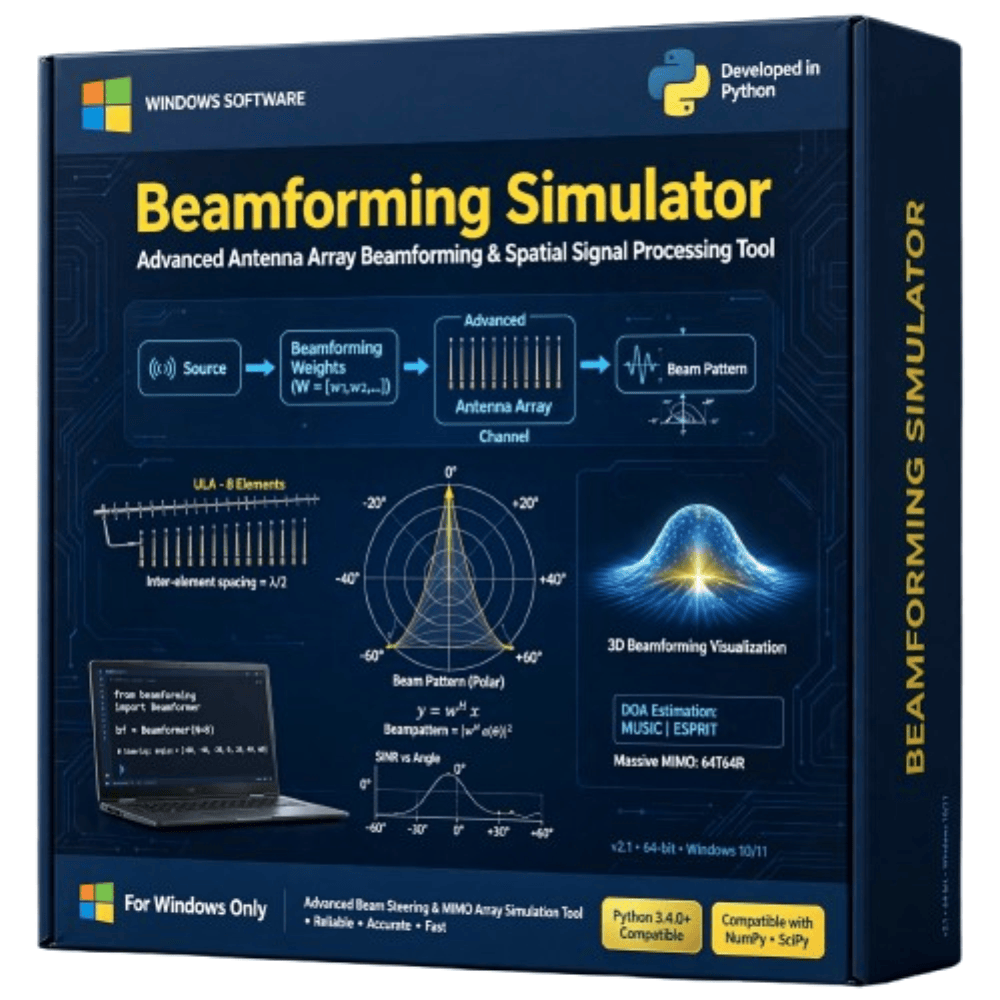
The Beamforming Simulator is a practical wireless communication simulation project designed to demonstrate how antenna arrays can control and direct radio-frequency signals toward desired users or directions. The simulator helps visualize beam patterns, signal direction, antenna-array behavior, and beam steering under different parameters. It is suitable for studying beamforming, antenna arrays, MIMO, 5G communication, wireless networks, and signal processing. This project is ideal for engineering students, researchers, and learners working on wireless communication and advanced antenna technologies.
₹1,999.00 -
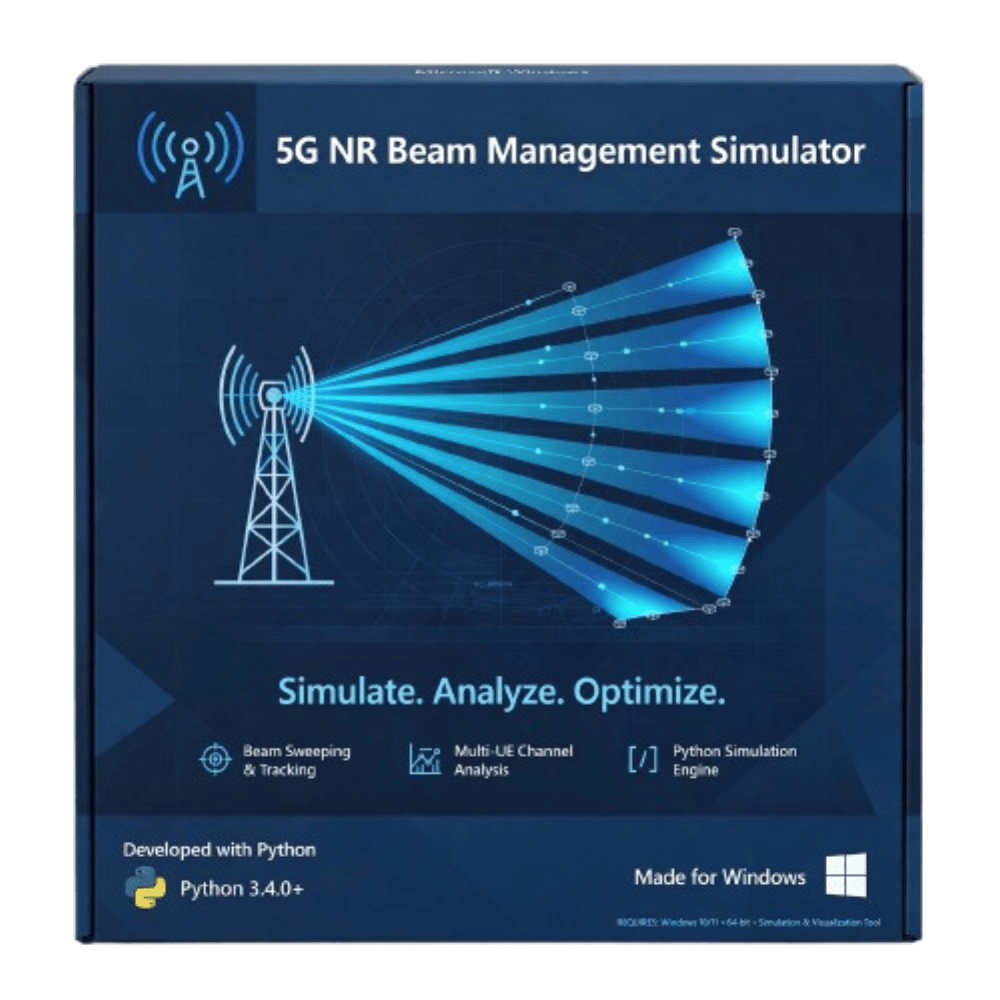
5G NR Beam Management Simulator is an advanced simulation solution designed to model, analyze, and optimize beam management procedures in 5G New Radio (NR) networks. It enables engineers and researchers to evaluate beam sweeping, beam measurement, beam selection, beam reporting, and beam recovery under diverse network and channel conditions. The simulator supports performance analysis of directional communication, helping users assess beamforming strategies, mobility scenarios, link reliability, and system-level performance before real-world deployment.
Original price was: ₹74,999.00.₹12,999.00Current price is: ₹12,999.00. -
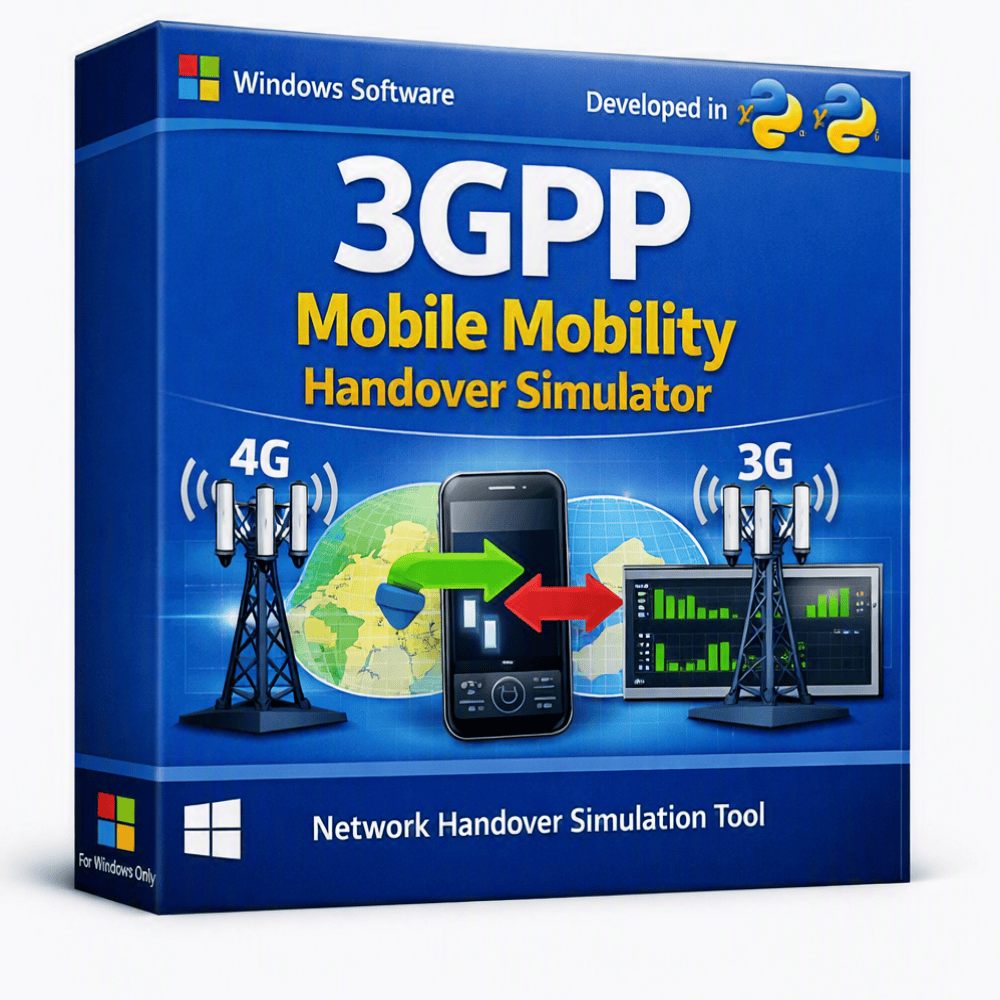
A powerful simulation tool for analyzing and validating 3GPP mobile mobility and handover procedures. The simulator enables users to model mobile network scenarios, study handover behavior, and evaluate mobility performance under different network conditions.
Key Features:
- 3GPP-compliant mobility and handover simulation
- Configurable network and mobility scenarios
- Analysis of handover performance and behavior
- Supports research, testing, and network optimization
- Useful for telecom engineers, researchers, and academic projects
Ideal for 5G/4G/3G mobility research, protocol testing, network planning, and academic simulation studies.
₹3,999.00 -
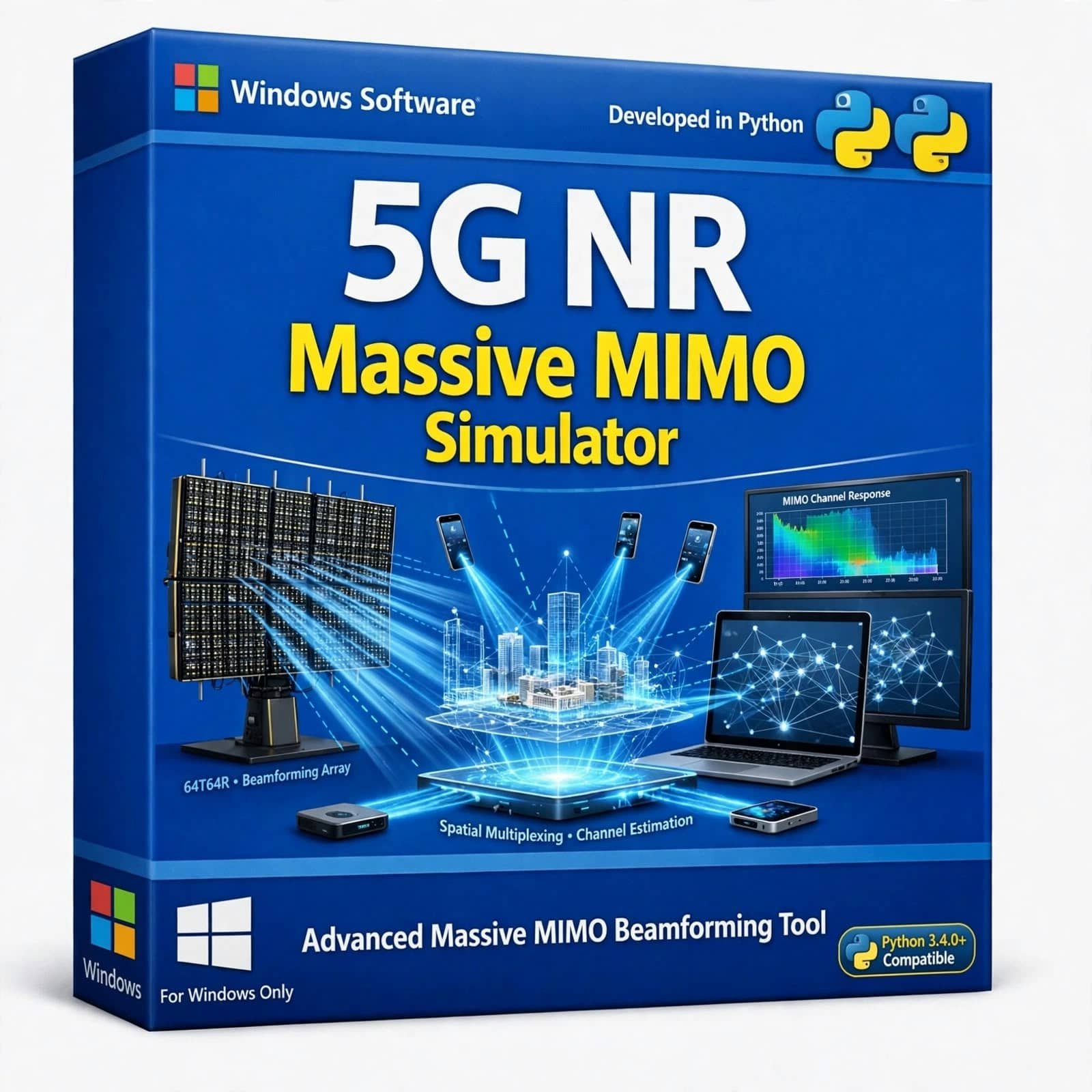
5G NR Massive MIMO Simulator is an advanced simulation solution for modeling and analyzing Massive Multiple-Input Multiple-Output (MIMO) technologies in 5G New Radio networks. It enables users to study large-scale antenna arrays, beamforming, precoding, spatial multiplexing, multi-user MIMO, channel estimation, and interference under configurable channel conditions. The simulator supports analysis of throughput, spectral efficiency, SINR, BER, BLER, MIMO capacity, beamforming gain, and multi-user performance, making it ideal for 5G NR research, algorithm development, academic projects, and 5G/6G wireless system optimization.
Original price was: ₹149,999.00.₹14,999.00Current price is: ₹14,999.00. -
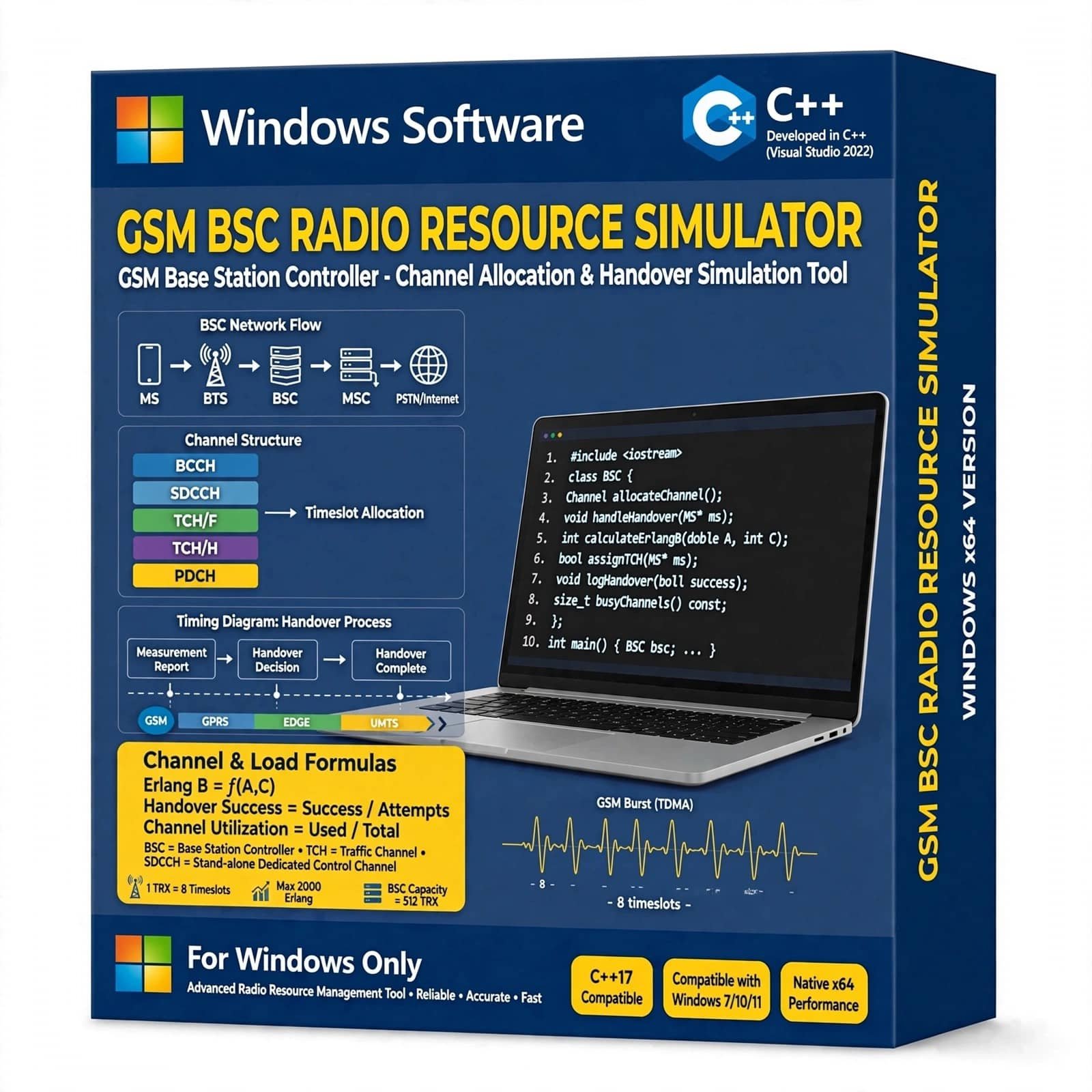
GSM BSC Radio Resource Simulator is a professional telecom training and development solution designed to simulate GSM Base Station Controller (BSC) radio resource management functions. It helps students, telecom engineers, researchers, and network professionals understand GSM radio resource allocation, channel management, call handling, handover concepts, and BSC-related network procedures in a controlled simulation environment.
Original price was: ₹750.00.₹100.00Current price is: ₹100.00. -
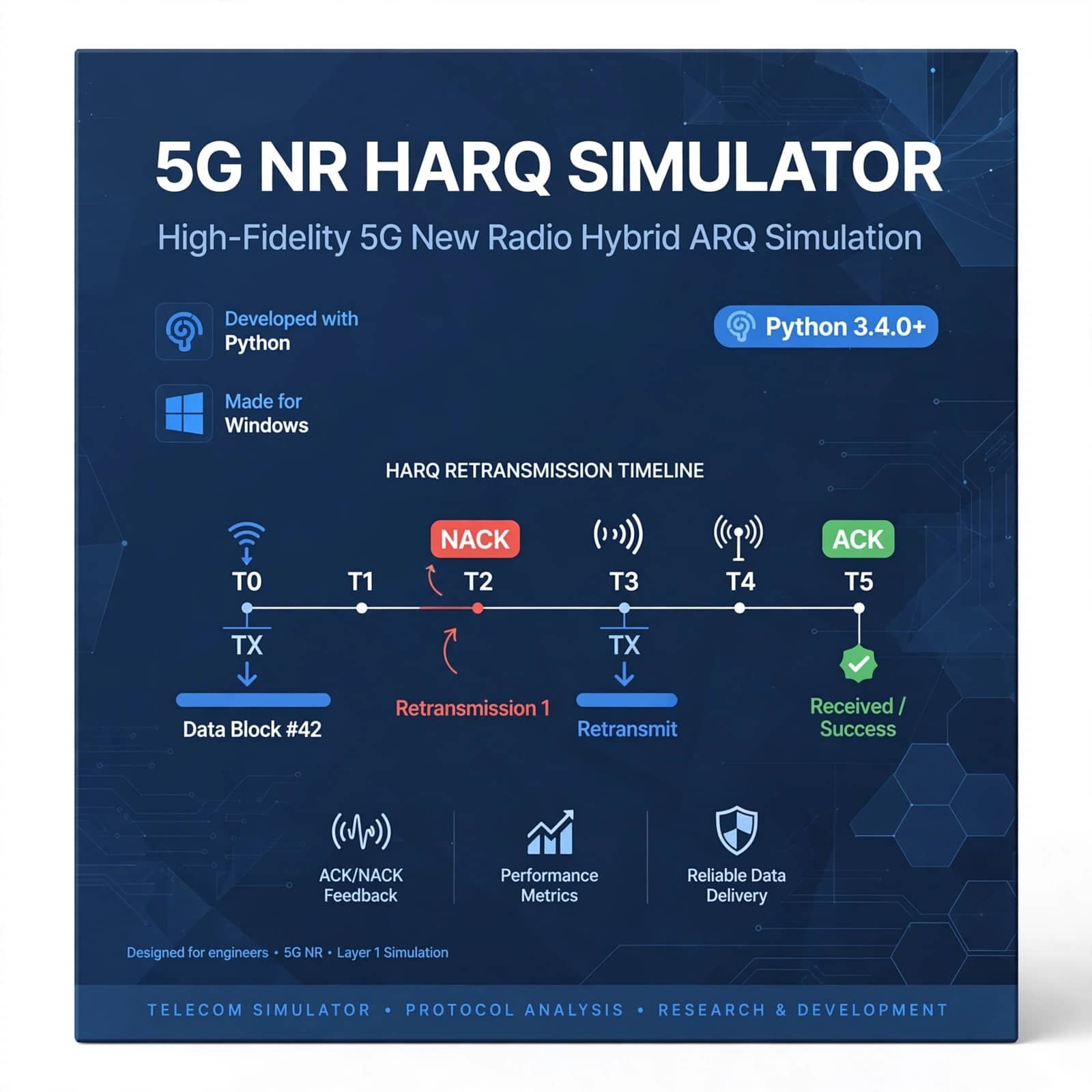
5G NR HARQ Simulator is an advanced simulation solution for modeling and analyzing Hybrid Automatic Repeat Request (HARQ) mechanisms in 5G New Radio networks. It enables users to study HARQ processes, ACK/NACK feedback, retransmissions, link adaptation, channel errors, and communication reliability under configurable network conditions. The simulator supports analysis of throughput, BLER, latency, retransmission rate, packet errors, spectral efficiency, and other key performance metrics, making it suitable for 5G NR research, algorithm development, academic projects, and wireless communication system optimization.
Original price was: ₹74,999.00.₹9,999.00Current price is: ₹9,999.00.


Reviews
There are no reviews yet.