
90% Off

5G Digital Twin


Original price was: ₹249,999.00.₹24,999.00Current price is: ₹24,999.00.
In StockA Python-based 5G Digital Twin solution for creating a virtual representation of 5G network environments, components, and operational behavior. Designed for 5G research, network analysis, simulation, optimization, and academic projects, it enables users to model network scenarios, monitor virtualized network behavior, and experiment with different configurations in a controlled software environment.
Ideal for telecom engineers, researchers, developers, students, and academic institutions working on 5G network planning, performance analysis, intelligent network management, and digital twin research.
Description
5G Digital Twin Simulator
The Python-Based 5G Digital Twin is a software solution designed to create and study a virtual representation of a 5G mobile network and its operational environment. Developed using Python, the platform provides researchers, telecom engineers, developers, students, and academic institutions with a flexible environment for modeling, analyzing, and experimenting with 5G network behavior.
Digital Twin technology is becoming an important concept in next-generation telecommunications because it enables a physical or operational network to be represented within a virtual environment. By creating a digital model of network components, configurations, traffic conditions, and operational scenarios, users can investigate network behavior, evaluate potential changes, and perform experiments without directly modifying a live network.
Python-Based Digital Twin Platform
The simulator is developed using Python, providing a flexible programming environment for building network models, simulation logic, data processing, analytics, and experimental algorithms. Python’s extensive ecosystem makes it suitable for research-oriented applications involving artificial intelligence, machine learning, data analytics, optimization, and network simulation.
The Python-based architecture can allow researchers and developers to customize simulation scenarios and experiment with different network parameters according to their specific research requirements.
5G Network Modeling
The 5G Digital Twin can be used to represent different aspects of a 5G network within a virtual environment. Depending on the implemented model, users can study network components, connectivity, traffic behavior, resource utilization, mobility, performance metrics, and other operational characteristics.
The virtual environment can provide a practical way to understand how changes in network configuration or operating conditions may influence overall network performance.
Network Simulation and Analysis
One of the primary applications of a 5G Digital Twin is the ability to perform what-if analysis and experimentation. Users can create different network scenarios and evaluate their potential impact before applying similar concepts to a real or production environment.
The platform can be useful for investigating areas such as:
- 5G network performance
- Network resource utilization
- Traffic and load behavior
- Mobility scenarios
- Network configuration analysis
- Capacity and performance studies
- Network optimization
- Fault and event analysis
- Intelligent network management
- AI/ML-based network experimentation
Support for 5G Research
The Python-based 5G Digital Twin is particularly useful for research and development projects involving modern mobile communication technologies. Researchers can use the virtual environment to investigate new algorithms, network optimization techniques, intelligent resource management approaches, and automated network control strategies.
The Digital Twin concept can also be combined with Artificial Intelligence (AI) and Machine Learning (ML) techniques to analyze network data, identify patterns, predict network behavior, and investigate intelligent decision-making approaches.
Educational Applications
Universities and academic institutions can use the 5G Digital Twin as a practical learning and laboratory tool. Students can explore 5G network concepts through virtual models rather than relying exclusively on theoretical descriptions.
It can be useful for undergraduate projects, postgraduate research, telecommunications laboratories, academic demonstrations, and thesis work related to 5G and beyond-5G technologies.

Key Features
- Python-based 5G Digital Twin platform
- Virtual modeling of 5G network environments
- Configurable network and simulation scenarios
- Network behavior and performance analysis
- Support for what-if and experimental analysis
- Suitable for network optimization research
- Useful for AI/ML-based 5G research
- Supports mobility and traffic-related studies
- Suitable for academic and industrial research
- Flexible environment for developers and researchers
- Useful for demonstrations, training, and laboratory experiments
Ideal for Researchers and Telecom Professionals
The Python-Based 5G Digital Twin is designed for users who need a practical environment for investigating 5G network behavior and experimenting with new technologies. It can support research in telecommunications, network optimization, intelligent networking, AI-driven network management, and digital twin technologies.
Researchers and developers can use the platform as a foundation for developing customized models and simulation scenarios. Students can use it for academic projects and demonstrations, while telecom professionals can explore network behavior and optimization concepts in a controlled virtual environment.
Product Information
Product Name: Python-Based 5G Digital Twin
Technology: 5G / Digital Twin
Programming Language: Python
Application Type: Network Simulation and Digital Twin Software
Primary Use: Research, Simulation, Analysis, Optimization, Education, and Development
Target Users: Telecom Engineers, Researchers, Developers, Students, Universities, and R&D Organizations
The Python-Based 5G Digital Twin provides a flexible software environment for creating virtual representations of 5G network scenarios and studying their behavior. By combining 5G networking concepts with Python-based simulation and modeling, it offers a valuable platform for research, education, experimentation, network optimization, and development of intelligent 5G solutions.
Related products
-
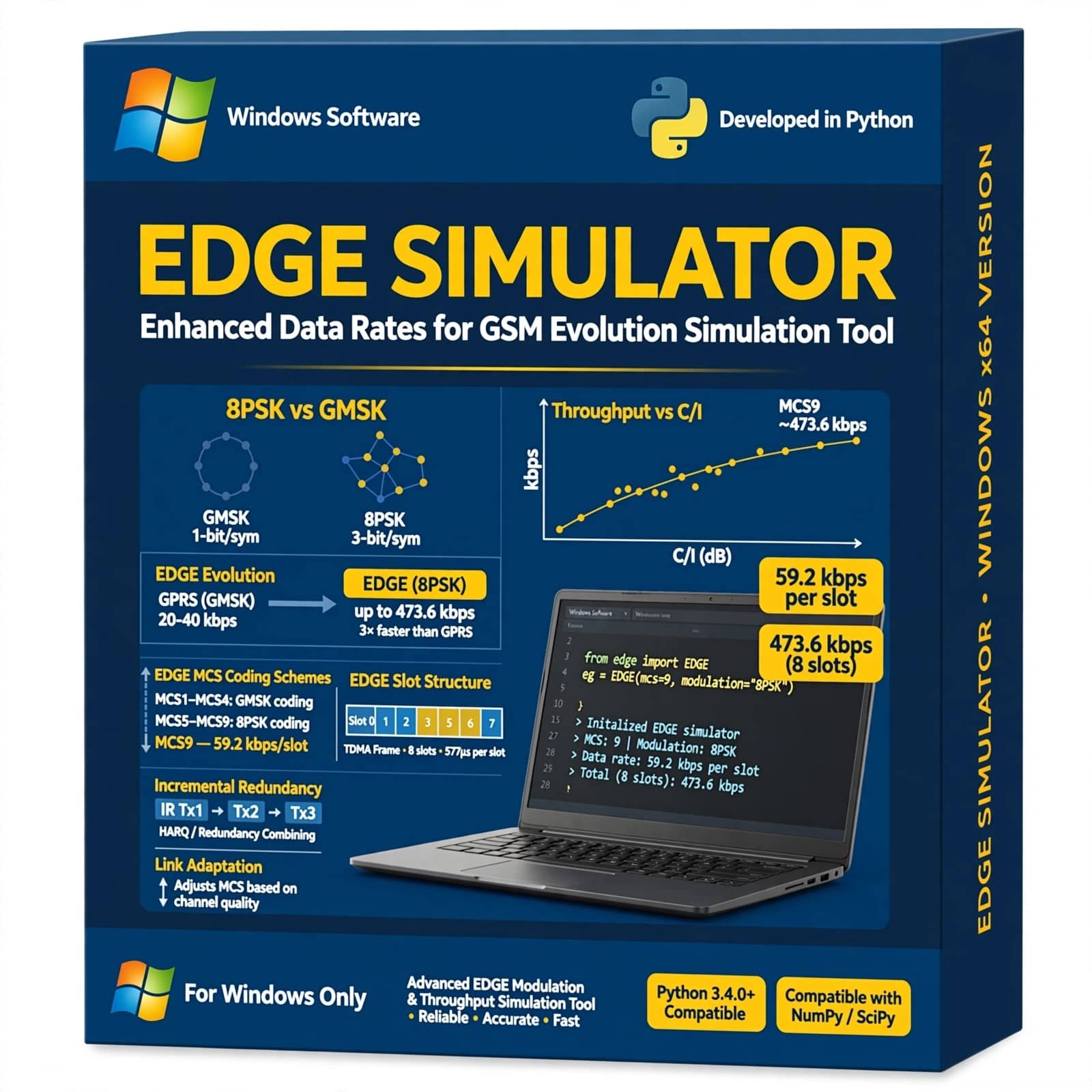
EDGE Simulator Using Python is a practical mobile communication simulation tool designed to demonstrate and analyze Enhanced Data rates for GSM Evolution (EDGE) technology. It helps students, researchers, and communication engineers study GSM/EDGE data transmission, modulation, channel conditions, bit error rate, data rates, and wireless communication performance using Python-based simulation.
₹3,499.00 -
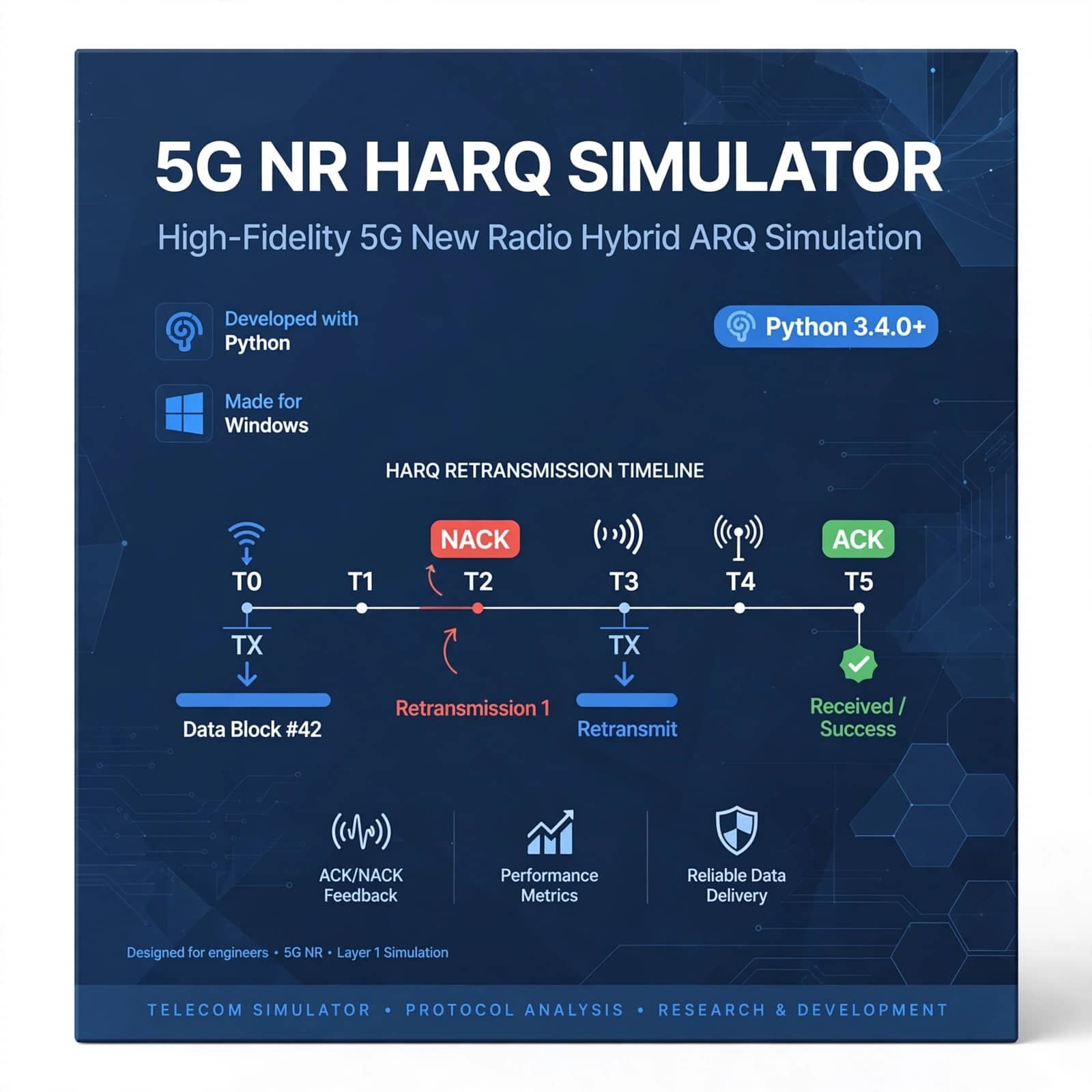
5G NR HARQ Simulator is an advanced simulation solution for modeling and analyzing Hybrid Automatic Repeat Request (HARQ) mechanisms in 5G New Radio networks. It enables users to study HARQ processes, ACK/NACK feedback, retransmissions, link adaptation, channel errors, and communication reliability under configurable network conditions. The simulator supports analysis of throughput, BLER, latency, retransmission rate, packet errors, spectral efficiency, and other key performance metrics, making it suitable for 5G NR research, algorithm development, academic projects, and wireless communication system optimization.
Original price was: ₹74,999.00.₹9,999.00Current price is: ₹9,999.00. -
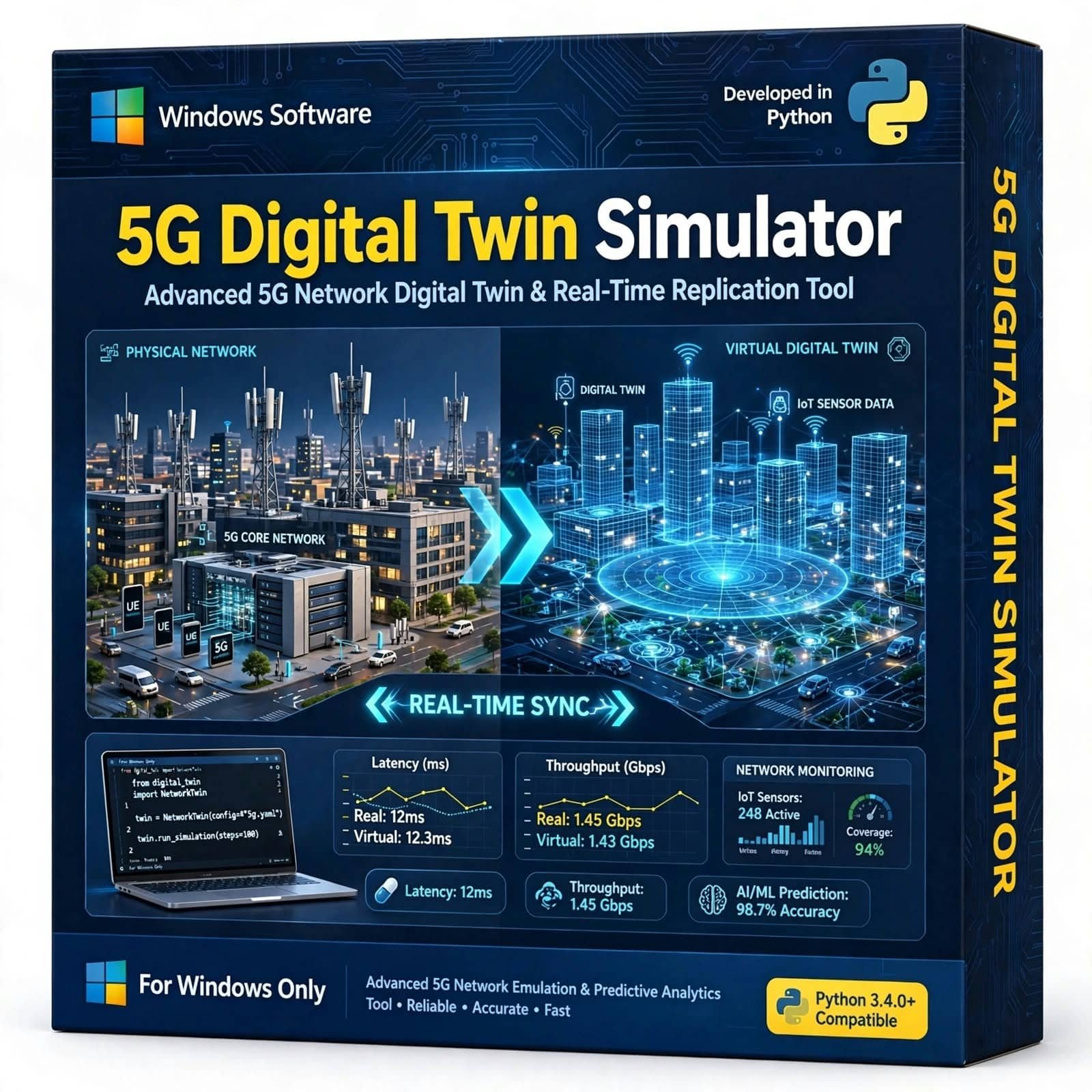
The 5G Digital Twin is a Python-based software solution designed for researchers, engineers, developers, students, and telecommunications professionals interested in modeling, simulating, and analyzing 5G communication networks and their real-world behavior in a virtual environment.
A digital twin provides a virtual representation of a physical or network system, enabling users to study system behavior, evaluate scenarios, analyze performance, and experiment with different configurations. Developed using Python, this 5G Digital Twin can support research, education, network analysis, experimentation, and proof-of-concept development.
Available for sale as a software product. Contact us for pricing, licensing, technical specifications, customization, and purchase information.
₹9,999.00 -
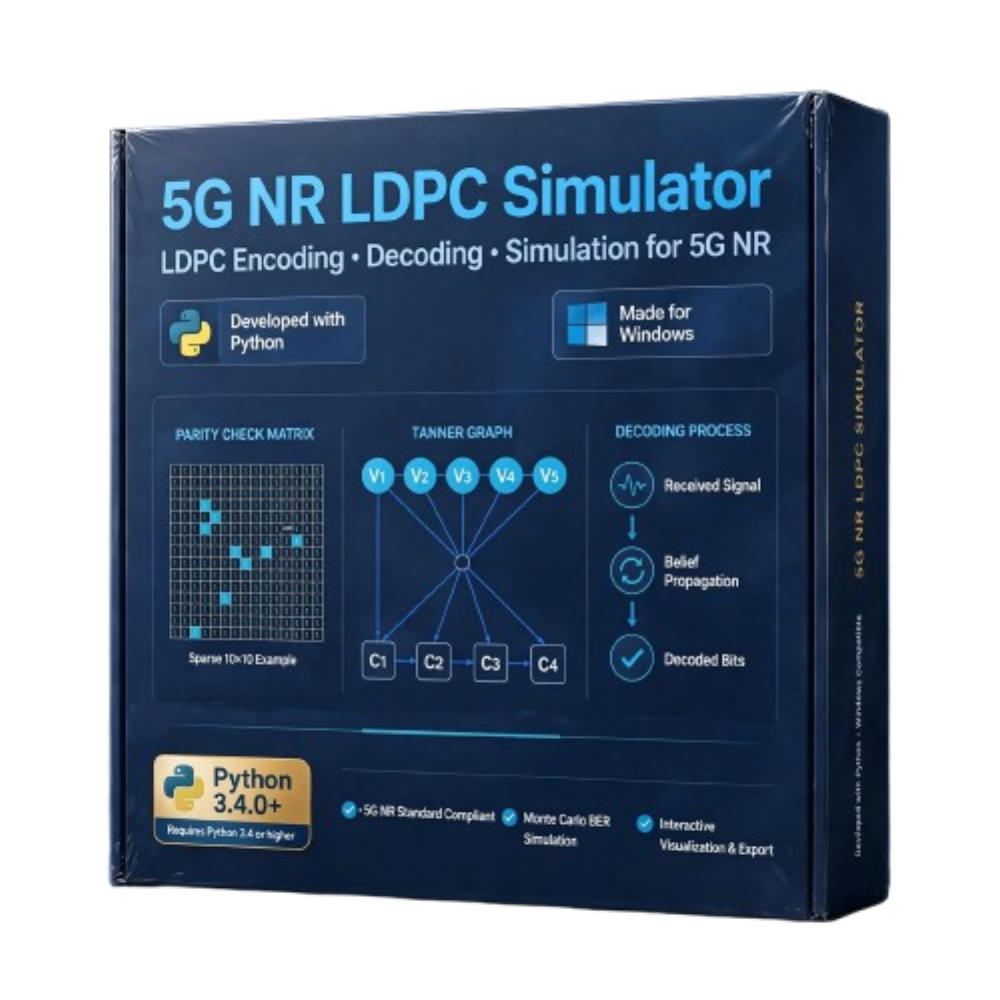
5G NR LDPC Simulator is an advanced simulation solution for modeling and analyzing Low-Density Parity-Check (LDPC) channel coding used in 5G New Radio systems. It enables users to simulate LDPC encoding and decoding, evaluate error correction performance, and analyze BER, BLER, SNR, coding rate, decoding iterations, throughput, and convergence under configurable channel conditions. The simulator is ideal for 5G NR channel coding research, algorithm development, academic projects, decoder performance analysis, and next-generation wireless communication system optimization.
Original price was: ₹129,999.00.₹12,999.00Current price is: ₹12,999.00. -
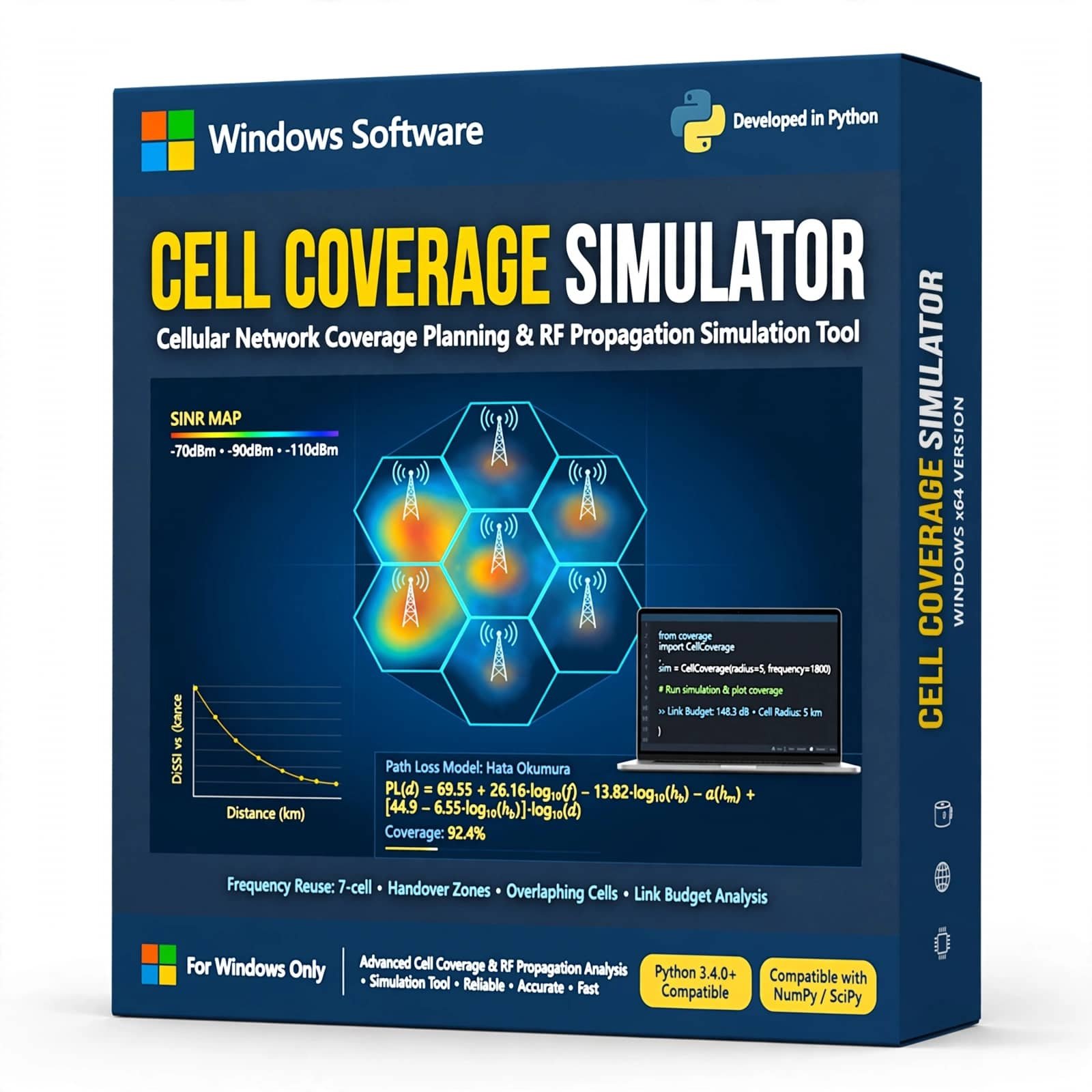
Cell Coverage Simulator is a wireless communication simulation tool designed to model and analyze cellular network coverage using Python. It helps students, researchers, and telecom professionals visualize cell coverage, signal propagation, coverage areas, and network planning concepts through practical simulation and analysis.
₹6,999.00 -
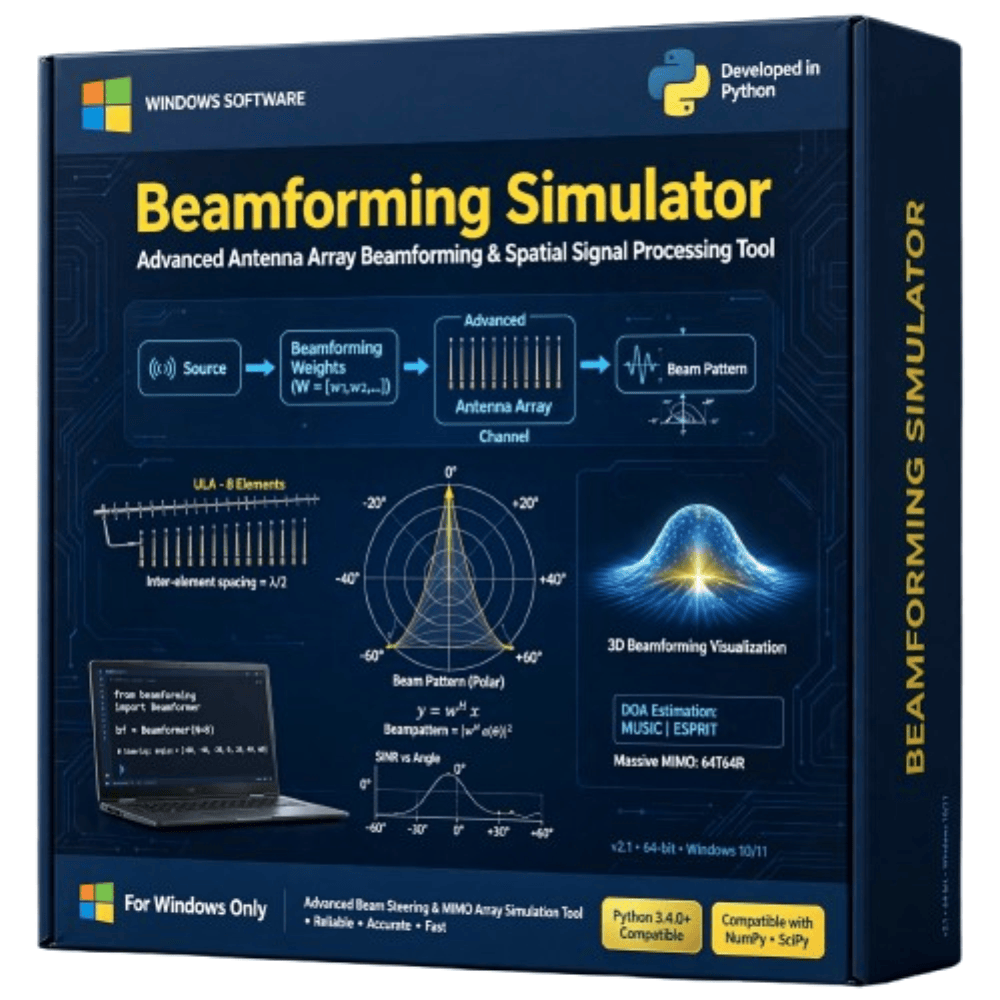
The Beamforming Simulator is a practical wireless communication simulation project designed to demonstrate how antenna arrays can control and direct radio-frequency signals toward desired users or directions. The simulator helps visualize beam patterns, signal direction, antenna-array behavior, and beam steering under different parameters. It is suitable for studying beamforming, antenna arrays, MIMO, 5G communication, wireless networks, and signal processing. This project is ideal for engineering students, researchers, and learners working on wireless communication and advanced antenna technologies.
₹1,999.00


Reviews
There are no reviews yet.