

LTE Scheduler Simulator


₹6,999.00
In StockLTE Scheduler Simulator developed with Python is a software-based simulation solution designed to study and analyze radio resource scheduling mechanisms in 4G LTE wireless communication networks. It provides a practical environment for understanding resource allocation, user scheduling, bandwidth management, throughput, fairness, Quality of Service (QoS), and scheduling algorithms. Ideal for LTE research, academic projects, telecom engineering studies, network performance analysis, and Python-based wireless communication simulation.
Description
LTE Scheduler Simulator
The LTE Scheduler Simulator developed with Python is a software-based simulation solution designed to help students, researchers, telecom engineers, and developers understand and experiment with radio resource scheduling in 4G LTE wireless communication networks.
Scheduling is a critical function in LTE because available radio resources must be distributed among multiple users and data transmissions. An LTE scheduler determines how resources can be allocated according to factors such as channel conditions, user requirements, throughput objectives, fairness, and Quality of Service (QoS).
Understanding LTE scheduling algorithms can be challenging through theory alone. The LTE Scheduler Simulator provides a practical software environment where users can explore resource allocation concepts, compare scheduling approaches, and analyze how scheduling decisions can influence network performance.
Developed using Python, the simulator provides a flexible platform for academic learning, telecom research, algorithm experimentation, and LTE network performance studies.
Understand LTE Scheduling
In a cellular network, multiple users compete for limited radio resources. The LTE scheduler plays an important role in determining which users receive resources and when those resources are assigned.
The scheduler operates within the LTE radio access network and makes resource allocation decisions based on available information and configured scheduling strategies.
An LTE Scheduler Simulator developed with Python can help users understand this process by providing a controlled environment for studying how scheduling decisions affect different users and overall network performance.
Python-Based LTE Scheduler Simulation
The simulator is developed using Python, making it suitable for research, experimentation, data analysis, and rapid development.
Python is widely used in scientific computing, networking, machine learning, optimization, and academic research. Its flexibility allows students and researchers to examine simulation logic, modify parameters, implement algorithms, and evaluate different scheduling scenarios.
A Python-based LTE scheduler simulator can therefore serve as a bridge between wireless communication theory and practical programming-based experimentation.
Explore LTE Resource Allocation
Radio resources in LTE are limited and need to be efficiently distributed among active users. Resource allocation is therefore a key part of LTE scheduling and radio resource management.
Using the simulator, users can study how available resources can be assigned to different users based on selected scheduling strategies and system conditions.
This can help students understand the relationship between resource allocation, user demand, channel conditions, throughput, and fairness.
Study LTE Scheduling Algorithms
Different scheduling strategies can produce different performance characteristics. Some approaches may focus on maximizing system throughput, while others may attempt to provide a fair distribution of resources among users.
An LTE Scheduler Simulator in Python can be used as a foundation for studying and comparing scheduling algorithms such as:
- Round Robin scheduling
- Proportional Fair scheduling
- Maximum Throughput scheduling
- Channel-aware scheduling
- QoS-oriented scheduling
- Custom scheduling strategies
The exact algorithms and functionality supported depend on the simulator implementation, but the platform can be used for experimentation with different scheduling concepts and approaches.
Analyze Throughput and Network Performance
Throughput is an important metric when evaluating LTE scheduling performance. The way resources are assigned to users can have a significant effect on individual and overall system throughput.
The simulator can provide a controlled environment for examining how scheduling decisions influence simulated network performance.
Researchers and students can use simulation scenarios to investigate relationships between resource allocation, user conditions, scheduling strategies, and throughput.
This makes the simulator useful for LTE performance analysis and wireless network research.
Study Fairness Between Users
Maximizing total throughput is not always the only objective of an LTE scheduler. In many scenarios, it is also important to consider how fairly available resources are distributed among users.
Scheduling algorithms can make different trade-offs between overall network efficiency and user-level fairness.
The LTE Scheduler Simulator developed with Python can help users explore these trade-offs and understand why different scheduling strategies may produce different performance results.
This makes it suitable for research projects focused on fair resource allocation, scheduling optimization, and multi-user wireless communication.
LTE QoS and Resource Scheduling
Quality of Service is another important consideration in LTE networks. Different applications may have different requirements related to latency, throughput, reliability, or resource availability.
An LTE scheduling simulator can be used to study how scheduling decisions may be influenced by user requirements and QoS-related considerations.
This provides a useful foundation for academic projects involving LTE QoS scheduling, resource management, traffic prioritization, and network optimization.

Applications of LTE Scheduler Simulator
The LTE Scheduler Simulator can be useful for a variety of academic, research, and development applications, including:
- 4G LTE scheduling simulation
- Radio resource management studies
- LTE resource allocation research
- Scheduling algorithm comparison
- Throughput analysis
- Fairness analysis
- QoS scheduling studies
- Wireless communication research
- LTE academic projects
- Final-year engineering projects
- Telecommunications laboratory demonstrations
- Python-based telecom projects
- LTE network performance analysis
- Resource allocation algorithm development
It can be particularly useful for students and researchers studying telecommunications, electronics and communication engineering, wireless communication, computer networks, information technology, and related fields.
Ideal for Academic and Final-Year Projects
The Python LTE Scheduler Simulator can provide a practical foundation for university assignments, laboratory exercises, final-year projects, and research work.
Students can use the simulator to demonstrate how scheduling algorithms operate and investigate how different strategies affect users and network performance.
For example, an academic project could compare multiple scheduling strategies under different simulated user or channel conditions and analyze metrics such as throughput and fairness.
This approach allows students to connect theoretical scheduling concepts with practical software-based experimentation.
Experiment with Multiple Users
LTE scheduling becomes particularly important in multi-user environments. When multiple UEs require access to the same radio resources, the scheduler needs to determine how those resources should be distributed.
A simulation environment makes it possible to create controlled multi-user scenarios and investigate how scheduling strategies respond to changing conditions.
Users can study how the number of users, resource availability, traffic requirements, or simulated channel conditions may influence scheduling outcomes.
Flexible Platform for LTE Research
One of the major advantages of simulation is the ability to conduct repeatable experiments without requiring a complete physical LTE network.
Researchers can create different scenarios, modify parameters, test scheduling approaches, record simulated results, and compare outcomes.
The Python implementation provides additional flexibility for experimentation and potential customization. Developers and researchers can use the simulator as a foundation for implementing additional scheduling logic or research-specific scenarios.
Benefits of LTE Scheduler Simulator
A Python-based LTE Scheduler Simulator provides several potential benefits:
- Practical understanding of LTE scheduling
- Python-based programmable environment
- Study of radio resource allocation
- Scheduling algorithm experimentation
- Throughput and fairness analysis
- Multi-user LTE simulation
- QoS scheduling research
- Useful for academic demonstrations
- Suitable for telecom research
- Can serve as a foundation for customized scheduling experiments
By combining LTE scheduling theory with software simulation, users can gain a deeper understanding of how radio resources can be managed in a multi-user cellular network.
Why Choose an LTE Scheduler Simulator?
Efficient radio resource management is essential to the performance of LTE networks. Scheduling decisions can influence throughput, fairness, resource utilization, and user experience.
The LTE Scheduler Simulator developed with Python provides a practical environment for exploring these concepts without requiring access to a complete commercial LTE network.
Its Python-based implementation makes it suitable for students, researchers, and developers who want to combine programming with wireless communication research.
Conclusion
The LTE Scheduler Simulator developed with Python provides a practical software environment for studying radio resource scheduling and allocation in 4G LTE networks. It can help users understand scheduling algorithms, multi-user resource allocation, throughput, fairness, QoS, and LTE network performance.
Whether you are working on an LTE academic project, final-year engineering project, wireless communication research project, scheduling algorithm study, radio resource management experiment, or Python-based telecom simulation, this simulator can provide a useful foundation for learning and experimentation.
Explore LTE Scheduler simulation with Python and gain practical insight into the resource-management techniques used to efficiently distribute radio resources among users in 4G LTE wireless communication systems.
Related products
-

The 2G GSM Cell Simulator is a Python-based software project designed to simulate fundamental GSM cellular-network concepts. It provides a practical environment for understanding mobile stations, GSM cells, base stations, cellular coverage, mobility, communication channels, and basic network behavior. The project includes Python source code that can be studied, customized, and extended for academic projects, demonstrations, research, and learning. It is ideal for Electronics & Communication Engineering, Telecommunications, Computer Science, and related students looking to explore 2G GSM technology and cellular network simulation through a software-based implementation.
₹3,999.00 -

The Beamforming Simulator is a practical wireless communication simulation project designed to demonstrate how antenna arrays can control and direct radio-frequency signals toward desired users or directions. The simulator helps visualize beam patterns, signal direction, antenna-array behavior, and beam steering under different parameters. It is suitable for studying beamforming, antenna arrays, MIMO, 5G communication, wireless networks, and signal processing. This project is ideal for engineering students, researchers, and learners working on wireless communication and advanced antenna technologies.
₹1,999.00 -
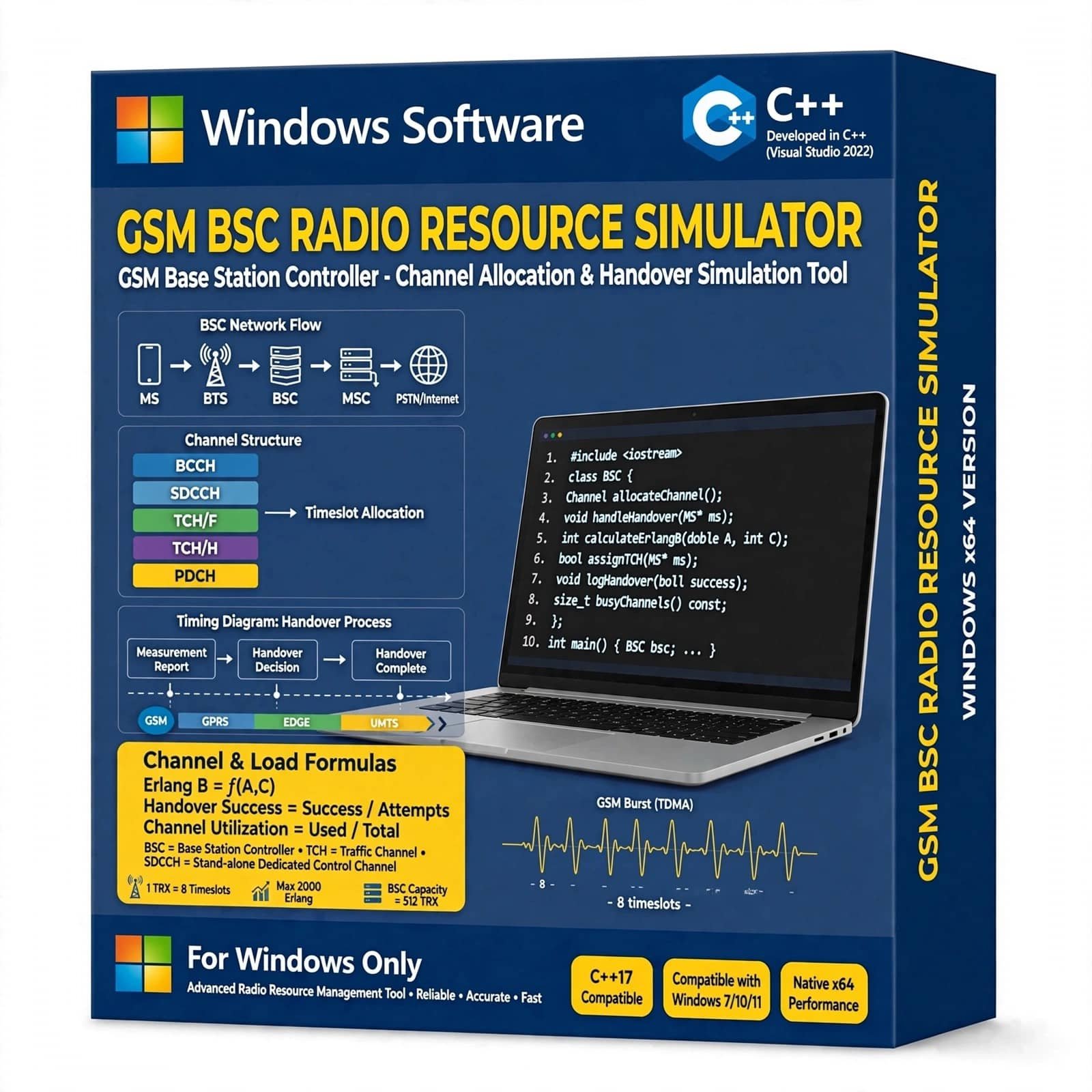
GSM BSC Radio Resource Simulator is a professional telecom training and development solution designed to simulate GSM Base Station Controller (BSC) radio resource management functions. It helps students, telecom engineers, researchers, and network professionals understand GSM radio resource allocation, channel management, call handling, handover concepts, and BSC-related network procedures in a controlled simulation environment.
Original price was: ₹750.00.₹100.00Current price is: ₹100.00. -

The 16QAM Modem Simulator is a C++-based software application designed to simulate and analyze a 16-QAM digital communication system. It demonstrates the complete modulation and demodulation process, including symbol mapping, signal generation, transmission, and data recovery. The simulator helps users understand key concepts of digital communication and evaluate system performance under different channel conditions.
₹1,999.00 -

Cell Coverage Simulator is a wireless communication simulation tool designed to model and analyze cellular network coverage using Python. It helps students, researchers, and telecom professionals visualize cell coverage, signal propagation, coverage areas, and network planning concepts through practical simulation and analysis.
₹6,999.00 -
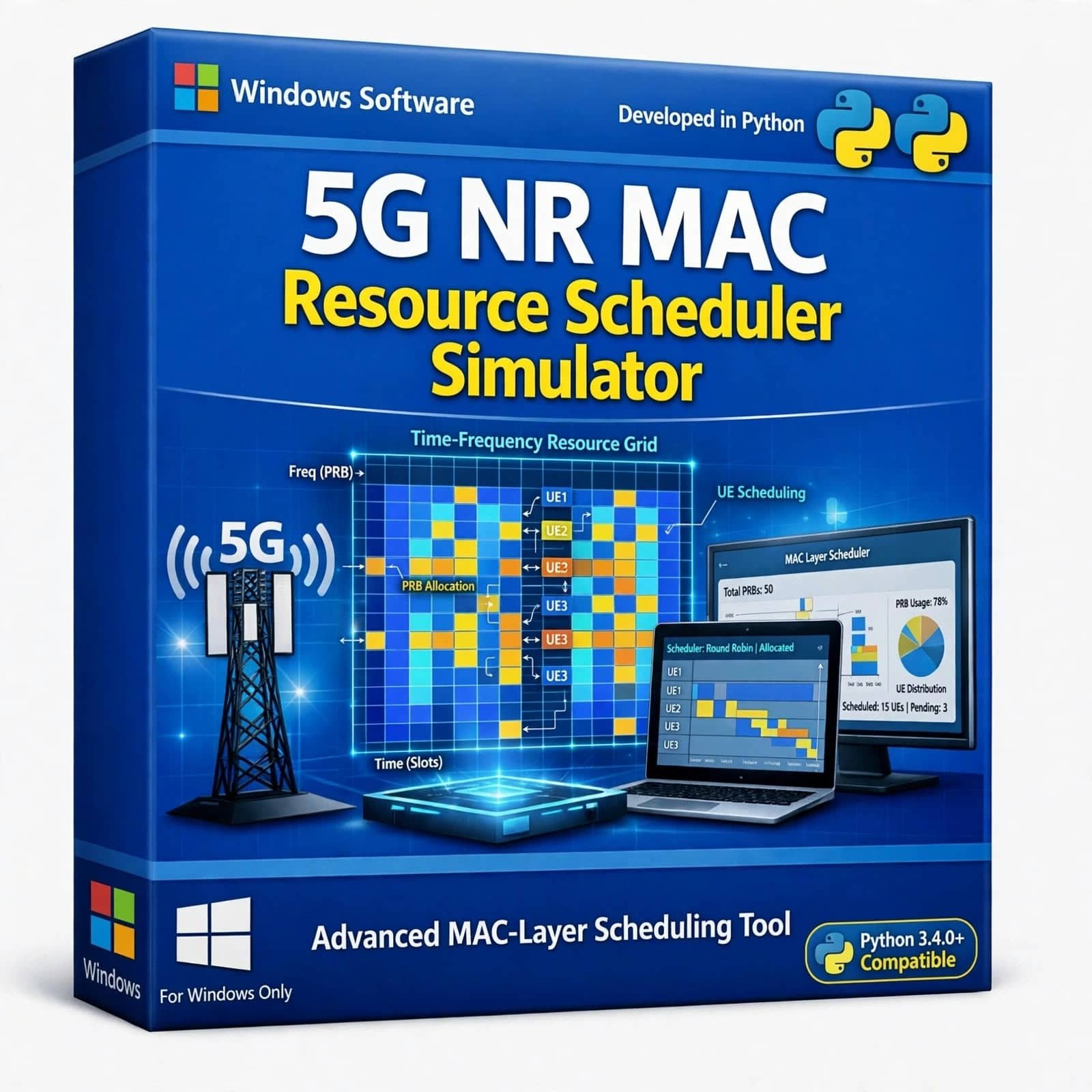
5G NR MAC Resource Scheduler Simulator is an advanced simulation solution for modeling and analyzing Medium Access Control (MAC) layer resource scheduling in 5G New Radio networks. It enables users to evaluate dynamic resource allocation, multi-UE scheduling, uplink and downlink resource management, QoS-aware scheduling, traffic conditions, and scheduling algorithms. The simulator supports analysis of throughput, latency, fairness, spectral efficiency, resource utilization, packet loss, and QoS performance, making it ideal for 5G NR research, scheduler algorithm development, academic projects, and wireless network optimization.
Original price was: ₹129,999.00.₹12,999.00Current price is: ₹12,999.00.


Reviews
There are no reviews yet.