

HSPA Simulator

₹3,999.00
In Stock3G HSPA Simulator with Python is a wireless communication simulation tool designed for studying High-Speed Packet Access (HSPA), 3G mobile broadband, WCDMA networks, packet data transmission, scheduling, throughput, and radio resource management. Developed using Python, it is suitable for telecom students, researchers, engineers, universities, and laboratories for practical HSPA simulation and academic projects.
Description
3G HSPA Simulator
The 3G HSPA Simulator with Python is a practical wireless communication simulation solution designed for studying High-Speed Packet Access (HSPA) and key concepts associated with 3G mobile broadband networks. Developed using Python, the simulator provides a controlled environment for students, researchers, telecom engineers, and academic institutions to explore packet-based communication, radio resource management, scheduling, throughput, channel behavior, and other fundamental HSPA concepts.
HSPA is an important evolution of 3G mobile communication technology that was developed to improve packet-data performance and provide higher-speed mobile broadband services. It introduced technologies and techniques designed to improve data throughput, network efficiency, and utilization of available radio resources.
The 3G HSPA Simulator with Python provides a software-based platform for understanding these concepts without requiring access to a live 3G cellular network.
Understand 3G HSPA Technology
High-Speed Packet Access (HSPA) refers to a family of enhancements to 3G networks designed to improve packet-data performance. HSPA is commonly associated with technologies such as HSDPA (High-Speed Downlink Packet Access) and HSUPA (High-Speed Uplink Packet Access).
Understanding HSPA provides valuable knowledge about the development of mobile broadband technologies and the techniques used to improve data communication over cellular radio networks.

The simulator can be used to explore concepts related to:
- 3G HSPA architecture
- HSPA packet data transmission
- HSDPA concepts
- HSUPA concepts
- WCDMA-based networks
- Radio resource management
- Packet scheduling
- Data throughput
- Wireless channel behavior
- Mobile broadband
- Cellular network performance
- 3G network simulation
The exact features and supported procedures depend on the implementation of the simulator.
Python-Based HSPA Simulation
The use of Python makes this simulator suitable for students and researchers who want to combine programming with wireless communication and mobile network simulation.
Python provides a flexible environment for modeling network behavior, generating simulation scenarios, implementing algorithms, processing results, and analyzing communication performance.
A Python-based HSPA simulator can therefore be used for both educational demonstrations and research-oriented experiments. Students can examine how wireless communication concepts are represented in software, while researchers can develop and test selected simulation models and algorithms.
The combination of Python programming and 3G HSPA simulation makes this product particularly useful for telecom engineering projects, university laboratories, wireless communication research, and academic demonstrations.
Study HSDPA and HSUPA Concepts
HSPA includes technologies that improve both downlink and uplink packet data performance.
HSDPA focuses on improving high-speed packet data transmission in the downlink direction, while HSUPA provides enhancements for uplink packet transmission.
The simulator can provide a practical environment for studying the principles associated with these technologies, depending on the supported implementation.
Users can explore concepts such as:
- Downlink packet transmission
- Uplink packet transmission
- Packet scheduling
- Radio resource allocation
- Data throughput
- Channel utilization
- Mobile user traffic
- Network resource management
- Packet-based communication
These concepts help learners understand how 3G networks evolved from traditional circuit-oriented services toward higher-performance packet-based mobile broadband.

HSPA Radio Resource Management
Efficient management of radio resources is an important part of cellular network performance. HSPA networks use scheduling and resource management techniques to support packet-data users and make effective use of available radio resources.
The simulator can help students understand the relationship between available radio resources, users, traffic, scheduling, and data throughput.
Simulation-based experiments can make it easier to understand how different network conditions or configurations can influence the behavior of a packet-based cellular system.
This makes the product useful for studying wireless resource allocation, packet scheduling, cellular network performance, and mobile broadband simulation.
3G HSPA Simulator for Academic Education
The simulator is suitable for engineering colleges, universities, telecom laboratories, wireless communication institutes, and technical training centers.
It can support practical learning for courses and laboratory sessions related to:
- 3G Mobile Communication
- HSPA Technology
- WCDMA
- Wireless Communication
- Cellular Networks
- Mobile Broadband
- Radio Resource Management
- Digital Communication
- Network Simulation
- Telecommunication Engineering
- Python Programming
Teachers can use the simulator to demonstrate HSPA concepts and explain the relationship between packet traffic, scheduling, radio resources, and network performance.
Students can use it for laboratory experiments, assignments, presentations, mini-projects, and final-year engineering projects.

Python HSPA Simulator for Research
The 3G HSPA Simulator with Python can also be useful for research involving wireless communication, packet scheduling, radio resource management, cellular network performance, and mobile broadband systems.
Simulation allows researchers to create controlled scenarios and evaluate selected network behaviors without requiring physical 3G infrastructure.
Python also provides a convenient environment for implementing algorithms and analyzing simulation results. Depending on the supported functionality, researchers can use the simulator as a foundation for experiments involving traffic conditions, resource allocation, scheduling strategies, throughput, and other performance-related parameters.
Study HSPA Network Performance
Network performance is an important consideration in mobile broadband systems. Parameters such as traffic load, available radio resources, scheduling, and channel conditions can influence data transmission performance.
A simulation environment allows users to study these relationships without relying on a production network.
The HSPA simulator can therefore be used for educational demonstrations and research exercises involving:
- Data throughput
- Packet transmission
- Network utilization
- Resource allocation
- User traffic
- Scheduling behavior
- Cellular network performance
- Mobile broadband scenarios
The specific performance metrics available depend on the simulator implementation.
Key Benefits
3G HSPA simulation: Study High-Speed Packet Access concepts through a software-based simulation environment.
Python based: Combine Python programming with mobile communication and wireless network modeling.
HSDPA and HSUPA concepts: Explore downlink and uplink packet-data technologies.
Packet-based communication: Understand the principles of high-speed packet transmission in 3G networks.
Resource management: Study the relationship between radio resources, scheduling, users, and throughput.
Academic project support: Suitable for university laboratories, engineering projects, demonstrations, and research.
Controlled environment: Perform experiments without requiring access to a live 3G cellular network.
Practical learning: Connect theoretical HSPA concepts with software-based simulation.
Applications
The 3G HSPA Simulator with Python can be used for:
- HSPA network simulation
- HSDPA simulation
- HSUPA simulation
- 3G mobile broadband studies
- WCDMA network simulation
- Packet scheduling experiments
- Radio resource management studies
- Cellular network performance analysis
- Throughput simulation
- Wireless communication laboratory experiments
- Python telecom projects
- 3G academic projects
- Mobile communication research
- HSPA training and education
It can also be used to demonstrate the evolution of 3G networks toward higher-speed packet-data services.
Who Can Use the 3G HSPA Simulator?
The product is suitable for:
- Telecom engineering students
- Electronics and communication engineering students
- Wireless communication students
- Network engineering students
- Telecom researchers
- Mobile communication researchers
- Python programming students
- Cellular network researchers
- Engineering colleges and universities
- Telecom training institutes
- Academic laboratories
- Final-year engineering project teams
It is particularly useful for learners who want to combine Python programming with 3G mobile communication and HSPA technology.
Why Choose a 3G HSPA Simulator with Python?
HSPA combines several concepts involving packet communication, scheduling, radio resources, and cellular network performance. These concepts can be challenging to understand through theory alone.
The 3G HSPA Simulator with Python provides a practical software environment for exploring these principles and understanding how packet-based mobile broadband systems operate.
Using simulation, students can investigate communication scenarios and gain a better understanding of the relationship between network resources, users, packet traffic, scheduling, and performance.
For academic institutions, the simulator can complement mobile communication and wireless networking courses. For students, it can support practical projects and laboratory exercises. For researchers, it can provide a controlled platform for selected HSPA and cellular network studies.
Conclusion
The 3G HSPA Simulator with Python is a practical solution for studying High-Speed Packet Access, HSDPA, HSUPA, WCDMA, packet data transmission, radio resource management, scheduling, and 3G mobile broadband.
Its Python-based approach makes it suitable for students, researchers, educators, telecom engineers, and academic institutions looking to combine programming with wireless communication simulation.
Whether you are working on a 3G HSPA project, HSDPA simulation, HSUPA study, Python telecom project, wireless communication laboratory experiment, or cellular network research project, this simulator provides a controlled environment for exploring important HSPA concepts.
For users searching for a 3G HSPA Simulator, HSPA Simulator with Python, HSDPA Simulator, HSUPA Simulator, 3G Network Simulator, WCDMA Simulator, Python Wireless Communication Simulator, Mobile Broadband Simulator, or HSPA Simulation Software, this product provides a useful platform for education, experimentation, training, and research.
Related products
-
5G NR Beam Management Simulator is an advanced simulation solution designed to model, analyze, and optimize beam management procedures in 5G New Radio (NR) networks. It enables engineers and researchers to evaluate beam sweeping, beam measurement, beam selection, beam reporting, and beam recovery under diverse network and channel conditions. The simulator supports performance analysis of directional communication, helping users assess beamforming strategies, mobility scenarios, link reliability, and system-level performance before real-world deployment.
Original price was: ₹74,999.00.₹12,999.00Current price is: ₹12,999.00. -
5G NR Massive MIMO Simulator is an advanced simulation solution for modeling and analyzing Massive Multiple-Input Multiple-Output (MIMO) technologies in 5G New Radio networks. It enables users to study large-scale antenna arrays, beamforming, precoding, spatial multiplexing, multi-user MIMO, channel estimation, and interference under configurable channel conditions. The simulator supports analysis of throughput, spectral efficiency, SINR, BER, BLER, MIMO capacity, beamforming gain, and multi-user performance, making it ideal for 5G NR research, algorithm development, academic projects, and 5G/6G wireless system optimization.
Original price was: ₹149,999.00.₹14,999.00Current price is: ₹14,999.00. -
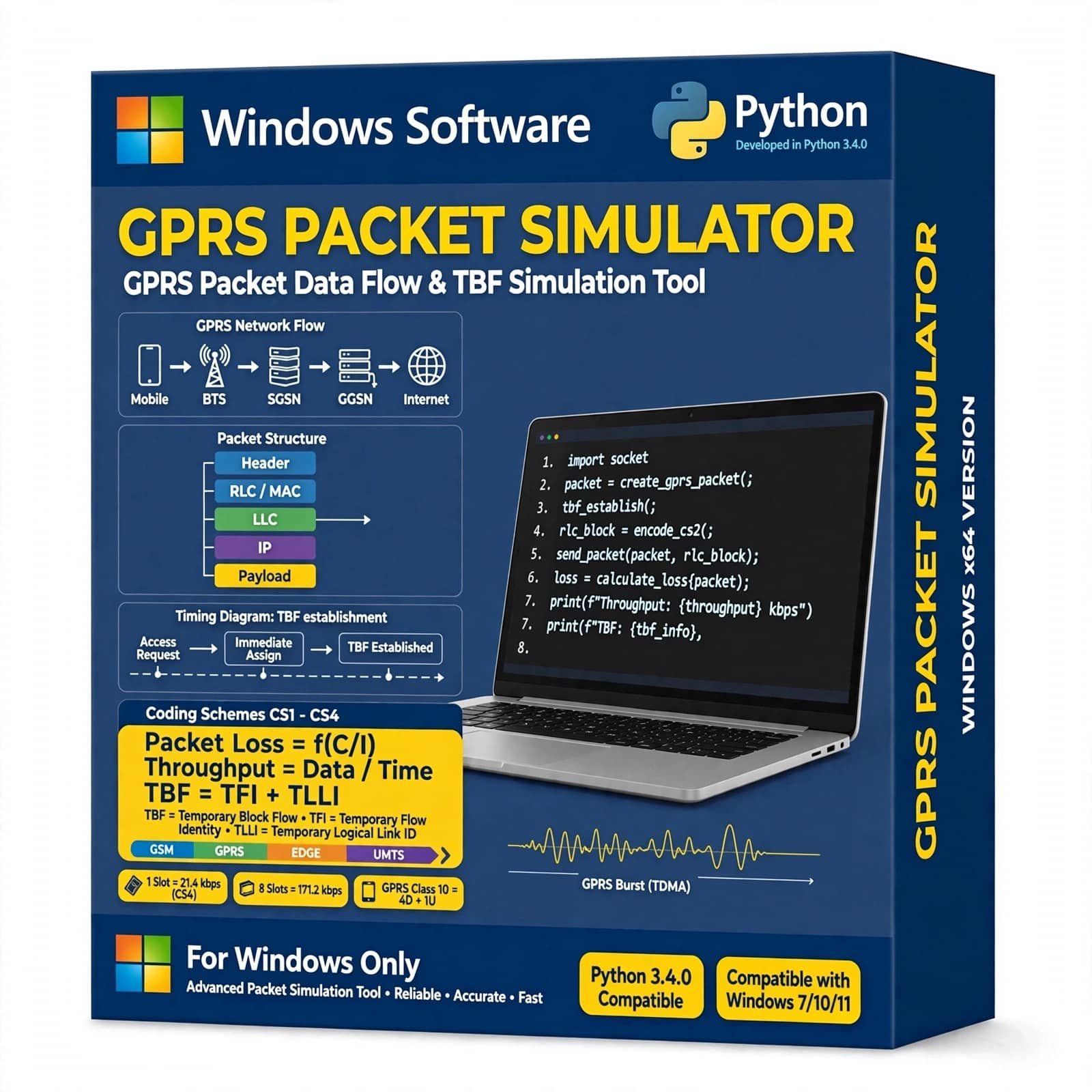
GPRS Packet Simulator is a powerful software solution for simulating GPRS data packets and testing GSM/GPRS communication systems. It helps developers, engineers, and testing teams generate, analyze, and validate packet-based communication in a controlled environment without requiring extensive physical network infrastructure. Ideal for GPRS testing, protocol development, IoT applications, and telecom system validation.
₹3,999.00 -
A Python-based 5G Core Network Simulator designed for studying, analyzing, and demonstrating 5G Core network architecture and procedures. Explore key 5G Network Functions such as AMF, SMF, UPF, AUSF, UDM, PCF, NRF, and NSSF, along with UE registration, authentication, session management, mobility, and signaling procedures.
Ideal for 5G research, telecom engineering, academic projects, university laboratories, protocol development, and network simulation. Provides a flexible software environment for experimenting with 5G Core concepts without requiring a complete commercial 5G network infrastructure.
Original price was: ₹74,999.00.₹19,999.00Current price is: ₹19,999.00. -
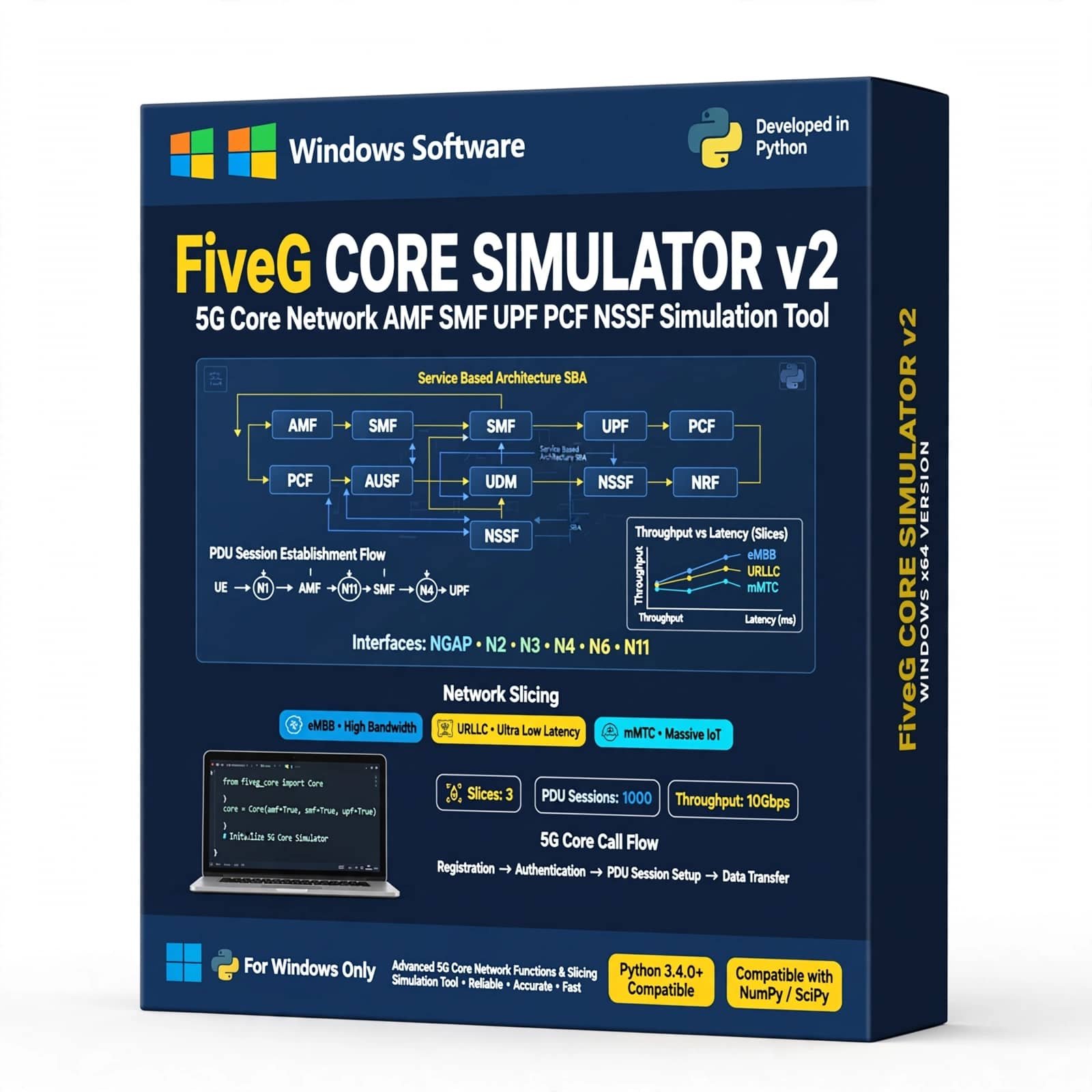
FiveG Core Simulator v2 is an educational 5G Core Network simulation tool designed to help students, educators, researchers, and telecom professionals understand 5G core architecture, network functions, signaling procedures, latency, and protocol interactions through an interactive topology and signaling animation environment.
₹19,999.00 -

The Beamforming Simulator is a practical wireless communication simulation project designed to demonstrate how antenna arrays can control and direct radio-frequency signals toward desired users or directions. The simulator helps visualize beam patterns, signal direction, antenna-array behavior, and beam steering under different parameters. It is suitable for studying beamforming, antenna arrays, MIMO, 5G communication, wireless networks, and signal processing. This project is ideal for engineering students, researchers, and learners working on wireless communication and advanced antenna technologies.
₹1,999.00



Reviews
There are no reviews yet.