
New
67% Off

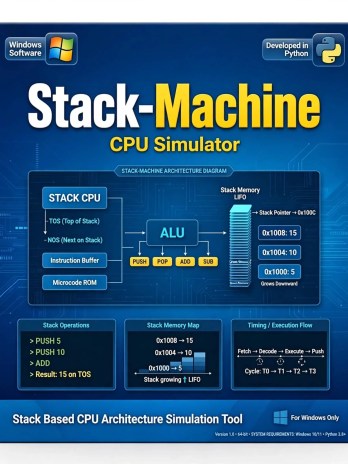
MIPS Single Cycle Processor Simulator

Original price was: ₹750.00.₹250.00Current price is: ₹250.00.
In StockMaster computer architecture hands-on with the MIPS Single Cycle Processor Simulator—an interactive software environment designed to bridge the gap between assembly language programming and hardware execution. Engineered for students, educators, and embedded systems developers, this simulator offers real-time visual tracking of data paths, register states, memory operations, and control line activations. By executing every MIPS instruction—from arithmetic and logical operations to branches and memory loads—in a single clock cycle, the tool provides immediate clarity on fundamental CPU operations. Step through code, inspect $t0-$s7 registers, edit RAM values, and debug complex assembly routines in an intuitive interface. Whether you are preparing for CS exams, designing custom FPGA hardware, or teaching micro-architecture, this light, responsive tool turns abstract micro architecture theories into visual, interactive learning.
Description
MIPS Single Cycle Processor Simulator
MIPS Single Cycle Processor Simulator – Understanding how software instructions translate into hardware signals is a foundational milestone for computer science students, software engineers, and digital design professionals. The MIPS Single Cycle Processor Simulator provides an immersive, visual environment built to demystify micro architecture execution.

By modeling a 32-bit Harvard Architecture CPU executing one instruction per clock cycle, this software allows users to observe, debug, and understand every electrical pathway, control bit, and register mutation inside a classic RISC processor.
Core Architecture & Execution Model
The MIPS Single Cycle Simulator faithfully implements the standard 32-bit MIPS-I instruction set architecture (ISA). In a single-cycle implementation, every step of instruction processing—Fetch, Decode, Execute, Memory Access, and Write-Back—occurs within a single unified clock edge.

Because every operation completes in one cycle, learners gain a crystal-clear mental model of how signal control lines coordinate hardware sub-components without the masking complexity of hardware pipelines or multi-cycle state machines.
Key Features & Capabilities
- Full MIPS Instruction Set Coverage: Execute R-type (e.g., add, sub, and, or, slt), I-type (e.g., lw, sw, addi, beq, bne), and J-type (e.g., j, jal) instructions with full architectural compliance.
- Dynamic Datapath Visualization: Watch multiplexers, the Arithmetic Logic Unit (ALU), sign-extenders, and memory units illuminate dynamically based on the active control signals (RegWrite, ALUOp, ALUSrc, MemRead, MemWrite, MemToReg).
- Interactive Register File Inspection: Real-time visibility into all 32 general-purpose registers (GPRs), including hardwired zero ($zero), temporary registers ($t0–$t9), saved registers ($s0–$s7), stack pointer ($sp), and return address ($ra).
- Isolated Instruction & Data Memory: Configurable Harvard-architecture memory spaces allow precise byte/word inspection and direct editing of memory addresses before and during code execution.
- Step-by-Step & Auto Execution: Run programs at customizable clock speeds or advance single clock cycles manually to pinpoint bugs in assembly logic.
- Built-in Assembler & Disassembler: Write clean MIPS assembly code directly inside the integrated editor, convert code to 32-bit binary/hexadecimal formats, and dissemble hex dumps instantly.

Detailed Technical Specifications
| Feature / Module | Specification / Supported Standard |
| Architecture | 32-bit Reduced Instruction Set Computer (RISC) |
| Execution Style | Single-Cycle (CPI = 1.0) |
| Memory Model | Dual-bus Harvard Architecture (Separate Instruction and Data Memory) |
| Registers | 32 x 32-bit General Purpose Registers ($0 through $31) |
| ALU Operations | ADD, SUB, AND, OR, NOR, SLT, Shift Left/Right Logical |
| Branching & Jumps | PC-relative branching (beq, bne) and absolute addressing (j, jal, jr) |
| File Import/Export | .s, .asm, .bin, .hex machine code files |

Who Is This Simulator Built For?
University Students & Computer Science Majors
Bridge the gap between theoretical textbooks (such as Computer Organization and Design by Patterson & Hennessy) and practical CPU implementation. Build a foundational understanding of microarchitecture before tackling modern pipelined or superscalar architectures.
CS Educators & University Instructors
Demonstrate hardware mechanics visually in the classroom. Generate test cases, illustrate how instruction decoding operates, and assign engaging assembly assignments without requiring physical FPGA development boards.
Hardware Engineers & Verilog/VHDL Developers
Use the single-cycle model as a functional software reference to verify digital RTL designs, instruction decoder logic, and control unit truth tables.

Frequently Asked Questions
How does a single-cycle simulator differ from a pipelined simulator?
In a single-cycle processor, a single instruction completes in its entirety within one clock cycle. A pipelined simulator models modern CPUs where multiple instructions overlap across separate hardware stages simultaneously. The single-cycle simulator simplifies learning by showing pure control signal generation without hazards, stalls, or forwarding mechanisms.
Can I load raw machine code into the simulator?
Yes. You can write MIPS assembly directly within the built-in IDE or load pre-compiled .hex or .bin files directly into Instruction Memory.
Does this software support hardware interrupts or floating-point operations?
The core simulator focuses on the standard integer MIPS-I ISA (R, I, and J instruction formats). It is designed primarily for foundational CPU architecture courses rather than floating-point coprocessor (COP1) emulation.
Related products
-
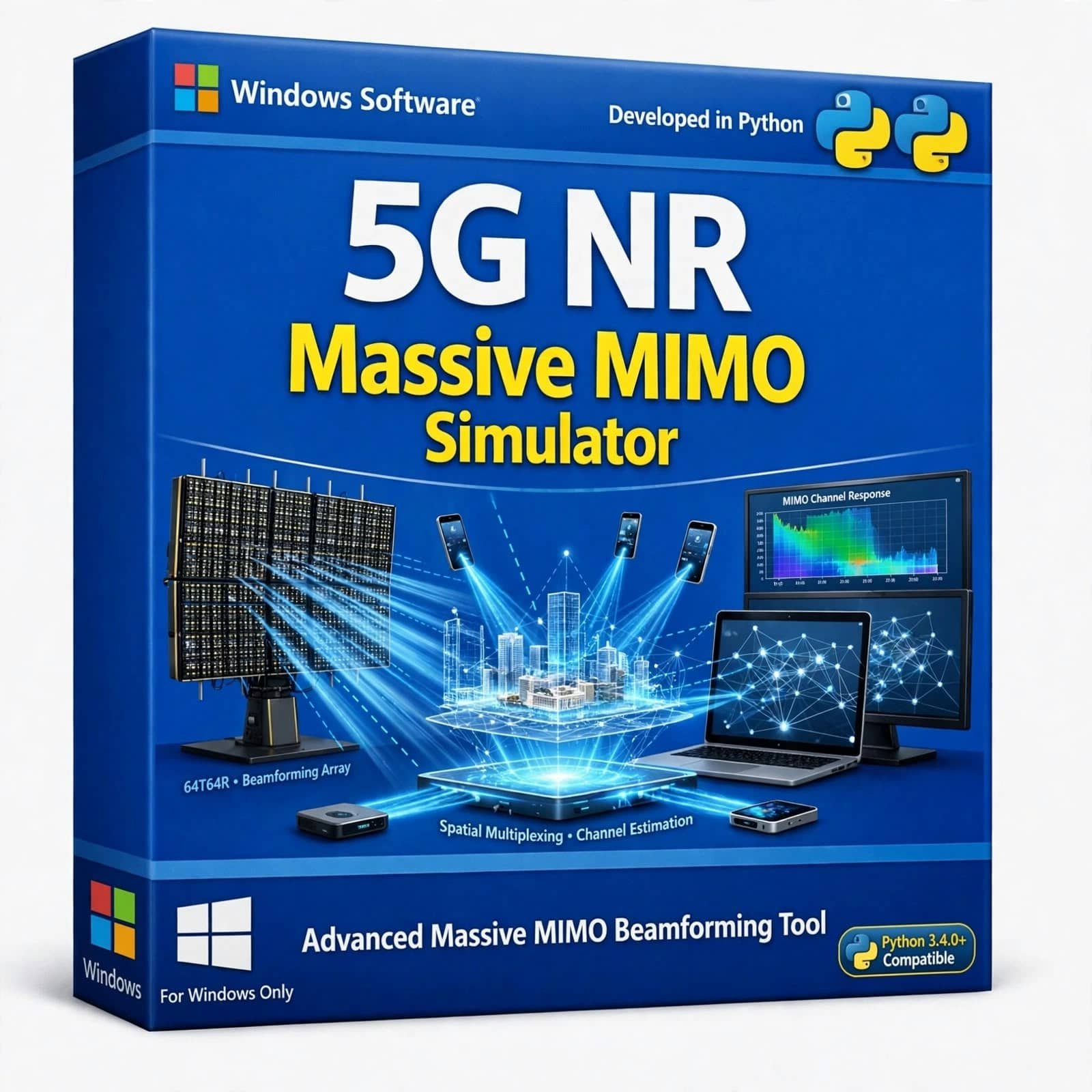
5G NR Massive MIMO Simulator is an advanced simulation solution for modeling and analyzing Massive Multiple-Input Multiple-Output (MIMO) technologies in 5G New Radio networks. It enables users to study large-scale antenna arrays, beamforming, precoding, spatial multiplexing, multi-user MIMO, channel estimation, and interference under configurable channel conditions. The simulator supports analysis of throughput, spectral efficiency, SINR, BER, BLER, MIMO capacity, beamforming gain, and multi-user performance, making it ideal for 5G NR research, algorithm development, academic projects, and 5G/6G wireless system optimization.
Original price was: ₹750.00.₹250.00Current price is: ₹250.00. -
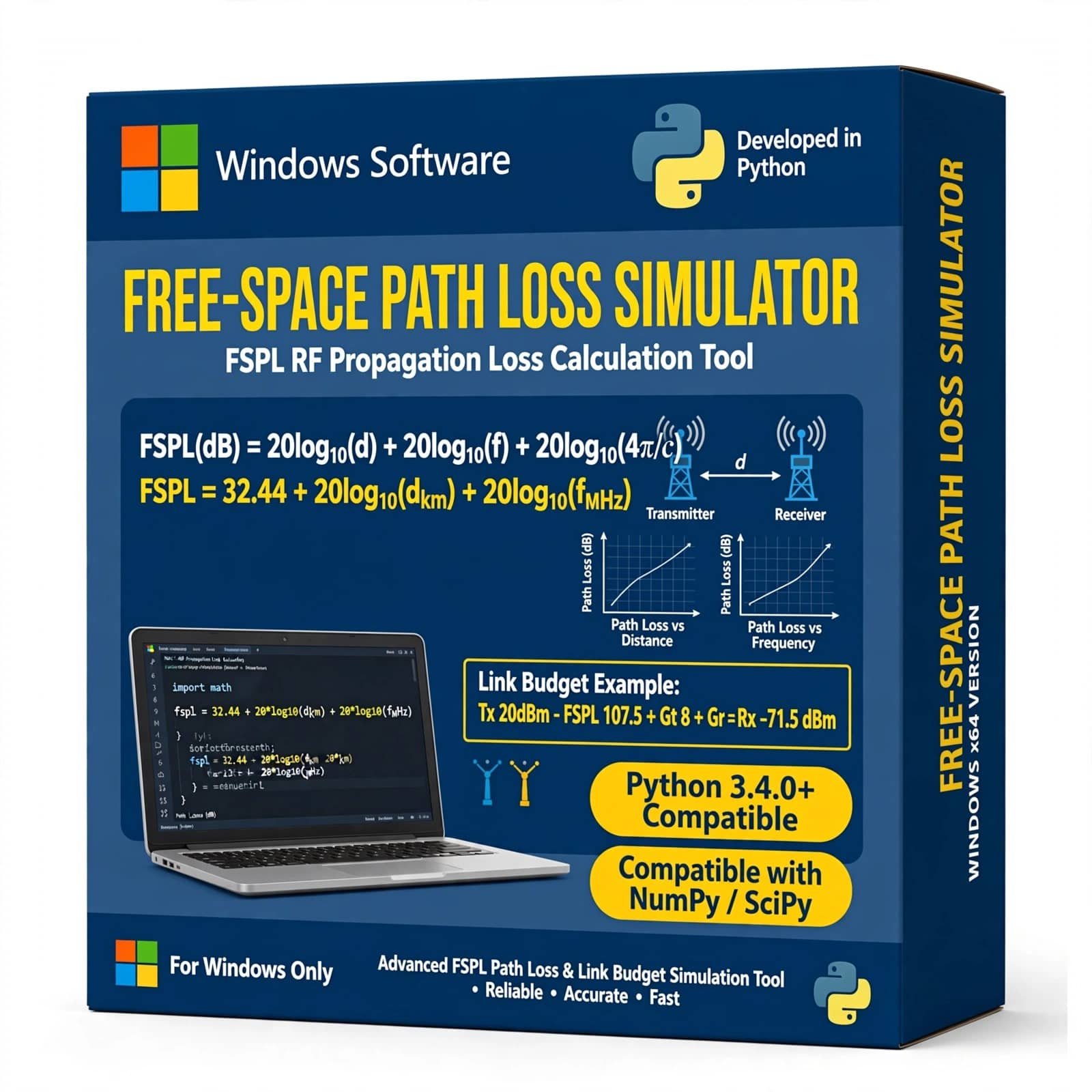
Free Space Path Loss Simulator Using Python is a practical wireless communication simulation project designed to calculate and visualize signal power loss as a radio wave travels through free space. Developed using Python, this simulator helps students, researchers, and communication engineers understand Free Space Path Loss (FSPL), transmission distance, frequency, received signal power, and wireless link performance.
The project provides an easy-to-understand simulation environment for analyzing how distance and operating frequency affect signal propagation. It is suitable for B.Tech, M.Tech, engineering students, academic projects, wireless communication studies, RF analysis, and Python-based simulation projects.
Original price was: ₹750.00.₹250.00Current price is: ₹250.00. -
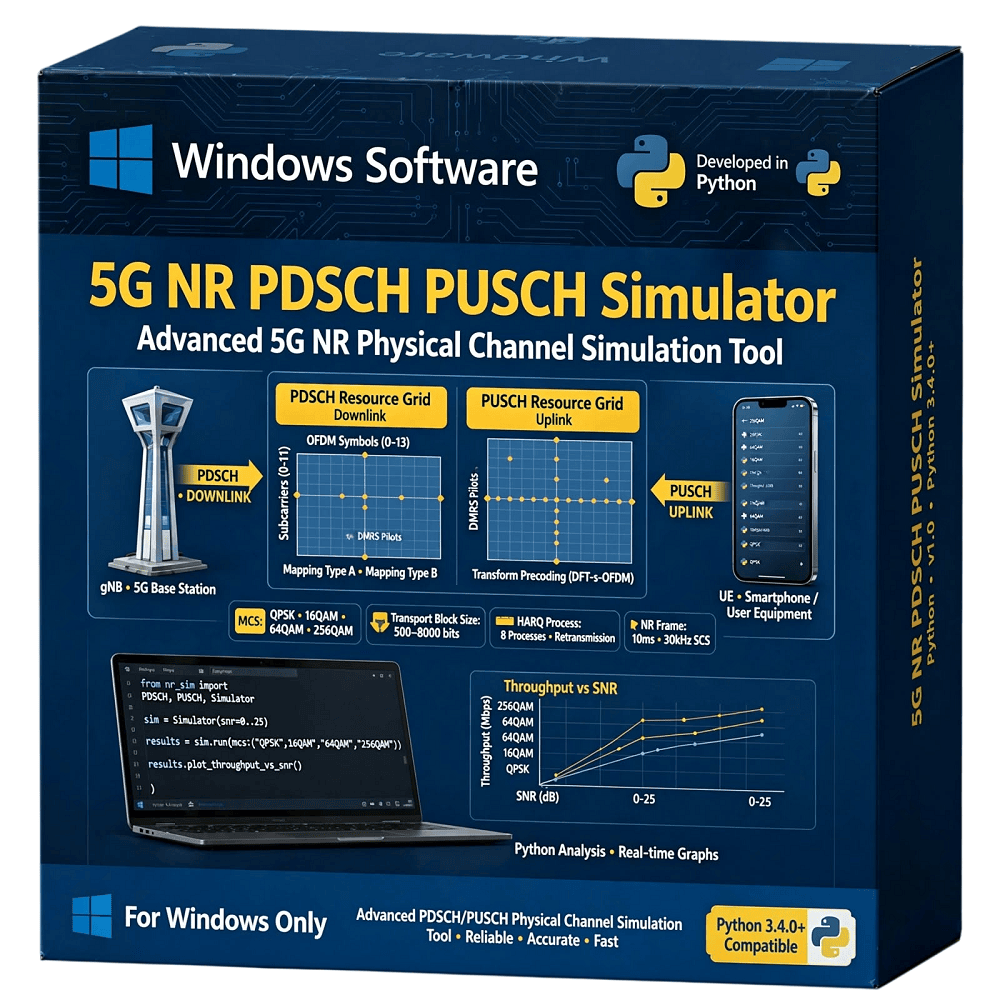
The 5G NR PDSCH PUSCH Simulator is a Python-based simulation software solution designed for researchers, engineers, students, and telecommunications professionals working with 5G New Radio (NR) physical-layer technologies. The simulator provides a practical environment for studying and experimenting with PDSCH (Physical Downlink Shared Channel) and PUSCH (Physical Uplink Shared Channel) transmission concepts.
Developed using Python, the simulator is suitable for academic research, algorithm development, demonstrations, testing, and educational applications related to 5G NR communication systems.
Available for sale as a software product. Contact us for product details, licensing, and purchase information.
Original price was: ₹750.00.₹250.00Current price is: ₹250.00. -
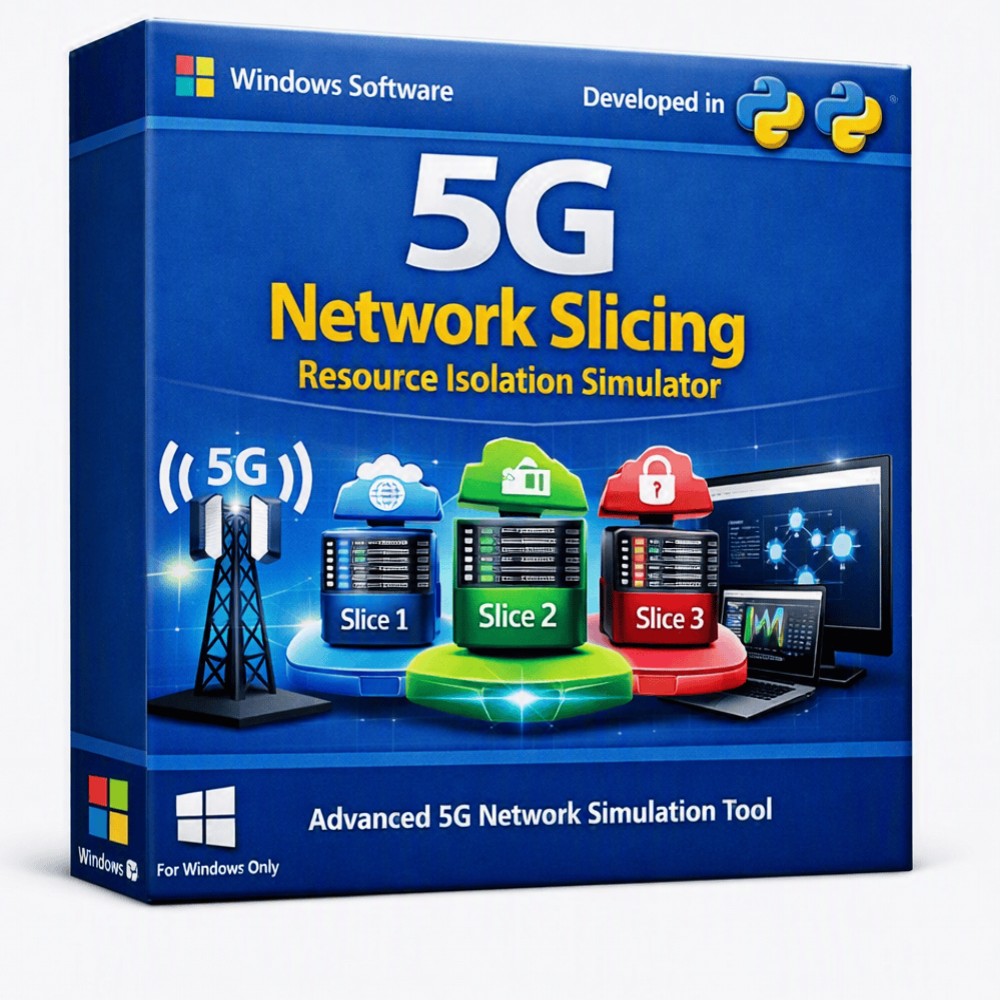
A Python-based 5G Network Slicing and Resource Isolation Simulator designed to model and analyze how multiple logical network slices can share physical 5G infrastructure while maintaining resource isolation. The simulator enables users to study CPU, memory, bandwidth, network capacity, traffic allocation, and resource management across different 5G network slices.
Ideal for 5G research, telecom engineering, academic projects, network optimization, resource allocation studies, and university laboratories.
Original price was: ₹750.00.₹250.00Current price is: ₹250.00. -
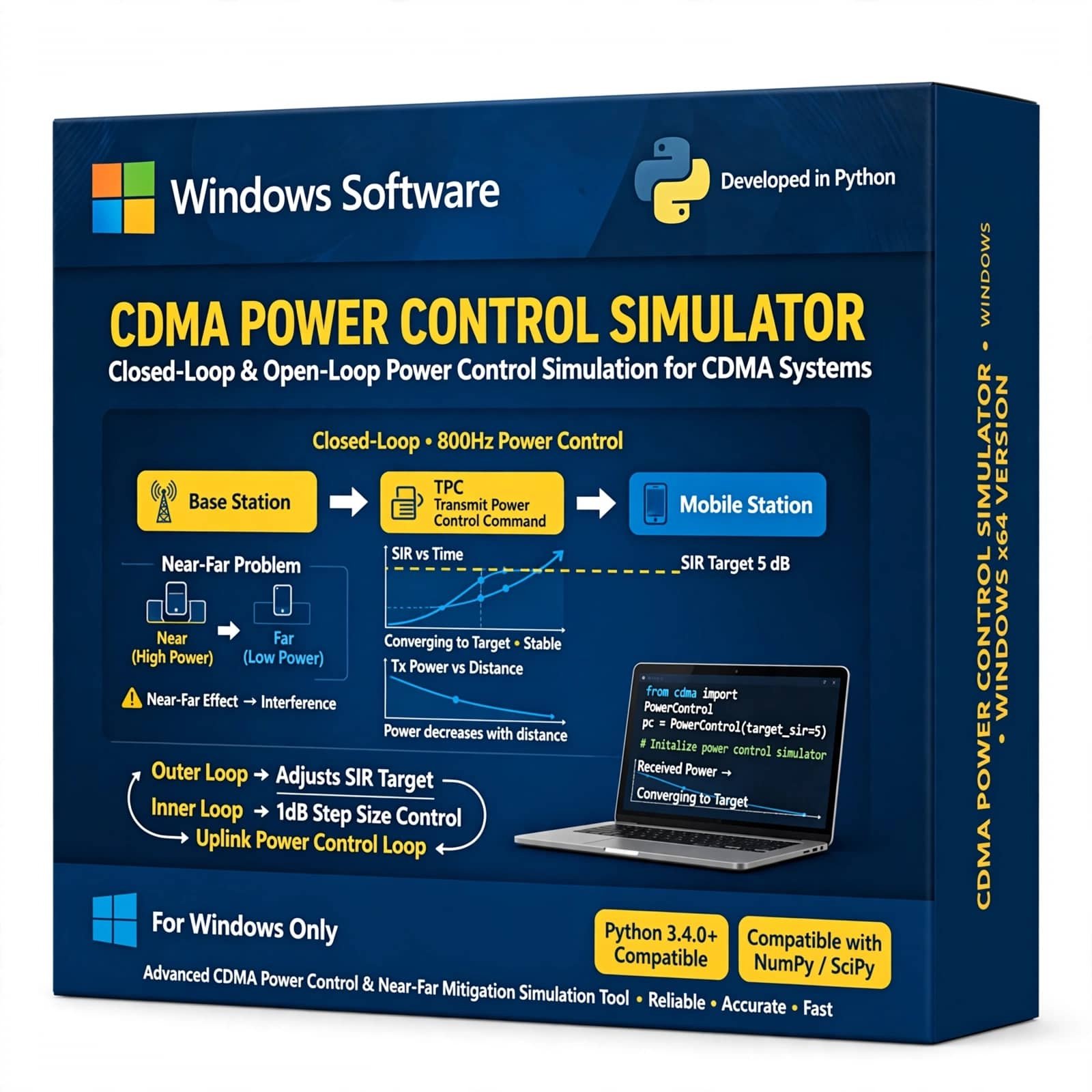
CDMA Power Control Simulator is an advanced communication engineering simulation tool designed to help students, researchers, and professionals understand and analyze power control techniques in Code Division Multiple Access (CDMA) wireless communication systems. It enables practical study of uplink and downlink power control, signal interference, power levels, and system performance.
Original price was: ₹750.00.₹250.00Current price is: ₹250.00. -
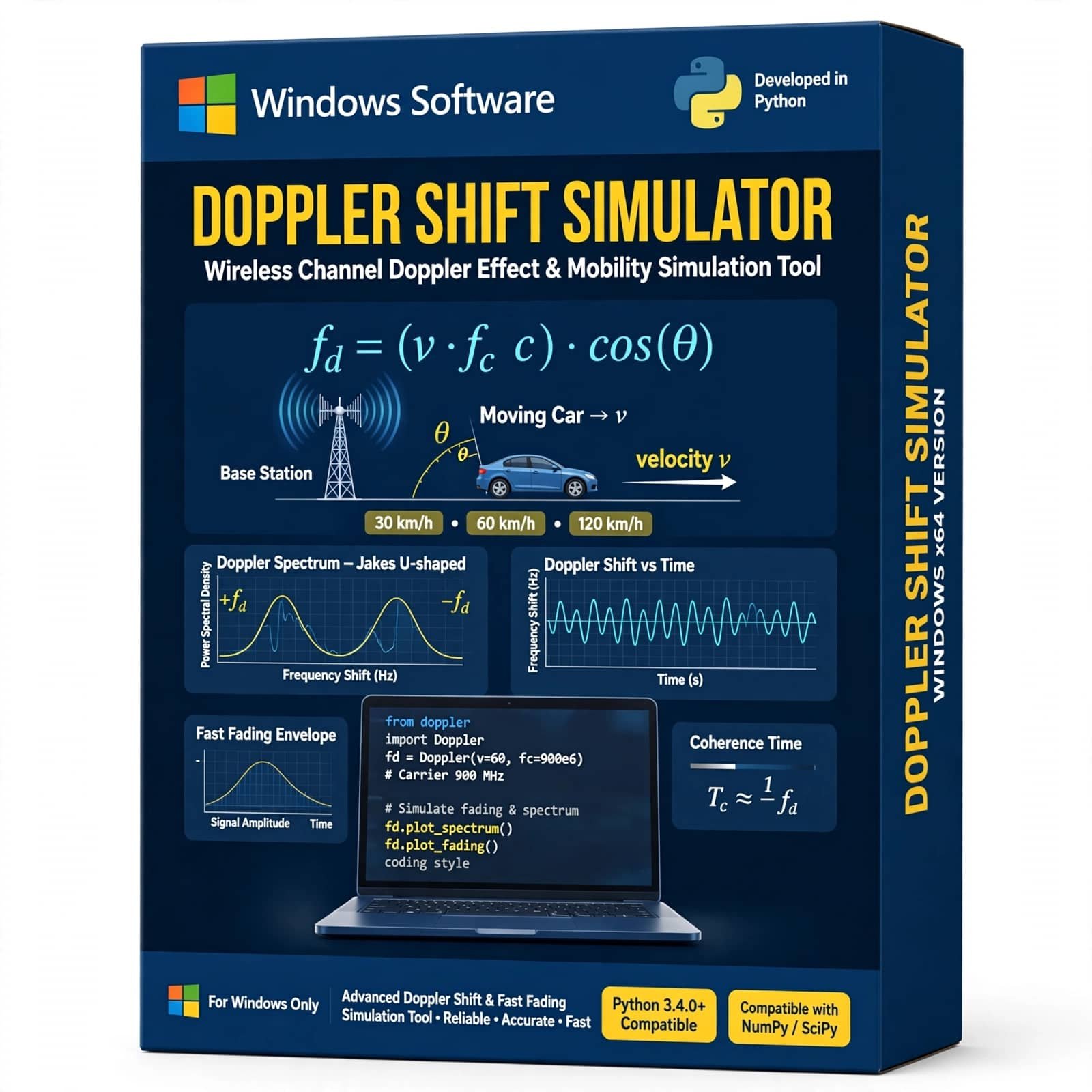
Doppler Shift Simulator Using Python is a practical wireless communication simulation tool for studying the Doppler effect and frequency shift caused by relative motion between a transmitter and receiver. It helps students, researchers, and communication engineers analyze Doppler frequency, carrier frequency, velocity, and mobile channel effects through Python-based simulation.
Original price was: ₹750.00.₹250.00Current price is: ₹250.00.


Reviews
There are no reviews yet.