

FiveG Core Simulator v2

₹19,999.00
In StockFiveG Core Simulator v2 is an educational 5G Core Network simulation tool designed to help students, educators, researchers, and telecom professionals understand 5G core architecture, network functions, signaling procedures, latency, and protocol interactions through an interactive topology and signaling animation environment.
Description
FiveG Core Simulator v2
Understanding the FiveG Core Simulator v2 architecture and signaling procedures of a 5G Core Network can be challenging when learning only from diagrams, specifications, or theoretical documentation. FiveG Core Simulator v2 provides an interactive way to explore how major 5G network functions communicate, how signaling procedures progress, and how parameters such as propagation delay, bandwidth, packet size, and queuing load can influence network behavior.
Designed as an educational 5G core network simulator, FiveG Core Simulator v2 combines a visual network topology with animated signaling procedures and detailed parameter controls. The result is a practical learning environment for students, instructors, researchers, and telecom engineering professionals who want to explore 5G Core Network concepts in a more intuitive way.
The simulator presents a visual representation of important 5G network components, including the UE (User Equipment), gNB, AMF, AUSF, UDM, and PCF. Network interfaces and signaling relationships are displayed directly within the topology, making it easier to understand how different network functions interact during procedures such as registration.
Interactive 5G Core Network Topology
One of the key features of FiveG Core Simulator v2 is its interactive topology and signaling animation. Instead of viewing a static architecture diagram, users can observe signaling activity across the network and follow the progression of a procedure from one network function to another.
The visual topology helps learners understand relationships between components such as:
- UE and gNB
- gNB and AMF
- AMF and AUSF
- AUSF and UDM
- AMF and PCF
- Other supporting 5G Core Network interfaces
This approach makes the simulator particularly useful for 5G architecture training, telecom education, networking courses, and laboratory demonstrations.
Explore 5G Registration Signaling
FiveG Core Simulator v2 includes an interactive Registration procedure that demonstrates the progression of signaling through the 5G network. Users can run the simulation using controls such as Play, Step, Pause, and Reset, allowing them to either observe the complete procedure or examine individual stages.
The Step functionality is especially useful for classroom instruction and technical analysis because it allows users to move through signaling events one stage at a time. The signaling log provides additional visibility into the events taking place during the procedure, including timing information and cumulative delay.
This makes FiveG Core Simulator v2 valuable for understanding concepts such as 5G UE registration, AMF signaling, authentication, network function interaction, signaling latency, and registration completion.

Configurable Network Parameters
The simulator also provides configurable global parameters that allow users to experiment with different network conditions. Parameters visible in the simulator include:
- Bandwidth (Mbps)
- Packet size (bytes)
- Concurrent UEs / queuing load
- Base queuing delay
- Per-link propagation delay
Users can adjust these values to investigate how changing network conditions may affect signaling performance and latency. This provides a practical foundation for experiments, demonstrations, assignments, and research-oriented exercises.
Analyze 5G Network Latency
Latency is an important consideration when studying mobile networks and signaling performance. FiveG Core Simulator v2 provides a dedicated latency-oriented view that helps users examine the contribution of different processing, propagation, and queuing factors.
By experimenting with link delays and network parameters, users can develop a better understanding of how end-to-end signaling time can be influenced by individual network elements and connections.
The Signaling Log further complements this functionality by presenting procedure events and timing information, enabling learners to connect the visual animation with measurable simulation results.
Ideal for 5G Education and Training
FiveG Core Simulator v2 is particularly suited to educational environments where learners need to understand 5G Core Network architecture and signaling without immediately working with complex production-grade telecom infrastructure.
It can be used for:
- 5G networking courses
- Telecom engineering education
- University and college laboratories
- 5G Core Network demonstrations
- Student projects and assignments
- Signaling procedure training
- Network architecture learning
- Latency and performance experiments
- Instructor-led classroom demonstrations
- Introductory research and simulation exercises
Key Benefits of FiveG Core Simulator v2
Visual Learning: Understand 5G network functions and interfaces through an interactive topology.
Hands-On Simulation: Explore signaling procedures rather than relying solely on theoretical diagrams.
Step-by-Step Analysis: Use Play, Step, Pause, and Reset controls to study individual stages.
Configurable Parameters: Experiment with bandwidth, packet size, concurrent UEs, queuing delay, and propagation delay.
Signaling Visibility: Follow signaling activity through the integrated signaling log.
Latency Analysis: Investigate how processing, propagation, and queuing factors contribute to network delay.
Educational Focus: Suitable for students, educators, telecom learners, and technical training environments.
Why Choose FiveG Core Simulator v2?
FiveG Core Simulator v2 bridges the gap between 5G Core Network theory and practical learning. Its combination of an interactive topology, animated signaling procedures, configurable network parameters, and latency analysis gives users a convenient environment for exploring how a 5G core network behaves.
Whether you are teaching 5G architecture, learning about AMF, AUSF, UDM, PCF and gNB interactions, studying 5G registration procedures, or demonstrating the impact of network delays, FiveG Core Simulator v2 provides an accessible and engaging simulation experience.
With its educational orientation and interactive controls, the simulator is a useful addition to 5G telecom training, academic laboratories, networking courses, and self-paced learning.
Related products
-
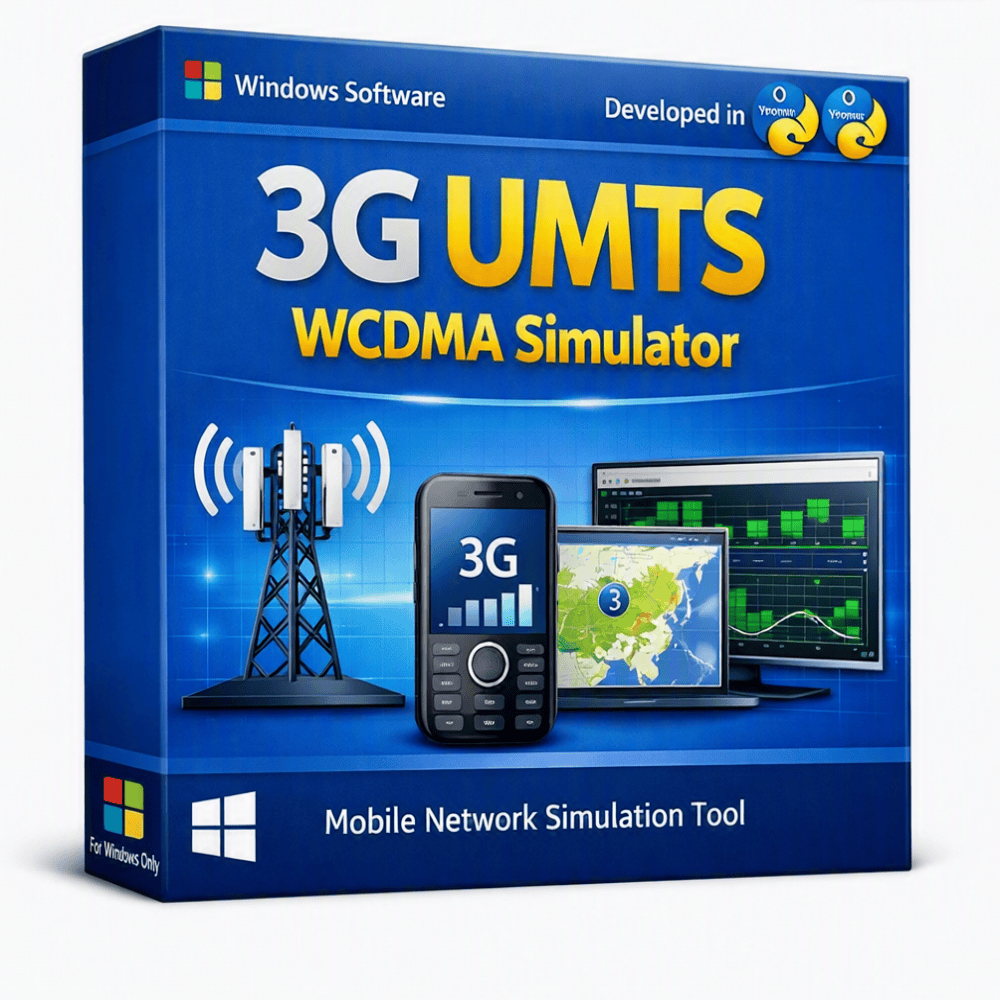
The 3G UMTS – WCDMA Simulator is a software-based simulation project designed to demonstrate the fundamental concepts of 3G Universal Mobile Telecommunications System (UMTS) and Wideband Code Division Multiple Access (WCDMA) technology. It provides a practical environment for studying cellular communication, spreading codes, signal transmission, mobile users, network connectivity, and WCDMA-based communication principles. The simulator is suitable for students, researchers, and developers working on telecommunications and wireless communication projects. It can be used for academic demonstrations, engineering projects, research, experimentation, and learning about 3G mobile communication and WCDMA network technologies.
₹3,999.00 -
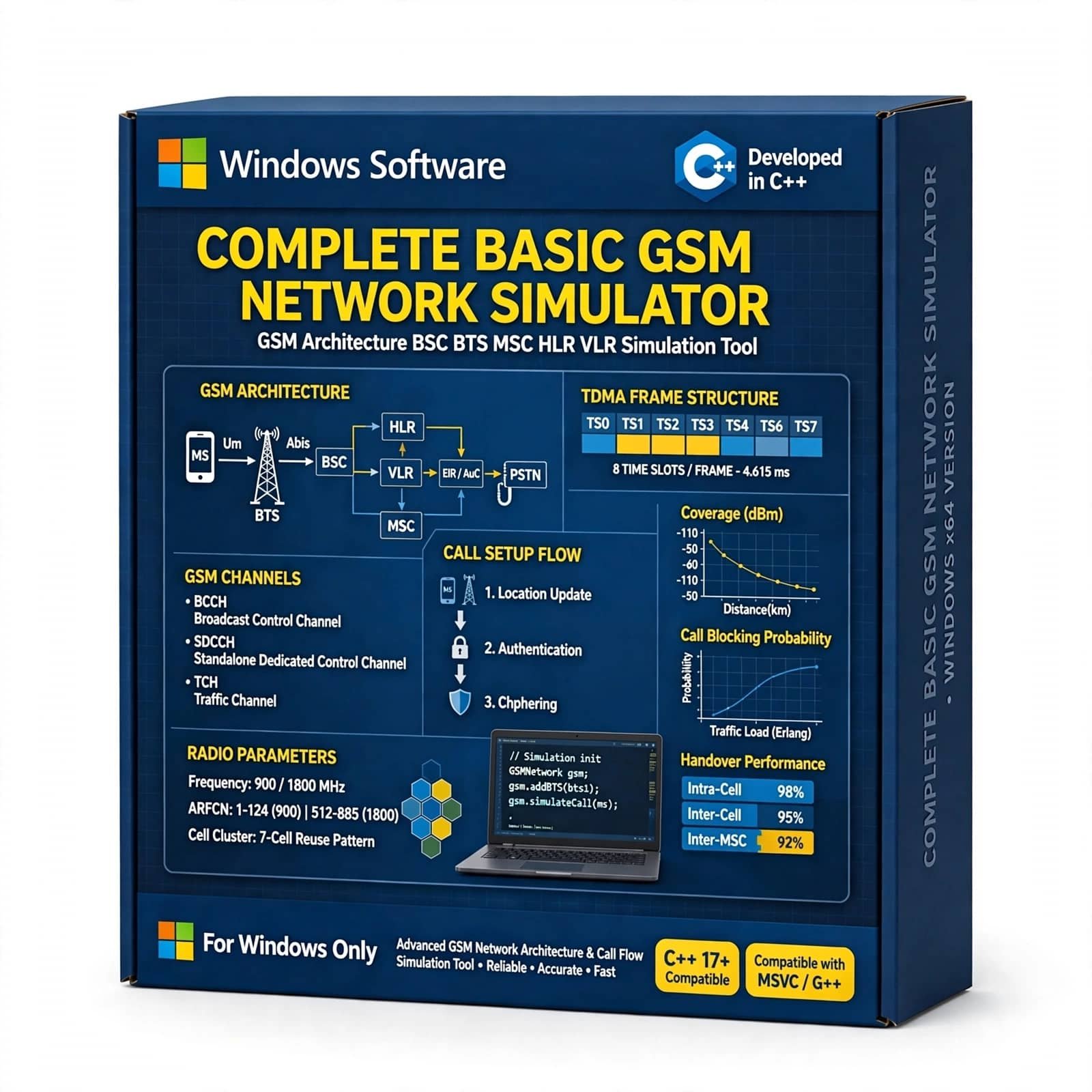
Complete Basic GSM Network with C++ is an educational and simulation-based project that demonstrates the fundamental architecture and operation of a GSM network using C++. It helps students and researchers understand GSM components, mobile communication, call and message handling, network signaling, and basic cellular network operations through a practical C++ implementation.
Original price was: ₹3,999.00.₹2,399.00Current price is: ₹2,399.00. -
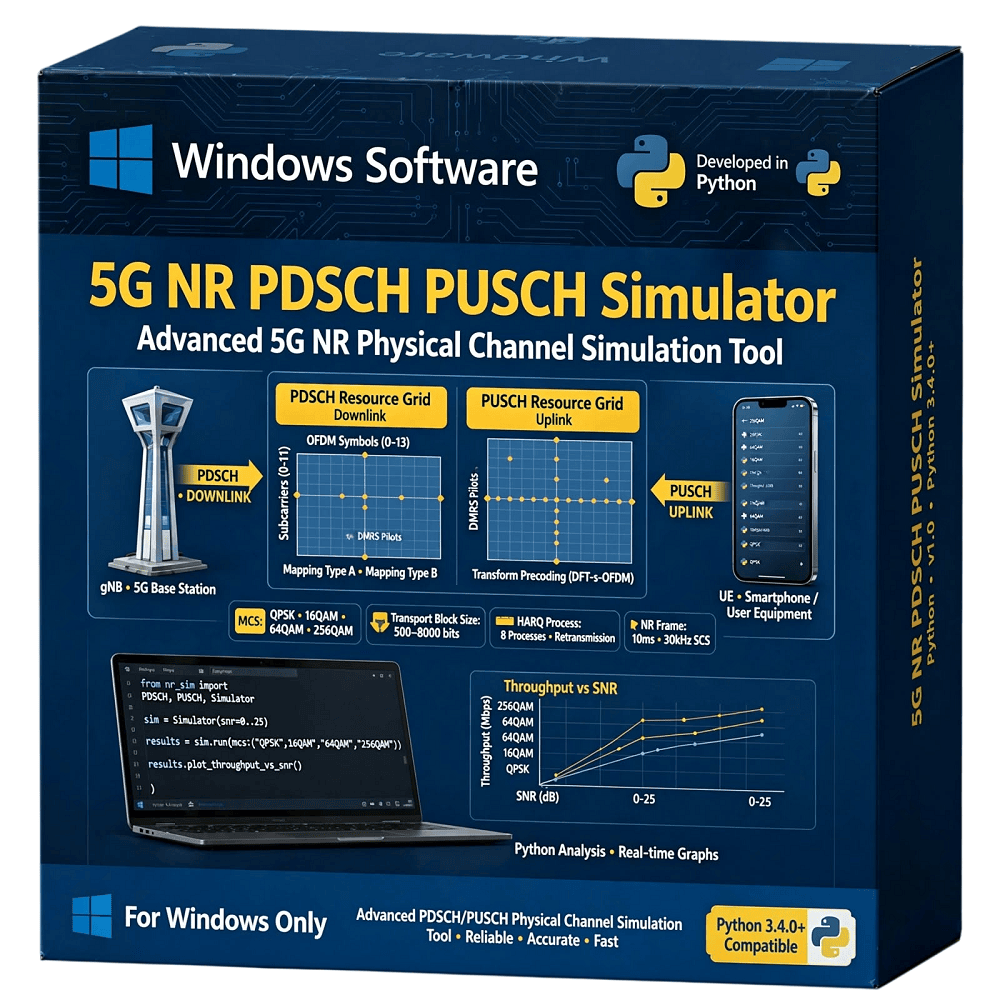
The 5G NR PDSCH PUSCH Simulator is a Python-based simulation software solution designed for researchers, engineers, students, and telecommunications professionals working with 5G New Radio (NR) physical-layer technologies. The simulator provides a practical environment for studying and experimenting with PDSCH (Physical Downlink Shared Channel) and PUSCH (Physical Uplink Shared Channel) transmission concepts.
Developed using Python, the simulator is suitable for academic research, algorithm development, demonstrations, testing, and educational applications related to 5G NR communication systems.
Available for sale as a software product. Contact us for product details, licensing, and purchase information.
Original price was: ₹129,999.00.₹12,999.00Current price is: ₹12,999.00. -
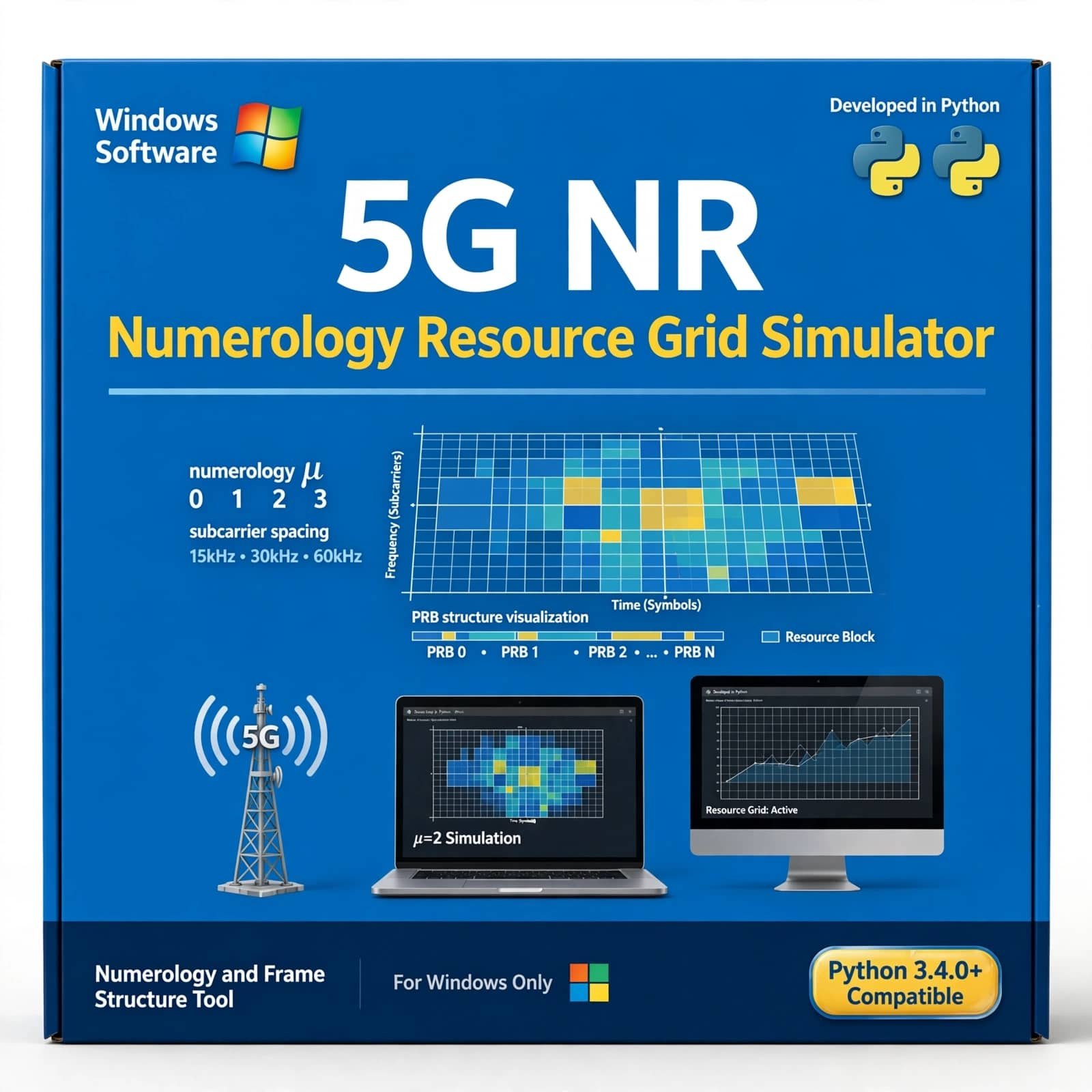
5G NR Numerology Resource Grid Simulator is an advanced simulation solution for modeling and analyzing 5G New Radio numerology and time-frequency resource grid structures. It enables users to study subcarrier spacing, OFDM symbols, slot structure, cyclic prefix, Physical Resource Blocks (PRBs), Resource Elements (REs), bandwidth configurations, and resource mapping. The simulator is ideal for 5G NR physical-layer research, numerology analysis, resource allocation studies, academic projects, waveform development, and 5G/6G wireless communication research.
Original price was: ₹99,999.00.₹9,999.00Current price is: ₹9,999.00. -
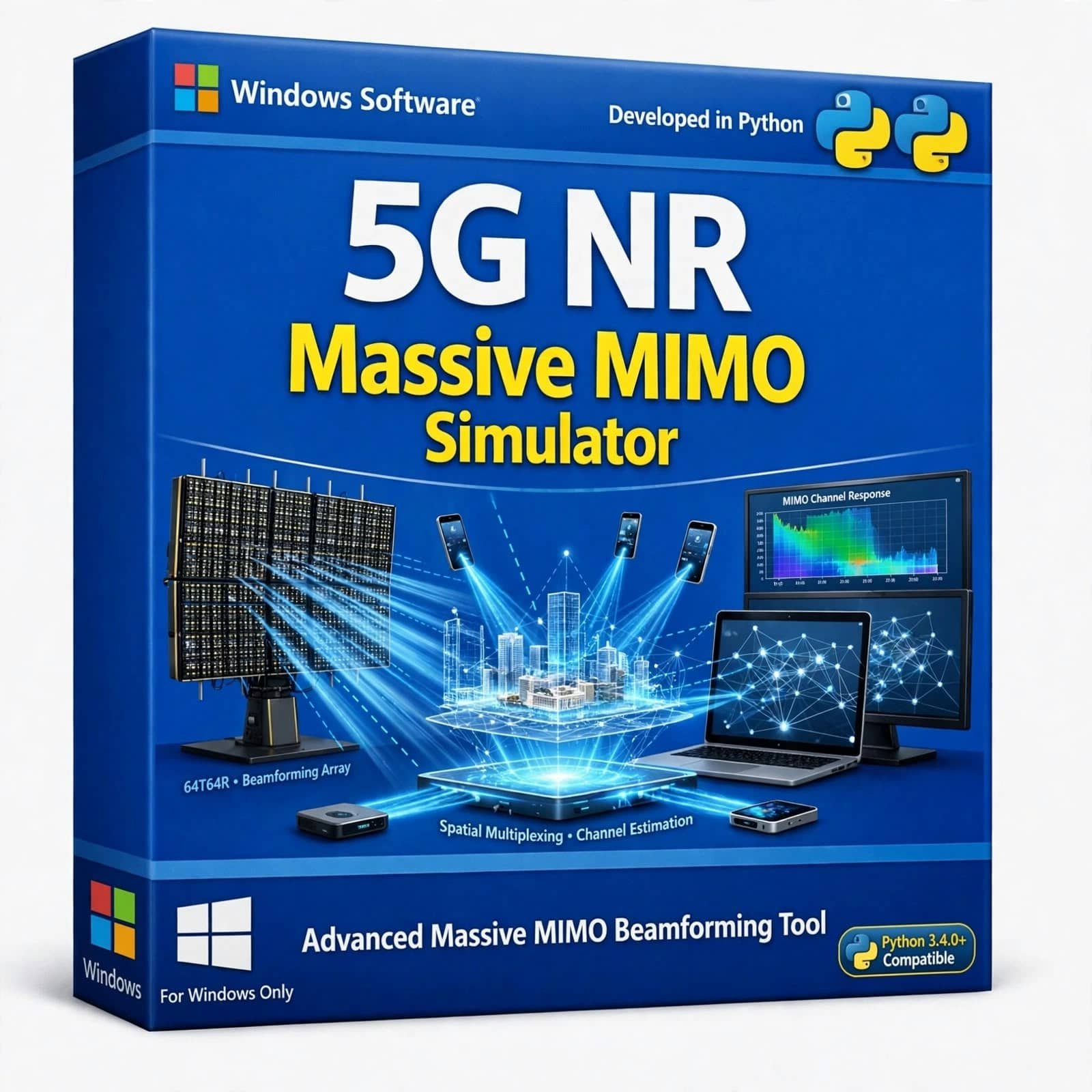
5G NR Massive MIMO Simulator is an advanced simulation solution for modeling and analyzing Massive Multiple-Input Multiple-Output (MIMO) technologies in 5G New Radio networks. It enables users to study large-scale antenna arrays, beamforming, precoding, spatial multiplexing, multi-user MIMO, channel estimation, and interference under configurable channel conditions. The simulator supports analysis of throughput, spectral efficiency, SINR, BER, BLER, MIMO capacity, beamforming gain, and multi-user performance, making it ideal for 5G NR research, algorithm development, academic projects, and 5G/6G wireless system optimization.
Original price was: ₹149,999.00.₹14,999.00Current price is: ₹14,999.00. -
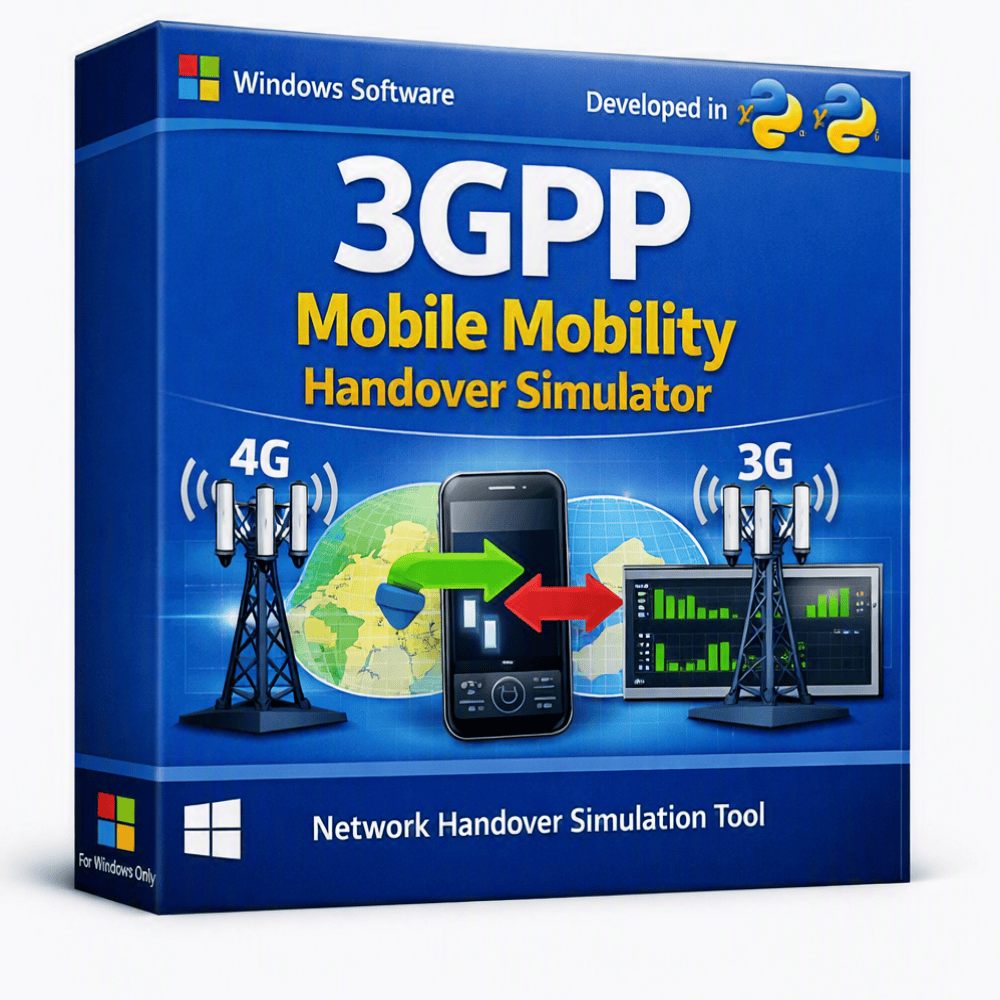
A powerful simulation tool for analyzing and validating 3GPP mobile mobility and handover procedures. The simulator enables users to model mobile network scenarios, study handover behavior, and evaluate mobility performance under different network conditions.
Key Features:
- 3GPP-compliant mobility and handover simulation
- Configurable network and mobility scenarios
- Analysis of handover performance and behavior
- Supports research, testing, and network optimization
- Useful for telecom engineers, researchers, and academic projects
Ideal for 5G/4G/3G mobility research, protocol testing, network planning, and academic simulation studies.
₹3,999.00


Reviews
There are no reviews yet.